投资级债券

Search documents
离岸观澜 | 11月中资离岸债发行规模创年内新高 年末兑付压力平稳可控
Xin Hua Cai Jing· 2025-12-16 16:16
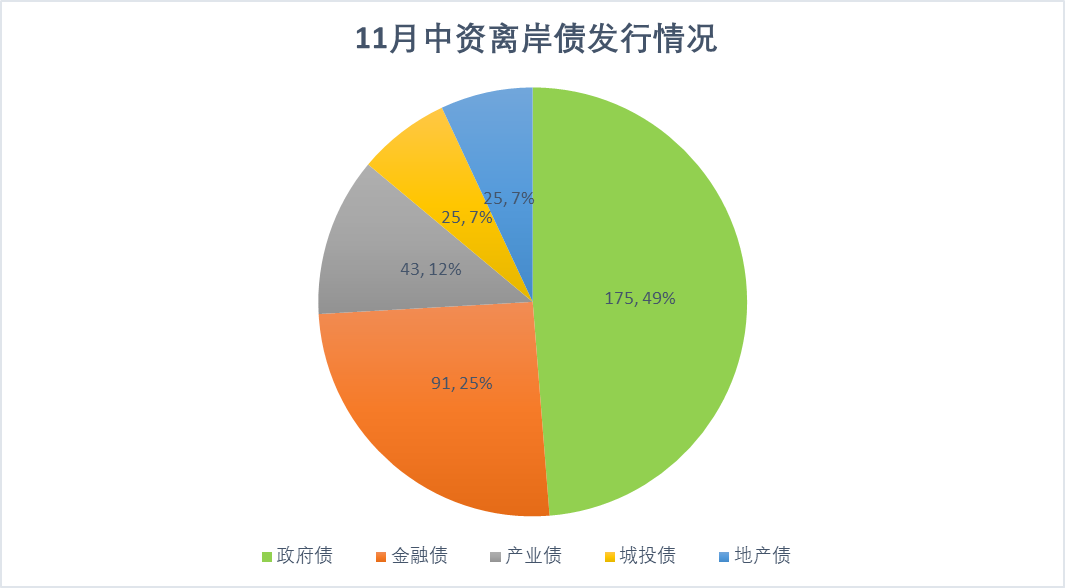
Core Viewpoint - In November 2025, the issuance of offshore bonds by Chinese entities reached a record high for the year, totaling approximately $35.9 billion, driven by a surge in sovereign and government bond issuance alongside a recovery in corporate financing demand, reflecting global investors' strong recognition of Chinese assets [1][2]. Group 1: Issuance Statistics - A total of 119 offshore bonds were issued in November, marking the highest monthly issuance in the past 12 months [2]. - The Ministry of Finance issued $4 billion in sovereign bonds in Hong Kong and €4 billion in Luxembourg, with total subscription amounts reaching $118.2 billion and €100.1 billion, indicating a subscription multiple of 30 times and 25 times, respectively [2]. - The issuance by 47 Chinese enterprises amounted to $18.3 billion, with an average bond size of $250 million, showing multi-dimensional growth [3]. Group 2: Bond Types and Currencies - Government bonds accounted for approximately $17.5 billion (49%), financial bonds for about $9.1 billion (25%), industrial bonds for $4.3 billion (12%), city investment bonds for $2.5 billion (7%), and real estate bonds for $2.5 billion (7%) [3]. - The 119 offshore bonds included 47 RMB bonds, 50 USD bonds, 8 HKD bonds, 8 EUR bonds, and 6 bonds in other currencies [4]. Group 3: Secondary Market Performance - The secondary market for Chinese offshore bonds experienced narrow fluctuations, with investment-grade bonds outperforming high-yield bonds [5]. - As of the end of November, the Markit iBoxx Asian Chinese USD bond index was at 251.23, with a monthly increase of 0.07%, while the high-yield index decreased by 2.18% [5][8]. Group 4: Future Outlook and Debt Repayment Pressure - The overall repayment pressure for Chinese offshore bonds remains manageable, with $11.28 billion due in December 2025 and $15.81 billion in January 2026, which is expected to be the highest repayment pressure in the next six months [9][12]. - Analysts predict that investment-grade bonds will perform better in the future, driven by improving financing conditions and ongoing support for cross-border financing [12].

国际巨头发声!资金流向股债市场
Zhong Guo Zheng Quan Bao· 2025-11-04 04:59
Core Insights - The macroeconomic environment shows resilience, with varying growth drivers across regions, including technology and AI in the US, inventory replenishment in Europe, and fiscal spending in China [3] - The global monetary policy easing cycle has commenced, with major central banks starting to cut interest rates in 2023, although the pace may be slower than market expectations [4] - A significant shift of funds from cash to fixed income and equity markets is occurring, driven by declining risk-free rates and the diminishing advantages of holding cash [5] Economic Growth and Policy - Policy support for economic growth is increasing, with a notable decline in leverage ratios across both developed and emerging markets, although disparities exist among sectors [2] - The US economy's growth is primarily supported by capital investments in technology and AI, while Europe benefits from trade uncertainties leading to inventory restocking [3] Investment Opportunities - The global high-yield bond market is maturing, with improved issuer quality and reduced average duration, making it an attractive investment option [6] - Investment-grade bonds remain appealing due to strong fundamentals and yields above historical averages, particularly in the US and Europe [6] - Emerging market bonds, especially local currency bonds, are gaining attention as they can enhance portfolio returns while reducing overall risk [6][7] Market Trends - The "cash migration" phenomenon is evident, with a significant increase in money market fund sizes since 2022, indicating a shift towards fixed income investments [5] - The expectation of a weaker US dollar in the medium to long term suggests that emerging market bonds may perform well during this period [7]
全球周二至少发行900亿美元投资级债券,信贷市场热度接近纪录高点
Sou Hu Cai Jing· 2025-09-03 03:23
Group 1 - Global borrowers issued at least $90 billion in investment-grade bonds on Tuesday, marking one of the busiest weeks of the year and bringing some credit markets close to record highs [1] - In the US, 27 companies issued high-grade bonds, just two shy of the record set after last year's Labor Day holiday, with a total of $43.3 billion in debt sold, the third-highest on record [1] - In Europe, at least 20 borrowers, including sovereign nations, issued over €47 billion ($54.7 billion) in investment-grade bonds, and when combined with high-yield bond issuers, the total reached €49.6 billion, surpassing the earlier record of €47.6 billion for a single day [1] Group 2 - In Japan, at least seven companies issued a total of $10 billion in dollar bonds on the same day, with Japanese issuers surpassing $100 billion in dollar and euro bond issuance for the first time in a year [1]
【晨星焦点基金系列】:汇丰亚洲高收益债券
Morningstar晨星· 2025-03-26 10:18
Core Viewpoint - The HSBC Asian High Yield Bond Fund aims to achieve an annualized return that exceeds its benchmark index, primarily investing in Asian dollar-denominated high-yield bonds, with a higher allocation to emerging market sovereign and investment-grade bonds compared to peers [2][4]. Fund Overview - Fund Code: 968092 - Fund Type: Asian High Yield Bonds - Benchmark Index: JPMorgan Asia Credit Index Non-Investment Grade Total Return Index [1] Fund Management - The fund was established on February 3, 2020, with a total fund size of 8.18 billion yuan as of March 25, 2025 [2]. - The fund is managed by a team including Mei Lizhong, Lin Jiaming, and Cai Jialin, with Mei Lizhong having nearly 30 years of investment management experience [4][6]. Performance Metrics - From May 2011 to February 2025, the fund achieved an annualized return of 2.58%, ranking in the 32nd percentile among similar funds [2][8]. - The fund's volatility, measured by standard deviation, was 8.63%, lower than the Morningstar peer average of 10.13%, also placing it in the 32nd percentile [8]. - The fund's annualized comprehensive fee rate is 1.36%, below the median of 1.49% for similar funds [8]. Investment Strategy - The fund employs a combination of top-down and bottom-up investment approaches, with a focus on macroeconomic analysis to determine asset allocation across credit, interest rates, and currencies [6][7]. - The fund's duration is generally adjusted within one year of the benchmark index duration, which is higher than the average duration of similar funds, exposing it to greater interest rate risk [6][7]. Risk Management - The fund has a higher exposure to emerging market sovereign and quasi-sovereign bonds, which can lead to more stable performance during credit market downturns [3][7]. - Recent challenges include defaults in the real estate sector, which have negatively impacted the fund's performance due to a significant allocation to real estate bonds [6][7]. Long-term Outlook - Despite short-term performance pressures, the fund has demonstrated strong long-term performance, with a risk-adjusted return (Sharpe ratio) ranking in the 19th percentile among peers [8].