
抗癌疗法

Search documents
Nature子刊:华中科技大学薛宇/彭迪团队开发结合深度学习和大语言模型的组学解读工作流
生物世界· 2026-01-10 03:06
Core Viewpoint - The research published by Huazhong University of Science and Technology introduces a hybrid workflow named LyMOI, which combines deep learning and large language models to enhance the understanding of autophagy regulatory factors and discover new cancer therapies [2][5]. Group 1: Research Methodology - The LyMOI workflow integrates GPT-3.5 for biological knowledge reasoning and employs a large graph model based on graph convolutional networks (GCN) [5]. - The model incorporates evolutionarily conserved protein interactions and utilizes hierarchical fine-tuning techniques to predict molecular regulatory factors from multi-omics data [5]. Group 2: Research Findings - The LyMOI system analyzed 1.3TB of transcriptomic, proteomic, and phosphoproteomic data, expanding the understanding of autophagy regulatory factors [7]. - It accurately identified two human cancer proteins, CTSL and FAM98A, which enhance autophagy effects under the treatment of the anti-tumor agent disulfiram (DSF) [7]. - In vitro experiments indicated that silencing these two genes weakened DSF-mediated autophagy and inhibited cancer cell proliferation [7]. - Notably, the combination of DSF with the CTSL-specific inhibitor Z-FY-CHO significantly suppressed tumor growth in vivo [7].


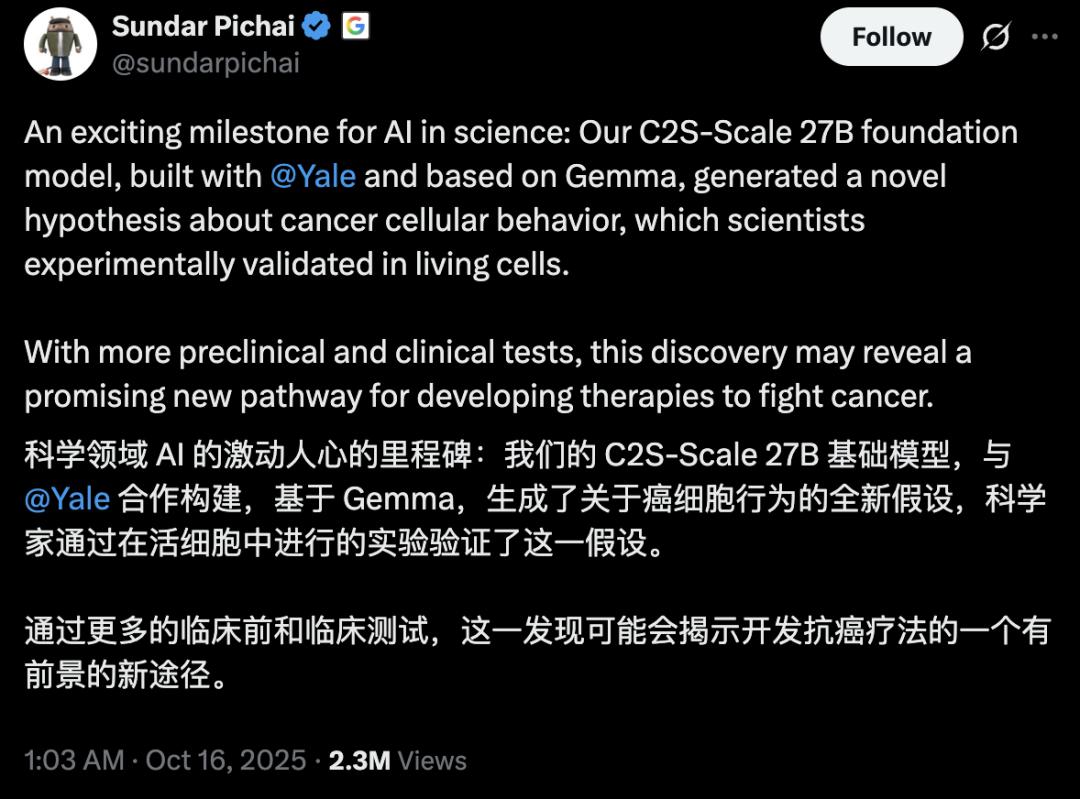
谷歌×耶鲁联手发布抗癌神器,AI推理精准狙击「隐身」癌细胞
3 6 Ke· 2025-10-17 00:41
Core Insights - Google and Yale University scientists have jointly released a large model called Cell2Sentence-Scale 27B (C2S-Scale), which proposes a new hypothesis regarding cancer cell behavior and has been validated through multiple in vitro experiments, showcasing the potential of AI models to generate original scientific hypotheses and open new avenues for cancer treatment [1][10] Model Overview - C2S-Scale is a foundational model with 27 billion parameters designed to understand the "language" of individual cells [3] - The model is built on Google's open-source Gemma model and trained on over 1 billion tokens of transcriptomic data, biological literature, and metadata, enabling it to analyze cell behavior across dimensions [1][4] Research Findings - The research team is advancing AI's role in generating scientific predictions in other immunological contexts, which could accelerate the development of new cancer therapies [1] - C2S-Scale has demonstrated that larger biological models can yield new reasoning capabilities, not just enhance existing abilities, thus revealing unknown patterns [4] Drug Discovery Process - Researchers conducted simulations on over 4,000 drugs in two environments: immune-context-positive and immune-context-neutral, to identify drugs that enhance antigen presentation specifically in immune-active conditions [5][6] - Approximately 10%–30% of the drugs had been previously reported, validating the model's credibility, while the remaining candidates represented novel findings [5][6] Key Discoveries - The model identified the kinase CK2 inhibitor silmitasertib (CX-4945) as having a significant "environmental differentiation effect," enhancing antigen presentation only in immune-active environments [7] - Subsequent experiments confirmed that combining silmitasertib with low-dose interferon significantly increased antigen presentation by approximately 50% [8] Implications for Cancer Treatment - The findings suggest a new potential pathway for making tumors more recognizable to the immune system, providing hope for immunotherapy advancements [10] - The C2S-Scale model's predictions have been validated through computer simulations and multiple in vitro experiments, indicating a reliable basis for new therapeutic approaches [9][10] Future Directions - The research is still in its early stages, but the results provide empirical evidence for developing new combination therapies and signal a new paradigm in biological discovery driven by large models [10] - The C2S-Scale model and its resources are now fully accessible on Hugging Face and GitHub, inviting further exploration and collaboration [10][12][13]

亚盛医药20250606
2025-06-09 01:42
Summary of the Conference Call for Ascentage Pharma Company Overview - **Company**: Ascentage Pharma - **Focus**: Development of innovative anti-cancer therapies, particularly BCL-2 selective inhibitors and MDM2-P53 pathway inhibitors Key Points Industry and Product Highlights - **APG2,575**: A selective BCL-2 inhibitor showing significant efficacy in patients with Acute Myeloid Leukemia (AML) and Myelodysplastic Syndromes (MDS) - Overall Response Rate (ORR) in treatment-naive patients is 83% and 43% in relapsed/refractory patients - ORR of 31% in patients previously treated with Venetoclax, indicating potential for hard-to-treat cases [2][4] - Faster onset of action (Tmax of 3-8 hours vs. 25-30 hours for Venetoclax) and shorter half-life (3-5 hours vs. 25-30 hours) [2][6] - Lower incidence of tumor lysis syndrome compared to Venetoclax [6] - **APG115**: An MDM2-P53 pathway inhibitor with potential applications across various cancer types - Clinical data presented at ASCO showed promising results, particularly in neuroendocrine tumors (ACC) [2][7][11] - In a Phase II trial, 2 complete responses and significant disease stabilization were observed [11] Clinical Development Plans - Ascentage Pharma plans to continue advancing APG2,575 and APG115 through global clinical trials, including registration studies for high-risk MDS and treatment-naive AML patients [4][12] - Ongoing discussions with regulatory bodies regarding the next steps for APG115 registration studies [12] Competitive Landscape - Venetoclax has shown lower infection rates and better tolerability in nearly 100 AML and MDS patients, establishing it as a standard treatment [10] - Ascentage Pharma is positioned as the second company globally to enter BCL-2 inhibitor clinical trials, with IND approval obtained [16] Future Directions - The company aims to strengthen collaborations with leading research institutions and companies to accelerate the development of new anti-cancer therapies [9][25] - Focus on expanding clinical trials and exploring combination therapies to address unmet medical needs in oncology [25] Market Potential - The market for multiple myeloma is substantial, with sales exceeding $30 billion in 2024, and Ascentage's BCL-2 inhibitors are expected to play a significant role [23][24] - The company is exploring registration clinical plans for multiple myeloma based on promising safety and efficacy data [24] Additional Insights - The company is actively pursuing global registration studies and expanding patient enrollment in ongoing trials [15][21] - Emphasis on the importance of safety and tolerability in the development of BCL-2 inhibitors, especially in comparison to existing therapies [18][24] This summary encapsulates the key insights and strategic directions discussed during the conference call, highlighting Ascentage Pharma's commitment to advancing innovative cancer therapies and addressing significant market opportunities.