推三返一

Search documents
破局流量困境:七星创客核心机制
Sou Hu Cai Jing· 2026-02-26 08:31
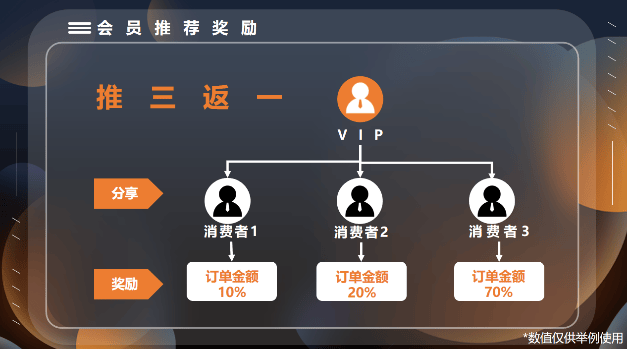
Core Insights - The article discusses the "Seven Star Maker" model and its core mechanism "Push Three Return One," which offers a low-cost, high-efficiency marketing path for businesses facing rising customer acquisition costs and a saturated market [1][2]. Group 1: Model Mechanism - The "Push Three Return One" model combines immediate incentives with long-term benefits, aiming to upgrade users from "consumers" to "promoters" and "team managers," thus lowering participation barriers and enabling low-cost user expansion [4]. - Users can become promoters by purchasing designated products, earning rewards of 10%, 20%, and 70% for referring their first, second, and third users respectively, allowing them to recoup their initial purchase cost [5][7]. Group 2: Seven Star System - The creator levels range from one star to seven stars, with each level having specific team size and performance requirements, and increasing reward percentages as levels rise [10]. - Higher-level creators receive additional incentives, such as the "Bole Award," which grants them 100% of the team performance rewards, and can achieve further promotions by cultivating other high-level creators [12][14]. Group 3: Practical Case Studies - In the beauty industry, a skincare brand utilized the "Seven Star Maker" model to rapidly grow its user base from zero to 500,000 in three months, achieving over 100 million in sales and a private repurchase rate 1.5 times higher than the industry average [18][19]. - A supermarket chain adopted the model to enhance local foot traffic and online sales, resulting in a 40% increase in offline customer flow and a 300% growth in online community sales within six months [20]. - A workplace education platform implemented the model to reduce customer acquisition costs, achieving over 10,000 sales of a course within two months and maintaining a user retention rate of over 75% [21]. Group 4: Key Success Factors - Compliance is essential for the sustainable operation of the model, requiring adherence to regulations and ensuring that rewards are tied to actual product sales to avoid legal issues [24]. - The quality of the product is fundamental, as successful cases demonstrate that high-quality products lead to higher user retention and willingness to promote [27][28]. - The model must be adaptable to different industry characteristics, allowing for flexible adjustments in reward structures to balance user incentives and company profits [30]. Conclusion - The "Seven Star Maker" and "Push Three Return One" model redefines the relationship between brands and consumers, transforming consumers into co-creators and beneficiaries, enabling businesses to achieve low-cost, high-efficiency user expansion in a challenging market environment [32][34].

七星创客助力企业低成本获客,高复购率产品如何放大裂变效应
Sou Hu Cai Jing· 2026-02-02 11:58
Core Concept - The "Qixing Chuangke" model transforms consumer behavior into entrepreneurial opportunities through a low-threshold recovery mechanism and a tiered incentive system, effectively addressing three major pain points in traditional recruitment [1] Group 1: Mechanism Overview - The "Push Three Return One" mechanism serves as the foundational incentive, allowing users to recover their initial investment by recommending a small number of new users, thus reducing participation risk [2] - An example illustrates that by recommending three users for a product priced at 1980 yuan, the total rewards can cover the initial cost, demonstrating the model's effectiveness [3] - The reward proportions can be customized based on industry specifics, encouraging higher returns for later recommendations to stimulate ongoing sharing [5] Group 2: Growth Structure - The tiered structure categorizes creators into seven levels, each with distinct upgrade conditions and benefits, creating a clear growth path that enhances user engagement and motivation [6] - High-level benefits include the "Bole Award," where creators at the third level and above can earn rewards from their direct subordinates' performance, fostering a mentorship mechanism [8] - The "Weighted Dividend" system allows creators to earn additional dividends based on the overall performance of the platform once they reach specific management levels [10] Group 3: Revenue Sources - Revenue is generated through direct commission for each new user referred, team-level rewards based on total sales, and special rewards for upper-level creators from their subordinates' performance [12] Group 4: Compliance Design - To avoid legal issues, the model emphasizes real product transactions, limits team rewards to three levels, and ensures transparent rules regarding commission and upgrade conditions [16][17][18] - Data security is prioritized through blockchain technology and a dual-layer risk control system to prevent fraudulent activities [19] - The total commission should not exceed 60% of the product's gross profit to maintain the company's profitability [20] Group 5: Conclusion - The "Qixing Chuangke" model is not just a growth tool but a new paradigm for reshaping user relationships, turning traditional buyer-seller dynamics into collaborative partnerships [21] - The success of this model relies on a combination of product strength, model design, and compliance to ensure sustainable development [22]
低成本获客新范式:“推三返一”如何重构社交电商生态
Sou Hu Cai Jing· 2025-04-22 05:15
Core Concept - The "Push Three Return One" model combines fission marketing and consumer rebates, allowing users to receive full or partial refunds or additional rewards after successfully recommending three new users to purchase specified products, emphasizing "consume first, rebate later" for low-cost user growth [1] Operation Process - Users automatically become members and gain referral qualifications after purchasing products, sharing links or QR codes to invite friends [6] - A tiered commission structure rewards users with 10%-20% for the first referral, 20%-30% for the second, and 50%-70% for the third, enabling them to "break even" [6][7] Reward Mechanism Design - Direct push rewards feature a tiered commission to stimulate referral motivation, with potential earnings increasing from 20% to 50% [7] - Team performance rewards allow higher-level members to earn 3%-15% from their team's performance, enhancing engagement [7][8] Business Model Advantages - The model significantly reduces customer acquisition costs by over 80% through word-of-mouth marketing [11] - It can lead to explosive sales growth, as evidenced by a brand that gained 100,000 users in just seven days [11] - User loyalty is enhanced through rebates and team rewards, resulting in a notable increase in repurchase rates [11] Psychological Motivation - The model leverages reciprocity, loss aversion, and social currency to drive user engagement and referrals [12] - Users actively promote to earn rebates, creating a cycle of consumption and recommendation [12] Market Impact - The fission mechanism can lead to exponential user growth, with reports of a brand experiencing over 500% user growth in a single month [12] - Enhanced brand loyalty is achieved through rebates and team rewards, fostering long-term value [12] Technical Requirements - Development of a distribution system is necessary to support multi-level reward calculations and user relationship tracking [14] - Big data applications are essential for analyzing user behavior and optimizing rebate strategies [14] Future Trends - The model is expected to evolve with technology integration, such as AI and blockchain, to improve reward distribution transparency [17] - Variants like "Push N Return One" may emerge to cater to high-ticket industries [17] - Compliance will be a core challenge, with platforms needing to innovate within legal frameworks to stand out [19]