支付行业严监管

Search documents
近3亿元罚单压顶 支付牌照年注销12张
Bei Jing Shang Bao· 2026-01-06 15:52
Core Insights - The third-party payment industry is undergoing significant restructuring and regulatory tightening, with a notable increase in license cancellations and penalties in 2025 [1][2][4] Group 1: Industry Restructuring - A total of 12 payment licenses were canceled in 2025, bringing the total number of licensed institutions down to 163, a reduction of over 40% from the industry's peak [2] - Zhonggang Yintong Payment, established in 2011, became the 108th license holder to be canceled, having faced a suspension of its license renewal for over three years due to regulatory issues [2][3] - The exit of institutions is characterized by a prevalence of compliance issues and limited operational scope, with many companies lacking core competitiveness and resources to survive in a competitive market [3][9] Group 2: Regulatory Environment - In 2025, the People's Bank of China and its branches issued at least 82 penalties in the payment industry, totaling over 293 million yuan, with several penalties exceeding 10 million yuan [4][5] - The regulatory approach has intensified, with a focus on core risk areas such as clearing violations and anti-money laundering failures, reflecting a "zero tolerance" stance [5][6] - The trend of increasing penalties is indicative of a shift towards more precise and effective regulation, with a forthcoming classification rating system aimed at implementing differentiated supervision [9][10] Group 3: Future Industry Trends - The payment industry is expected to enter a new phase characterized by "precise regulation and capability competition," leading to increased market concentration and a focus on compliance [9] - Large institutions are anticipated to play a systemic support role, while smaller entities are encouraged to leverage regional advantages and specialized services [9][10] - The development of a sustainable ecosystem in the payment industry will depend on clear roles, shared risks, and reasonable returns among all participants [9][10]
年内11张支付牌照下线
2 1 Shi Ji Jing Ji Bao Dao· 2025-10-17 04:04
Core Viewpoint - The payment industry is undergoing accelerated consolidation due to strict regulations and intense competition, with the People's Bank of China recently announcing the cancellation of the payment license for Fujian Yikatong Payment Co., marking the 11th license cancellation this year [1][5]. Group 1: License Cancellations - Fujian Yikatong was established in July 2010 and received its payment business license in June 2012, focusing on prepaid card issuance and acceptance in Fujian [5]. - Since the first batch of third-party payment licenses was issued in May 2011, a total of 271 licenses have been granted, with 107 licenses currently canceled, leaving 164 active licenses [5]. - The majority of canceled licenses are for prepaid cards, indicating a natural market selection process where outdated licenses are phased out [6]. Group 2: Reasons for License Reduction - Analysts attribute the reduction in payment licenses to three main factors: enhanced regulatory oversight, financial difficulties or serious violations among some payment institutions, and internal consolidation within payment companies [6]. - The market is expected to see a "Matthew Effect," where a few major players dominate the market, leaving little room for smaller firms [6]. Group 3: Regulatory Penalties - Several payment institutions have recently faced significant fines for violations related to prepaid card management, account management, and settlement management [9]. - The total number of penalties disclosed this year has reached at least 74, with a total amount of 190 million yuan, indicating an increase in the number of institutions penalized compared to the previous year [10]. - The dual penalty system, which holds both institutions and responsible individuals accountable, has become the norm, with fines for individuals reaching up to 500,000 yuan [10].


5月支付机构百万级罚单频出,严监管升级!
Bei Jing Shang Bao· 2025-05-14 10:19
Core Viewpoint - The recent penalties imposed on payment institutions in China highlight the ongoing strict regulatory environment in the payment industry, emphasizing compliance and accountability for both institutions and their management [2][3][7]. Summary by Category Regulatory Actions - On May 9, the Shenzhen branch of the People's Bank of China announced penalties totaling 3.72 million yuan against Shenzhen Kuaiyitong Payment Co., Ltd. and SF Hengtong Payment Co., Ltd. for various violations [2]. - Kuaiyitong was fined approximately 3.52 million yuan for multiple infractions, including failure to comply with merchant management and customer identity verification regulations [2]. - SF Hengtong Payment was fined 210,000 yuan, marking its first penalty from the central bank [2]. Compliance Issues - The penalties reflect significant compliance failures, particularly in anti-money laundering practices, such as not fulfilling customer identity verification obligations and failing to report large or suspicious transactions [3][7]. - The regulatory focus on anti-money laundering and merchant management indicates a tightening of oversight in the payment sector [7]. Industry Trends - Following the penalties in Shenzhen, the Jiangsu branch of the People's Bank of China also issued fines to four payment companies for violations related to prepaid card management and merchant management [3][4]. - The trend of substantial fines, including a notable case where Shanghai Dianyin Information Technology Co., Ltd. was fined 5.71 million yuan, suggests that regulatory scrutiny is intensifying [6][7]. Recommendations for Compliance - Industry experts recommend that payment institutions enhance their compliance frameworks, including establishing comprehensive merchant management systems and improving identity verification processes [7]. - The use of big data and AI technology is suggested to bolster the identification of suspicious transactions and to ensure consumer rights protection [7].

迅付信息科技、汇付支付、杉德支付各领超200万罚单!一季度行业已被罚没超6000万元
Bei Jing Shang Bao· 2025-04-14 10:50
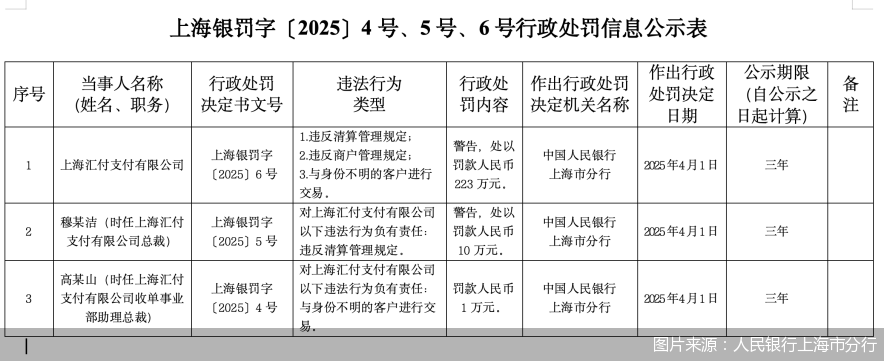
Core Viewpoint - Multiple payment institutions have recently faced penalties from the People's Bank of China for various violations, highlighting ongoing compliance issues within the industry [1][2][4]. Group 1: Penalties and Violations - Xunfu Information Technology, Huifutong Payment, and Sund Payment were fined 2.04 million, 2.23 million, and 2 million RMB respectively for violations including breaching clearing management regulations and engaging in transactions with unidentified clients [1][2]. - The penalties reflect a trend of dual penalties, where senior executives of the companies, such as the general manager of Sund Payment, were also fined, indicating a focus on holding leadership accountable [2][4]. - In the first quarter of 2025, payment institutions received over 20 fines totaling more than 60 million RMB, with significant penalties for companies like Beijing Yaku Space Information Exchange Technology and Guangzhou Huiju Payment Electronic Technology [5]. Group 2: Compliance Issues - The recurring issues of clearing and outsourcing violations are significant problems for payment institutions, particularly those involved in offline acquiring [3][4]. - Regulatory focus remains on anti-money laundering, merchant authenticity, and compliance, indicating that payment institutions must enhance internal controls and compliance measures [4][5]. - The increase in penalties and the introduction of new violation categories, such as failure to report cybersecurity incidents, suggest a tightening regulatory environment for the payment industry in 2025 [5][6]. Group 3: Future Regulatory Focus - As the digital economy evolves and new technologies like AI are adopted, issues related to information security and data protection are expected to become key regulatory concerns [6]. - Payment institutions are advised to review and strengthen their compliance frameworks across all operational processes to enhance risk management capabilities [6].