收益率控制政策

Search documents
十年期日债收益率创31年来最大年度涨幅!财政担忧加剧之际或成2026年市场“灰犀牛”
Zhi Tong Cai Jing· 2025-12-30 08:17
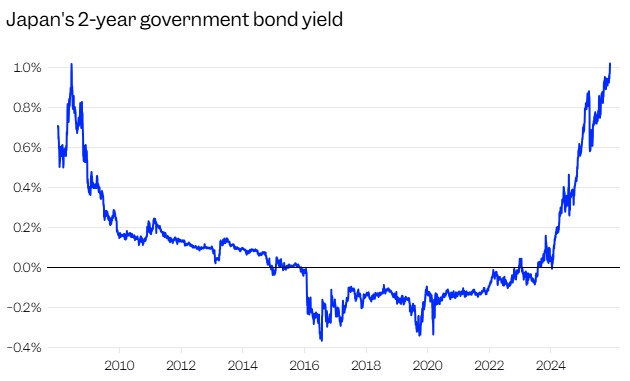
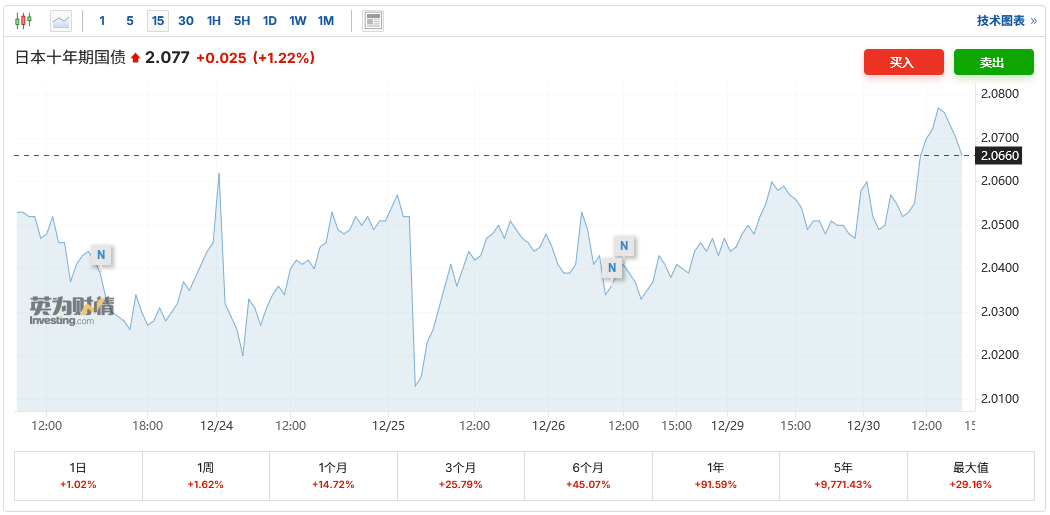
Group 1 - The core viewpoint of the articles highlights concerns over Japan's fiscal situation, leading to a significant rise in government bond yields, particularly the ten-year yield reaching 2.077%, close to its highest level since February 1999 [1][3] - The Japanese government approved a supplementary budget for fiscal year 2025 amounting to 18.3 trillion yen, the largest since the pandemic, with 11.7 trillion yen to be financed through new bond issuance [3] - The Bank of Japan's recent interest rate hike and indications of continued monetary tightening have contributed to rising bond yields, with the two-year yield increasing to 1.173%, up over 20% in the past month [4][3] Group 2 - The rise in Japanese bond yields is significant for global financial markets, as Japan has been a major player in the low-interest-rate environment, affecting currency arbitrage and investment flows [7] - Concerns are growing that the narrowing yield spread between Japanese and U.S. bonds could lead to a reversal of yen-based arbitrage trades, potentially impacting U.S. Treasury markets and stock valuations [7][8] - The Bank of Japan plans to slow its exit from the bond market, reducing its monthly bond purchases from 4 trillion yen to 2 trillion yen per quarter, and will also cut government bond sales in the upcoming fiscal year [8]

飙升的日债收益率:美股的灰犀牛?
智通财经网· 2025-12-17 08:35
Core Viewpoint - Japan's long-term bond yields have reached multi-year highs, indicating weak investor demand due to concerns over increased government spending and a potential interest rate hike on December 19 [1][4]. Group 1: Market Dynamics - The Japanese bond market, valued at $7.5 trillion, has experienced unusual volatility in recent months, starting from May when a poorly received 20-year bond auction led to soaring yields [1][4]. - The Bank of Japan (BOJ), which holds over half of the country's sovereign bonds, has begun to gradually reduce its balance sheet and decrease bond purchases, leaving a gap in the market that other buyers have not filled [1][4]. - Despite recent weak demand, there are signs of recovery, with a 30-year bond auction on December 4 attracting the strongest demand since 2019, particularly from foreign buyers seeking higher yields [5]. Group 2: Economic Implications - The BOJ's exit from the market coincides with Japan's transition out of a deflationary period, which has historically involved heavy bond purchases to stimulate the economy [4]. - Concerns over rising yields are compounded by a significant economic stimulus plan approved by the Japanese government, amounting to ¥21.3 trillion (approximately $1.37 billion), which may necessitate increased borrowing and bond issuance [8][9]. Group 3: Central Bank Response - The BOJ is aware of the increasing volatility in bond yields and plans to slow its exit from the bond market, reducing monthly bond purchases by ¥200 billion instead of ¥400 billion starting next fiscal year [7]. - The government is also attempting to mitigate yield pressure by relying on short-term debt issuance rather than long-term bonds to fund its stimulus plan [9]. Group 4: Global Market Impact - Rising Japanese bond yields are significant for global financial markets, as Japan has been a major player in the low-interest-rate environment that has influenced global investment strategies [11]. - The narrowing yield spread between Japanese and U.S. bonds could lead to a reversal of "yen carry trades," where investors borrow in yen to invest in higher-yielding assets, potentially causing market disruptions [11][14]. - Analysts warn that a significant unwinding of Japanese carry trades could impact U.S. markets, especially given the current fiscal challenges faced by the U.S. government [14].