
收紧货币政策

Search documents
若日本央行加息,日元或将进一步回升
Sou Hu Cai Jing· 2026-02-10 15:42
Core Viewpoint - Analysts from ING suggest that the Japanese yen may further appreciate due to a combination of loose fiscal policy and tightening monetary policy [1] Group 1: Economic and Political Context - The Liberal Democratic Party, led by Prime Minister Fumio Kishida, secured a majority in the recent snap elections, providing a strong mandate for economic growth and proactive foreign policy [1] - Analysts predict that the Bank of Japan may raise interest rates at least once, while the Federal Reserve could lower rates twice within the year [1] Group 2: Currency Exchange Dynamics - The potential for the USD/JPY exchange rate to approach 150 yen is highlighted, with any rise towards 158-160 yen likely to attract yen buyers due to the readiness of Japanese authorities to intervene at these levels [1] - The USD/JPY exchange rate has decreased by 1%, reaching a low of 154.19 yen on the 11th [1]
日本央行行长提出收紧货币政策,通胀上行风险正在加剧
Huan Qiu Wang· 2025-10-17 01:05
Group 1 - The core viewpoint is that the Bank of Japan is considering tightening monetary policy if the certainty of the expected economic outlook increases [1] - Bank of Japan Governor Ueda Kazuo indicated that inflation risks are rising, and the inflation rate may reach targets earlier than anticipated [1] - BOJ board member Tamura Naoki stated that the current policy interest rate is still far from neutral levels, suggesting a need to approach neutral rates to avoid future aggressive rate hikes [1] Group 2 - Tamura Naoki mentioned that the situation has entered a phase of assessing whether to raise interest rates due to increasing risks of price hikes [3] - He also pointed out that despite temporary increases in food prices, there is a possibility of a broader and sustained rise in prices [3]

金价跌跌不休,美联储打压黄金,数据公布还要雪上加霜
Sou Hu Cai Jing· 2025-08-01 10:02
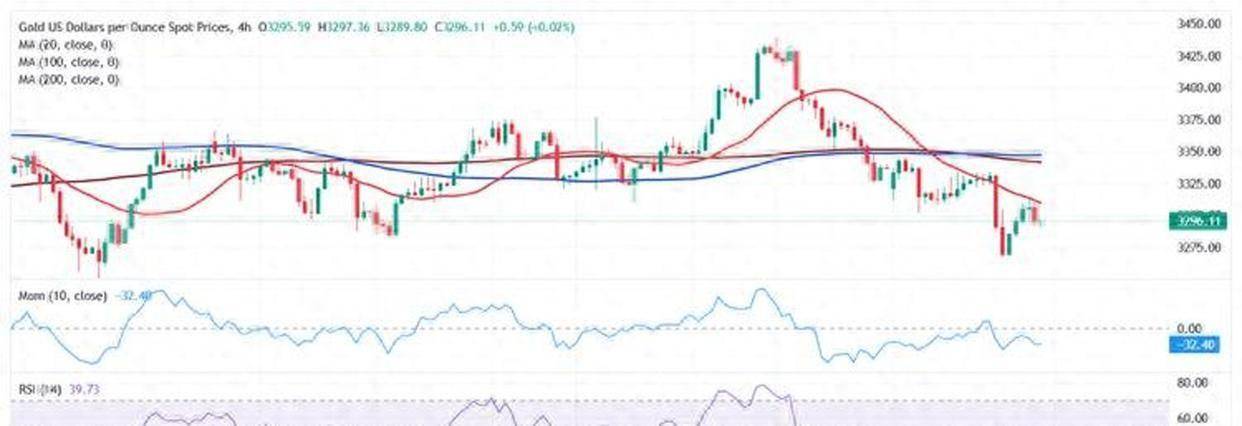
Core Viewpoint - The recent decline in gold prices is attributed to a stronger US dollar and tightening monetary policy, which has shifted investor sentiment away from gold as a safe-haven asset [1][3][10]. Group 1: Market Dynamics - The US dollar index has risen from around 102 points at the end of last year to nearly 105 by July, driven by the Federal Reserve's continuous interest rate hikes and asset reduction [3]. - The expectation of a slowdown in the US economy, indicated by anticipated lower job growth in July, has paradoxically led to a stronger dollar, further pressuring gold prices [3][5]. - Average hourly wages in July are expected to rise, suggesting persistent wage inflation, which supports the dollar's strength and negatively impacts gold [5]. Group 2: Technical Analysis - Gold prices are hovering around $3,280, with key moving averages showing signs of losing bullish momentum, indicating a bearish outlook [6]. - Support levels for gold are identified at $3,281, $3,268, and $3,246, while resistance levels are at $3,311, $3,328, and $3,345, suggesting a challenging environment for gold to recover [7]. Group 3: Global Economic Context - The US economy shows signs of slowing down, with a second-quarter GDP growth rate of only 2.1%, below the expected 2.4%, indicating potential easing of inflation pressures [8]. - Economic conditions in Europe and China are also affecting market dynamics, with the European Central Bank adjusting interest rates and China undergoing a manufacturing transformation [8]. - The ongoing monetary policy adjustments globally are leading to a stronger dollar, which is impacting gold's appeal as an investment [8][10].
巴西央行:在预期未被锚定的环境下,确保通胀趋向目标需要采取大幅收紧的货币政策,并持续相当长的时间。
news flash· 2025-06-18 21:41
Core Viewpoint - The Brazilian Central Bank emphasizes the necessity of implementing a significantly tight monetary policy for an extended period to ensure inflation trends towards the target in an environment where expectations are not anchored [1] Group 1 - The Central Bank indicates that a substantial tightening of monetary policy is required to manage inflation effectively [1] - The commitment to maintaining this tight policy for a prolonged duration highlights the seriousness of the inflation situation in Brazil [1]