政府停摆对资产的影响

Search documents
美股、原油跳水,中国金龙跌超3%,黄金短线拉升
2 1 Shi Ji Jing Ji Bao Dao· 2025-10-10 15:55
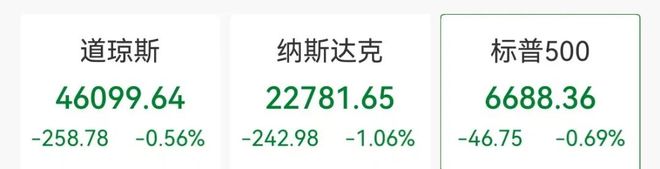
Market Overview - US stock indices opened slightly higher on October 10 but then experienced a sharp decline, with the Dow Jones down 0.56%, S&P 500 down 0.69%, and Nasdaq down 1.06% as of 23:10 Beijing time [1] - The seven major US tech companies all saw declines [3] Tech Sector Performance - The WanDe US Tech Seven Index (MAGS) fell by 1.05% to 63,885.18, with notable declines in major tech stocks: - Alphabet (GOOG) at $241.695, down 0.21% - NVIDIA (NVDA) at $192.070, down 0.26% - Microsoft (MSFT) at $517.860, down 0.87% - Apple (AAPL) at $251.550, down 0.98% - Tesla (TSLA) at $429.550, down 1.38% - Meta Platforms (META) at $717.240, down 2.22% - Amazon (AMZN) at $222.670, down 2.23% [4] Qualcomm Investigation - Qualcomm's stock dropped over 3% due to an investigation by China's market regulator for allegedly failing to legally report its acquisition of Autotalks, which may violate the Anti-Monopoly Law of the People's Republic of China [4] Chinese Stocks Performance - The Nasdaq Golden Dragon China Index fell over 3%, with several popular Chinese stocks declining significantly [5] Commodity Market - International oil prices continued to decline, with WTI crude oil down 3% to $59.209 per barrel, marking the lowest level since early May, and Brent crude down 2.85% to $63.360 per barrel [8] Gold Market - Spot gold prices rose to $4,010.44 per ounce, with an increase of 0.86% [9] US Government Shutdown Impact - The US government shutdown remains unresolved, with predictions indicating it could last over 15 days. The political deadlock has led to market volatility, affecting various asset classes [10] - Historical data suggests that during previous government shutdowns, the S&P 500 index has shown a 75% win rate with an average increase of 2.91% [11] - The shutdown has led to a mild increase in demand for US Treasury bonds, with a slight decrease in yields for 10-year and 2-year bonds [11] - The market response to the shutdown is mixed, with expectations of continued speculation on interest rate cuts, particularly affecting tech stocks, while cyclical and utility stocks may experience pullbacks [12]

美股、原油跳水,中国金龙跌超3%,黄金短线拉升
21世纪经济报道· 2025-10-10 15:35
Market Overview - On October 10, U.S. stock indices opened slightly higher but then experienced a sharp decline, with the Dow Jones down 0.56%, S&P 500 down 0.69%, and Nasdaq down 1.06% [1][2] - The major technology stocks, including the seven giants, all saw declines, with notable drops in companies like Tesla and Amazon [5] Company-Specific News - Qualcomm's stock fell over 3% due to an investigation by the State Administration for Market Regulation in China for allegedly failing to report its acquisition of Autotalks, which may violate antitrust laws [3] - The Nasdaq China Golden Dragon Index dropped over 3%, reflecting a downturn in several popular Chinese concept stocks [3] Commodity Market - International oil prices continued to decline, with WTI crude oil down 3% to $59.209 per barrel, marking the lowest level since early May, and Brent crude down 2.85% to $63.360 per barrel [7] - Gold prices saw a short-term increase, currently at $4010.44 per ounce, with a rise of 0.86% [7] Government Shutdown Impact - The ongoing U.S. government shutdown has led to market volatility, with predictions indicating it could last over 15 days [9] - Historical data suggests that government shutdowns have a mixed impact on the stock market, with the S&P 500 showing an average increase of 2.91% during such periods [10] - The shutdown has also affected U.S. Treasury yields, with a slight decrease in the 10-year Treasury yield and a more significant drop in the 2-year yield [10][11] Investment Sentiment - The market's reaction to the government shutdown is varied, with expectations of continued speculation on interest rate cuts, particularly in technology stocks, while cyclical and utility stocks may face pullbacks [11] - The shutdown has created a stronger short-term demand for the U.S. dollar, but long-term concerns about debt repayment pressures and fiscal dysfunction may suppress the dollar's value [11]