
政治交易

Search documents
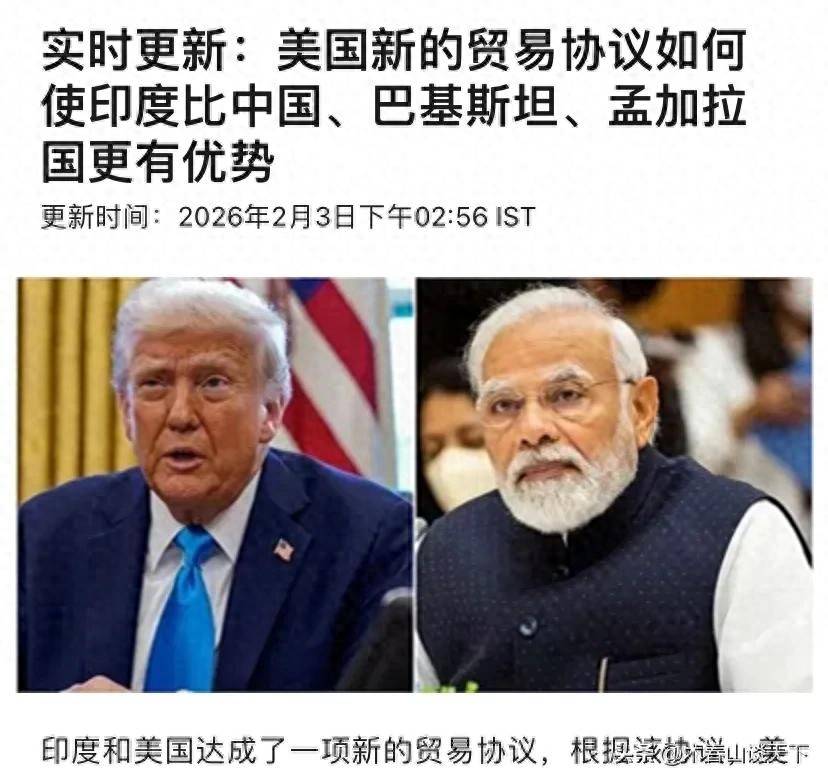
印度人兴奋:关税比中国少50%,特朗普:我和莫迪是能成事的人
Sou Hu Cai Jing· 2026-02-11 06:11
Group 1 - The core point of the article highlights a significant reduction in tariffs for Indian exports to the U.S., which has created a favorable environment for Indian businesses, contrasting sharply with previous punitive tariffs that had severely impacted exports [3][5] - The effective tariff rate for Indian exports has dropped to 14.1%, a substantial decrease compared to the previous 50% rate, allowing Indian exporters to regain competitiveness in the U.S. market [5][7] - The market reacted positively to the news, with the Indian iShares ETF surging over 4% and the Indian Rupee appreciating against the U.S. Dollar, indicating strong investor confidence [5][7] Group 2 - Trump announced a potential $500 billion increase in U.S. exports to India, which would significantly boost India's imports from the U.S., although this figure is viewed skeptically by analysts due to the logistical challenges involved [7][11] - Modi's approach was more cautious, focusing on the tariff reduction while avoiding commitments regarding the cessation of Russian oil imports, indicating a strategic balancing act [9][13] - The ongoing import of Russian oil by India, despite political pressure, showcases India's pragmatic energy strategy and its ability to navigate complex geopolitical landscapes [15][17] Group 3 - The agreement between Trump and Modi is seen as a political maneuver that serves both leaders' interests, with Trump gaining a diplomatic win and Modi securing a market opportunity while maintaining ties with Russia [17] - The long-term sustainability of this agreement remains uncertain, as it is perceived more as a political performance rather than a solid economic contract, raising questions about future market dynamics [17]

当学术自由遭遇政治交易:美国七所顶尖大学为何对白宫说“不”
Di Yi Cai Jing· 2025-10-21 10:25
Core Points - The Trump administration's proposal for a "Higher Education Academic Excellence Pact" has faced significant rejection from top universities, with seven out of nine invited institutions declining to participate [1][4][5] - The agreement aims to exchange federal funding for greater control over university policies, including admissions and faculty hiring [2][3] Group 1: Proposal Details - The pact offers priority access to federal research funding for universities that align with the Trump administration's policies, while granting the government increased control over various academic areas [2][3] - Key conditions of the agreement include eliminating gender and racial factors in admissions, assessing faculty diversity, and implementing a five-year tuition freeze [3] Group 2: University Responses - MIT was the first to publicly reject the proposal, stating that it contradicts their core belief that research funding should be based solely on academic merit [4] - Following MIT, other universities such as Brown, Penn, and USC also issued statements declining the proposal [4][5] - Arizona University became the seventh institution to refuse the pact, emphasizing the importance of academic freedom and independent research funding [4] Group 3: Government's Misjudgment - The Trump administration previously exerted pressure on universities by freezing federal research grants, leading some institutions to reach temporary agreements [5] - The recent collective rejection of the new proposal indicates a miscalculation by the White House regarding its influence over academic institutions [5][6] Group 4: State-Level Reactions - California's Governor Newsom warned that any state university signing the pact would face immediate funding cuts, labeling the agreement as radical [6]