政策冲击

Search documents
邦特科技冲刺北交所上市:“铁三角”共治格局松动 政策冲击下能否逆风翻盘?
Mei Ri Jing Ji Xin Wen· 2026-02-24 15:06
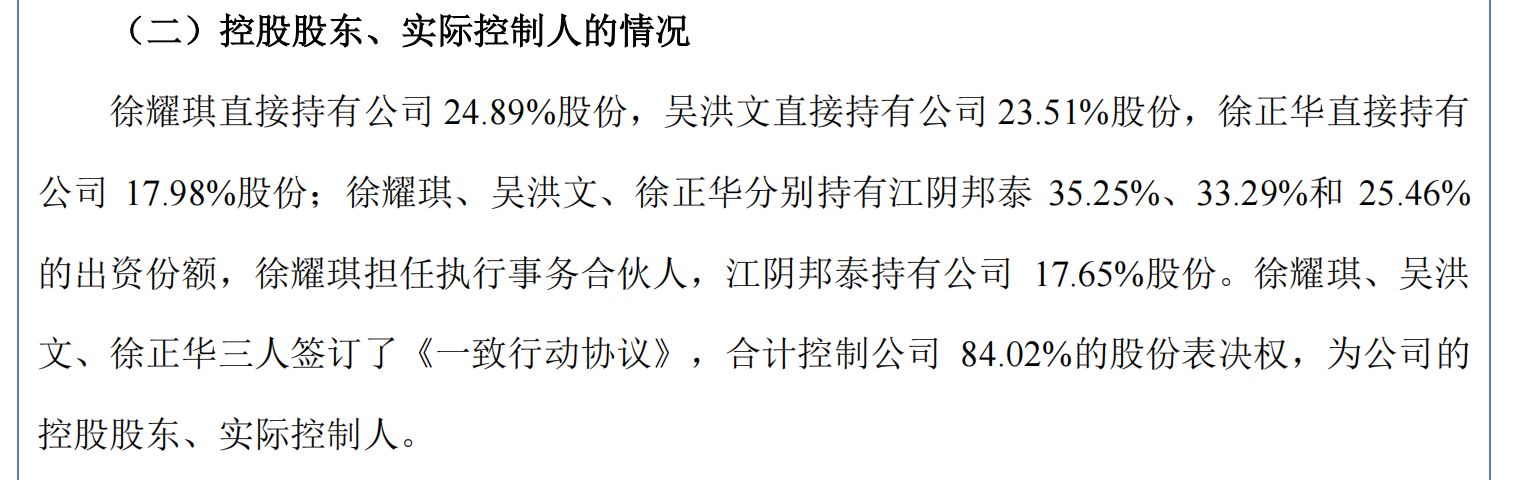
Core Viewpoint - Jiangyin Bangte New Material Technology Co., Ltd. (referred to as "Bangte Technology") is preparing for an IPO on the Beijing Stock Exchange, led by its founders who have worked together for over 20 years. However, the company faces significant challenges due to a recent policy change that cancels export tax rebates for aluminum products, which could impact its revenue and operational stability [1][9]. Group 1: Company Structure and Governance - Bangte Technology is controlled by three co-founders: Xu Yaoqi, Wu Hongwen, and Xu Zhenghua, who have a similar shareholding structure, forming a "triple alliance" governance model [1][2]. - As of now, Xu Yaoqi holds 24.89% of the shares, Wu Hongwen 23.51%, and Xu Zhenghua 17.98%. They also control an additional 17.65% through a partnership, totaling 84.02% voting rights [2][5]. - A unanimous action agreement was signed in December 2021, designating Xu Yaoqi's opinion as the final decision in case of disagreements among the founders [5]. Group 2: Recent Developments and Challenges - The cancellation of export tax rebates for aluminum products, effective December 1, 2024, poses a significant threat to Bangte Technology, particularly affecting its core product, aluminum foil tape, which has contributed 40%-44% of revenue from 2022 to 2024 [9]. - In the first half of 2025, the company's revenue decreased by 3.88% year-on-year to approximately 4.11 billion yuan, marking a halt in its growth trajectory [7]. - The company's production capacity utilization rate for aluminum foil tape dropped sharply to 60.99% in the first half of 2025, down 24.2 percentage points from 85.16% in 2024 [10]. Group 3: Financial Performance and Future Plans - From 2022 to 2024, Bangte Technology's revenue grew from approximately 734 million yuan to about 890 million yuan, while net profit increased from around 44.08 million yuan to 52.29 million yuan [7]. - Despite the declining utilization rate, the company plans to raise approximately 228 million yuan for a new production project, which has raised concerns about the potential for excess capacity and impairment risks [10][11]. - The company has also faced scrutiny regarding its financial decisions, including significant dividends totaling 70 million yuan in 2023, which exceeded its net profit for that year, while simultaneously planning to raise funds for working capital [12].

道是早上悟的 人是下午没的
Datayes· 2025-09-18 11:45
Core Viewpoint - The A-share market experienced significant volatility, with the Shanghai Composite Index reaching a high of 3899.96 before dropping to a low of 3801.00, reflecting market uncertainty influenced by both external and internal factors [1][3][4]. Market Performance - Total trading volume reached 8.76 billion shares, with a total turnover of 1.37 trillion yuan and a turnover rate of 1.84% [3]. - The Shanghai Composite Index closed down 1.15%, the Shenzhen Component down 1.06%, and the ChiNext Index down 1.64% [18]. External Factors - The Federal Reserve's recent interest rate cut of 25 basis points has led to a rebound in the US dollar index above 97, while commodity prices have significantly declined [4]. - Market participants are speculating on the implications of the Fed's rate cut, contributing to the volatility in the A-share market [4]. Internal Factors - There has been notable selling pressure in the brokerage sector, with major firms like Guotai Junan, CITIC Securities, and others experiencing large sell orders, which has raised concerns about market manipulation [4][6]. - Some analysts suggest that the selling pressure may be linked to institutional investors needing to liquidate positions due to upcoming lock-up expirations or other financial obligations [6]. Sentiment and Valuation - Goldman Sachs has introduced an upgraded retail sentiment indicator for A-shares, currently reading 1.3, indicating consolidation risk but not a trend reversal [8]. - Most valuation metrics suggest that large-cap stocks are not overvalued, with the index's price-to-earnings ratio at median levels, indicating continued attractiveness for liquidity-driven investments [9]. Investment Strategy - The recommendation is to maintain an overweight rating on A-shares and H-shares, with a projected upside of 8% and 3% over the next 12 months, respectively, suggesting a strategy of buying on dips [13]. Sector Performance - The electronic, communication, and social services sectors showed strong performance, while non-bank financials, metals, and power equipment sectors faced declines [40]. - The net outflow of funds was significant in the non-bank financial sector, with a total outflow of 773.77 billion yuan, indicating a shift in investor sentiment [27]. Key Developments - The Chinese government has reportedly instructed major tech companies to halt purchases of AI chips from Nvidia, which may impact the semiconductor sector [18]. - Huawei's roadmap for its Ascend series chips was released, outlining a phased launch from 2026 to 2028, which could influence the AI and semiconductor markets [18]. Conclusion - The A-share market is currently navigating through a phase of volatility influenced by both external economic conditions and internal market dynamics, with significant implications for investment strategies and sector performance [1][4][6][18].