
公司治理结构

Search documents
东莞证券董事会调整!国资主导格局进一步强化
券商中国· 2026-03-18 12:27
Core Viewpoint - Dongguan Securities has undergone significant changes in its board structure following a shift in its equity ownership, with a notable increase in state-owned capital's control and a reduction in private shareholders' representation [2][3][4]. Group 1: Board Restructuring - The recent board meeting resulted in a new board composition, reflecting the reduced influence of private shareholders, particularly after Jinlong Co.'s stake reduction [2][4]. - The new board consists of 9 members, with only one representative from private shareholders, while the majority are linked to state-owned entities [6]. - Yang Yang, the president of Dongguan Securities, has been appointed to the board, indicating a closer integration of management and governance [7]. Group 2: Shareholder Structure Changes - Dongguan Securities was established in 1997 and is controlled by the Dongguan State-owned Assets Supervision and Administration Commission [3]. - In June 2025, a significant change occurred when a state-owned consortium acquired a 20% stake from Jinlong Co. for 2.272 billion yuan, increasing state ownership from 55.4% to 75.4% [3]. - Following this transaction, Jinlong Co.'s stake decreased to 20%, and it now holds a combined 24.6% with New Century Education [3]. Group 3: Performance and IPO Prospects - Dongguan Securities reported a revenue of 2.753 billion yuan in 2024, marking a 27.73% year-on-year increase, and a net profit of 923 million yuan, up 45.4% [9]. - For the first nine months of 2025, the company anticipates revenues between 2.344 billion and 2.591 billion yuan, reflecting a growth of 44.93% to 60.18%, with net profits expected to rise by 77.77% to 96.48% [9]. - Analysts suggest that the strengthened state control and improved governance structure may facilitate the company's IPO process [9].


可靠股份管理层矛盾激化 董事鲍佳243万高薪事件成争论焦点
Chang Jiang Shang Bao· 2026-02-25 08:10
Core Viewpoint - The conflict between the chairman Jin Liwei and director Bao Jia of Kexin Co., Ltd. has intensified, leading to the dismissal of independent director Jing Naiquan, raising concerns about the independence of the board [1][5][9] Group 1: Board Decisions and Voting - On February 23, Kexin Co. announced the dismissal of independent director Jing Naiquan, with 5 out of 7 board members voting in favor and 2 (Bao Jia and Jing Naiquan) voting against [2][3] - The company stated that Jing Naiquan lost his independence and failed to fulfill his duties as an independent director [2][5] Group 2: Reasons for Dismissal - The core reason for Jing Naiquan's dismissal was his alleged "collapse of independence" regarding matters involving Bao Jia's high salary, which Kexin Co. claims undermined the decision-making process [5][6] - Bao Jia argued that Jing Naiquan maintained independent judgment and that the dismissal was retaliation from Jin Liwei for his principled stance [4][5] Group 3: Salary Dispute - The central issue of contention is Bao Jia's reported salary of 2.43 million yuan for 2024, which he claims is justified and supported by arbitration records [7][9] - Kexin Co. contends that Bao Jia's high salary is inappropriate, especially since he did not work for the company in 2025, and that the company was misled into believing it was under "arbitration pressure" to pay [9] Group 4: Regulatory Concerns - A company secretary suggested that the Zhejiang Securities Regulatory Bureau conduct a special investigation into Kexin Co.'s related party transactions and the performance of independent directors, emphasizing the need for improved governance and oversight [1][9]

可靠股份管理层矛盾激化独董遭罢免 董事鲍佳243万高薪事件成争论焦点
Chang Jiang Shang Bao· 2026-02-24 23:50
Core Viewpoint - The conflict between the chairman of Kexin Co., Ltd. Jin Liwei and director Bao Jia has intensified, leading to the dismissal of independent director Jing Naiquan, who has been accused of losing independence [1][5][7]. Group 1: Company Governance Issues - Kexin Co., Ltd. announced the dismissal of independent director Jing Naiquan, with 5 out of 7 board members voting in favor, while Bao Jia and Jing Naiquan opposed the motion [4][5]. - The company claims that Jing Naiquan failed to fulfill his duties and lacked the professional ethics expected of an independent director, leading to the decision to terminate his position [5][7]. - Bao Jia argues that the dismissal is a retaliatory action by Jin Liwei against Jing Naiquan for maintaining independent judgment and opposing Bao Jia's interests [6][11]. Group 2: Compensation Controversy - The central issue of the dispute revolves around Bao Jia's high salary of 2.43 million yuan, which he claims is justified, while the company argues it is inappropriate given his lack of service in 2025 [3][10][11]. - Kexin Co., Ltd. has raised concerns about Jing Naiquan's actions during discussions about Bao Jia's compensation, suggesting that he exhibited a bias that undermined his independence [8][9]. - Bao Jia asserts that Jin Liwei's actions regarding his salary and role in the company demonstrate a breach of trust and integrity [10][11].
邦特科技冲刺北交所上市:“铁三角”共治格局松动 政策冲击下能否逆风翻盘?
Mei Ri Jing Ji Xin Wen· 2026-02-24 15:06
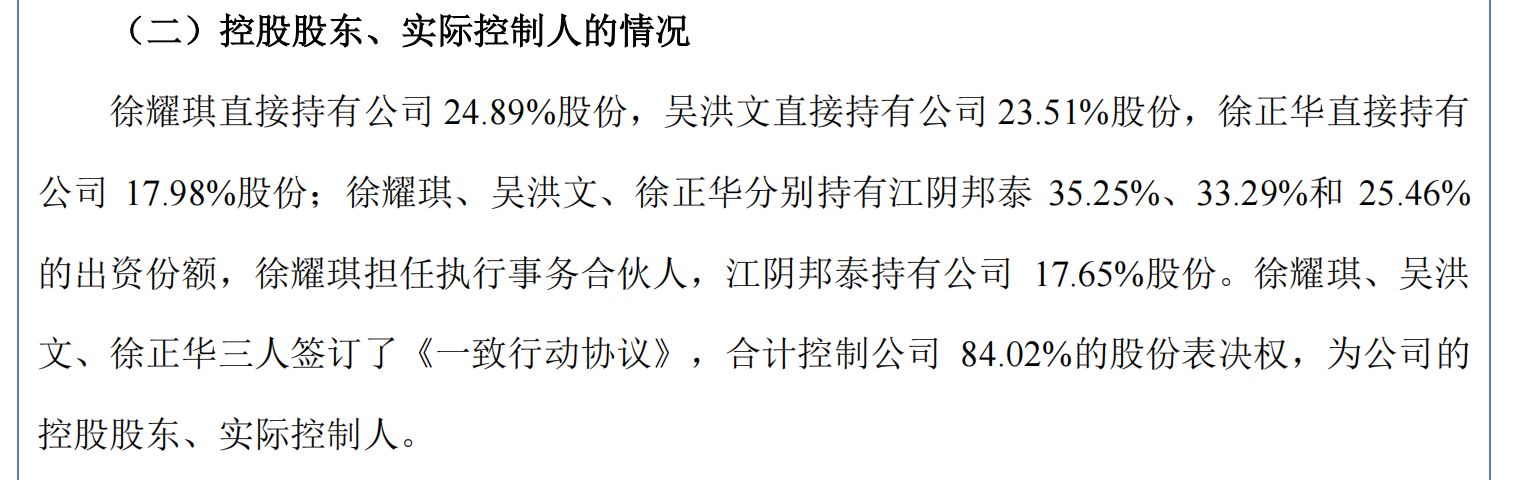
Core Viewpoint - Jiangyin Bangte New Material Technology Co., Ltd. (referred to as "Bangte Technology") is preparing for an IPO on the Beijing Stock Exchange, led by its founders who have worked together for over 20 years. However, the company faces significant challenges due to a recent policy change that cancels export tax rebates for aluminum products, which could impact its revenue and operational stability [1][9]. Group 1: Company Structure and Governance - Bangte Technology is controlled by three co-founders: Xu Yaoqi, Wu Hongwen, and Xu Zhenghua, who have a similar shareholding structure, forming a "triple alliance" governance model [1][2]. - As of now, Xu Yaoqi holds 24.89% of the shares, Wu Hongwen 23.51%, and Xu Zhenghua 17.98%. They also control an additional 17.65% through a partnership, totaling 84.02% voting rights [2][5]. - A unanimous action agreement was signed in December 2021, designating Xu Yaoqi's opinion as the final decision in case of disagreements among the founders [5]. Group 2: Recent Developments and Challenges - The cancellation of export tax rebates for aluminum products, effective December 1, 2024, poses a significant threat to Bangte Technology, particularly affecting its core product, aluminum foil tape, which has contributed 40%-44% of revenue from 2022 to 2024 [9]. - In the first half of 2025, the company's revenue decreased by 3.88% year-on-year to approximately 4.11 billion yuan, marking a halt in its growth trajectory [7]. - The company's production capacity utilization rate for aluminum foil tape dropped sharply to 60.99% in the first half of 2025, down 24.2 percentage points from 85.16% in 2024 [10]. Group 3: Financial Performance and Future Plans - From 2022 to 2024, Bangte Technology's revenue grew from approximately 734 million yuan to about 890 million yuan, while net profit increased from around 44.08 million yuan to 52.29 million yuan [7]. - Despite the declining utilization rate, the company plans to raise approximately 228 million yuan for a new production project, which has raised concerns about the potential for excess capacity and impairment risks [10][11]. - The company has also faced scrutiny regarding its financial decisions, including significant dividends totaling 70 million yuan in 2023, which exceeded its net profit for that year, while simultaneously planning to raise funds for working capital [12].
华海清科(688120.SH):独立董事金玉丰、李全、管荣齐辞职
Ge Long Hui A P P· 2026-02-13 09:36
Core Viewpoint - The company, Huahai Qingke (688120.SH), is undergoing a change in its independent board members as three independent directors have submitted their resignation due to nearing the six-year term limit, while new candidates have been proposed to ensure governance continuity [1] Group 1 - The board received resignation letters from independent directors Jin Yufeng, Li Quan, and Guan Rongqi, who will continue their duties until new independent directors are elected [1] - The company held its 12th meeting of the second board on February 13, 2026, to discuss the nomination of new independent directors [1] - Lei Zhenlin, Ma Defang, and Wang Hao have been nominated as candidates for the second board's independent directors, with Ma Defang being a professional accountant [1]

浙江永安高管变动,公司治理结构引关注
Jing Ji Guan Cha Wang· 2026-02-13 03:52
Executive Changes - Zhejiang Yong'an announced the resignation of Cao Zheng as executive director and vice chairman, and Zhou Youqin as executive director, CEO, and authorized representative, effective on February 6, 2026 [2] - These changes may impact the company's governance structure, prompting investors to monitor subsequent adjustments in the board of directors [2] Future Plans - The company has not disclosed any specific plans for significant future events following the executive changes [1]
长久物流:公司将持续规范资本市场运作,完善公司治理结构
Zheng Quan Ri Bao Wang· 2026-02-05 12:17
Core Viewpoint - The company emphasizes the importance of standardizing capital market operations, improving corporate governance, and enhancing information disclosure and investor relations management [1] Group 1: Strategic Investment - The company will adhere to the principle of maximizing shareholder value when evaluating quality enterprises or resource targets for strategic investments [1] - It plans to conduct mergers and acquisitions at appropriate times to promote market resource integration and extend the industrial chain [1] Group 2: Internal Growth Focus - In the absence of clear investment opportunities, the company will concentrate on internal growth through technological innovation, business expansion, and management optimization [1] - This approach aims to solidify the company's development foundation and enhance its core competitiveness [1]

金风科技:公司已经建立较完善的治理结构
Zheng Quan Ri Bao Wang· 2026-01-30 15:13
Core Viewpoint - The company has established a comprehensive governance structure to ensure sustainable operations and healthy development [1] Group 1 - The company is actively engaging with investors through interactive platforms [1] - The governance structure is designed to support long-term growth and stability [1]
中国邮政储蓄银行完成执行董事选举,芦苇先生正式履职
Xin Lang Cai Jing· 2026-01-19 19:14
Core Viewpoint - The successful election of Mr. Lu Wei as the executive director of China Postal Savings Bank marks a significant step in enhancing the bank's corporate governance structure and strengthening the board's capabilities, which will inject new momentum into the bank's future strategic development and management decisions [1] Group 1: Meeting Details - The first extraordinary general meeting of 2026 was held on January 19, 2026, to elect a new executive director [1] - The meeting was attended by 2,476 shareholders and proxies, representing approximately 108.518 billion shares with voting rights, which accounts for 90.48% of the total voting shares [1] - The voting process combined both on-site and online participation, demonstrating high shareholder engagement in corporate governance matters [1] Group 2: Election Outcome - The proposal to elect Mr. Lu Wei as the executive director was formally approved during the meeting [1] - The legal opinion confirmed that the meeting's convening, procedures, attendance qualifications, and voting results were all lawful and valid [1] - The election of the executive director is seen as a crucial advancement for the bank's governance and strategic direction [1]

淳厚基金的闹剧终于结束了
Xin Lang Cai Jing· 2026-01-09 12:22
Core Viewpoint - The approval by the China Securities Regulatory Commission (CSRC) for Shanghai Changning State-owned Assets Management Co., Ltd. to become the major shareholder and actual controller of Chunhou Fund marks the end of a nearly four-year ownership dispute that began in March 2022 [1][9]. Group 1: Origin of the Dispute - The dispute originated when second shareholder Liu Zhiwei used asymmetric communication methods to privately negotiate share acquisitions with third and fourth shareholders, leading to his absolute control over the company without notifying other shareholders [2][10]. - Liu Zhiwei signed share transfer agreements and attempted to acquire shares from the first major shareholder, Xing Yuan, who only agreed to sell 10% of her shares [2][10]. Group 2: Regulatory Actions - The Shanghai Securities Regulatory Bureau issued eight fines against Chunhou Fund and related personnel for failing to report significant shareholder changes and for having an inadequate internal governance structure [3][11]. - Chunhou Fund was ordered to rectify its governance issues within three months and was prohibited from accepting new fund registrations during the rectification period [3][12]. Group 3: Impact on Business - The ownership dispute led to a paralysis of Chunhou Fund's board, hindering effective meetings and compliance with regulatory disclosure requirements [5][12]. - The fund's management scale decreased from 35.294 billion yuan in Q2 2024 to 19.912 billion yuan currently, with no new fund issuances since 2024 [5][12]. Group 4: Transition to State Ownership - The transfer of 58.80% of Chunhou Fund's registered capital to Shanghai Changning State-owned Assets signifies a shift from a personal-controlled public fund to a state-controlled entity [7][13]. - This transition is expected to resolve long-standing governance issues and enhance the company's governance structure, allowing it to refocus on its core business [7][13].