教育经费投入

Search documents
我省教育经费投入增速位居全国前列
Xin Lang Cai Jing· 2026-01-19 17:08
Group 1 - The core viewpoint of the articles highlights the significant increase in educational funding in the province, with a 2.8% growth in general public budget education funding compared to the previous year, ranking 5th nationally [1] - The average general public budget education funding per student has increased by 2.9%, placing the province 3rd in the country [1] - During the "14th Five-Year Plan" period, the province's general public budget education expenditure exceeded 740 billion, achieving a year-on-year growth of 4.8% by the end of the plan, maintaining a national ranking of 9th [1] Group 2 - The province's financial support for education has been enhanced, with a doubling of the coverage for vocational education national scholarships and increases in scholarship standards for doctoral and master's students by 20% and 25% respectively [2] - Over the "14th Five-Year Plan" period, the total financial allocation for student support exceeded 67 billion, benefiting over 80 million students [2] - Starting from the fall semester of 2025, over 880 million will be allocated to support the gradual implementation of free preschool education, benefiting nearly 600,000 children in public kindergartens [2]
我国教育经费总投入逼近7万亿元
21世纪经济报道· 2026-01-09 13:59
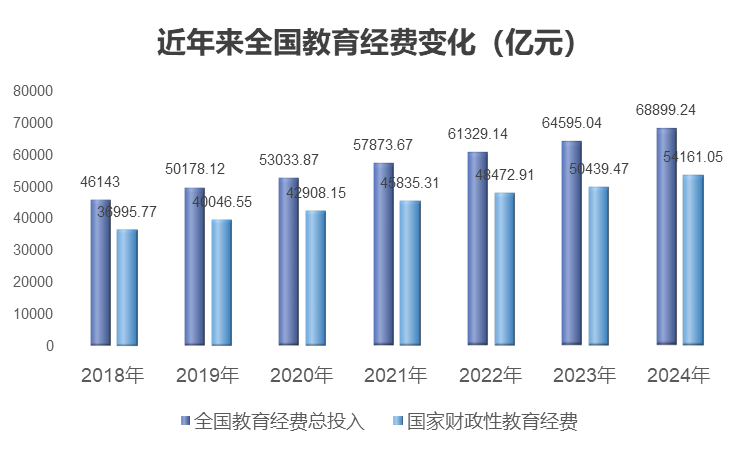
Group 1 - The core viewpoint of the article emphasizes the continuous growth of national education funding, highlighting that investment in education is crucial for human development and national competitiveness [1][3][6] - In 2024, the total national education funding reached 68,899.24 billion yuan, a 6.66% increase from the previous year, with government funding accounting for 54,161.05 billion yuan, up 7.38% [1][3] - The proportion of national fiscal education funding to GDP in 2024 is 4.02%, maintaining above 4% for 13 consecutive years, which is significant given the low overall fiscal revenue to GDP ratio in China [1][8][9] Group 2 - The article notes that 78.61% of the total education funding comes from government sources, indicating a strong reliance on public investment for education [6] - The general public budget for education accounted for 14.58% of the total public budget, with its growth rate exceeding that of overall public budget revenue by 0.31 percentage points [6] - The government has implemented free preschool education, benefiting over 12 million children and reducing family expenses by approximately 20 billion yuan for a single semester [6] Group 3 - The article discusses the adjustment in reporting education funding, stating that average per-student spending will no longer be reported by educational stage to better align with changes in school-age populations [12][13] - It highlights the need for resource integration across educational stages due to the declining school-age population, particularly in primary and preschool education [12][13] - The report emphasizes the importance of adapting fiscal education funding mechanisms to support higher education in response to demographic changes, particularly in populous provinces and central-western regions [13][17]


2024年全国教育经费总投入为68899.24亿元
Xin Hua She· 2026-01-09 13:17
Core Insights - The total education funding in China for 2024 is projected to be 688.99 billion yuan, reflecting a growth of 6.66% compared to the previous year [1] - The government fiscal education funding, which includes various sources such as public budget allocations and corporate contributions, amounts to 541.61 billion yuan, showing an increase of 7.38% year-on-year [1] Group 1 - The total education expenditure for 2024 is 688.99 billion yuan, marking a 6.66% increase from the previous year [1] - The national fiscal education funding is 541.61 billion yuan, with a year-on-year growth of 7.38% [1]
国家教育经费账单发布:连续13年完成“4%目标”
2 1 Shi Ji Jing Ji Bao Dao· 2026-01-09 11:31
Group 1 - The core viewpoint of the article emphasizes the continuous growth of national education funding, which is crucial for the development of the education sector and the enhancement of national competitiveness and innovation capabilities [2][6][7] - In 2024, the total national education funding reached 68,899.24 billion yuan, marking a 6.66% increase from the previous year, while the national fiscal education funding was 54,161.05 billion yuan, up by 7.38% [1][3] - The proportion of national fiscal education funding to GDP in 2024 was 4.02%, maintaining above 4% for 13 consecutive years, reflecting the government's commitment to prioritizing education despite tight fiscal conditions [1][8][11] Group 2 - The government funding for education constitutes 78.61% of the total education funding, with the growth rate of general public budget education funding exceeding that of overall public budget revenue by 0.31 percentage points [6][7] - The "4% target" is a significant indicator of a country's fiscal education investment level, and the adjustment of its description from "generally not lower than" to "higher than" indicates a stronger emphasis on education [8][10] - The recent changes in the announcement regarding the average education expenditure per student, which no longer categorizes by educational stages, aim to adapt to the changes in school-age population and improve the efficiency of education funding utilization [12][13] Group 3 - The article highlights the need for a robust mechanism to adapt to changes in school-age populations, which is a critical variable affecting long-term education investment patterns [14] - It suggests that the government should optimize the fiscal support methods for education across regions, ensuring that funding is directed to areas with population influx and improving conditions in weaker regions [14] - The article also calls for legislative measures to enhance tax incentives for educational donations, thereby stimulating social investment in education [11][14]
广东全省教育经费总投入连续30多年居全国首位
Zhong Guo Fa Zhan Wang· 2026-01-09 09:08
Core Insights - Guangdong Province is set to enhance its education system significantly by the end of 2025, with a total of 36,868 schools and an enrollment of 27.66 million students, marking an increase of 1.66 million students compared to the end of the previous five-year plan [1] - The province aims to improve the quality of education, with a focus on moral education and the integration of ideological and political education across all levels [3] - Guangdong's education funding continues to lead the nation, with a total investment of 674.74 billion yuan in 2024, reflecting a 25.3% increase since 2020 [6] Group 1: Education Infrastructure and Enrollment - By the end of 2025, Guangdong will have 36,868 schools, an increase of 28 from the end of the previous five-year plan, ranking second in the country [1] - The number of enrolled students is projected to reach 27.66 million, an increase of 1.66 million, the highest in the nation [1] - The province has 168,040 full-time teachers, an increase of 15,850, also the highest in the country [1] Group 2: Quality of Education - The province is focusing on high-quality education development, achieving a gross enrollment rate of 100% in preschool education and 96% in nine-year compulsory education [3] - The number of higher education institutions has increased from 154 to 166, with 10 new undergraduate institutions established [3] - The overall health and fitness levels of students have improved, with a 3.3% decrease in the overall myopia rate among children and adolescents since 2020 [3] Group 3: Economic and Social Development - Eight universities have been approved to grant master's degrees, and five for doctoral degrees, nearing the total number approved in the past 20 years [4] - The number of master's and doctoral students is expected to reach 235,500, with an increase of 52.19% and 14.76% respectively compared to the end of the previous five-year plan [4] - Over 400 new undergraduate programs in fields such as robotics and artificial intelligence have been added to optimize the academic structure [4] Group 4: International Cooperation and Outreach - Guangdong has established 48 cooperative education programs at the undergraduate level with international institutions [5] - The province has set up 12 schools for students from Hong Kong, Macau, and Taiwan, with nearly 110,000 students enrolled in primary and secondary education [6] - The "Study in China, Study in Guangdong" initiative has been launched, with over 20,000 international students currently studying in the province [6] Group 5: Financial Investment in Education - Guangdong's education expenditure has consistently increased, with a total budget of 398.64 billion yuan for 2024, representing a 12.7% increase since 2020 [6] - The province's education funding accounts for over one-fifth of the general public budget, maintaining a leading position nationally [6] - A comprehensive financial aid policy for economically disadvantaged students has been established, ensuring no student is left behind due to financial constraints [6]
民生大国建设关键在于“投资于人”
Sou Hu Cai Jing· 2025-11-27 21:35
Core Viewpoint - The article emphasizes the importance of "investing in people" as a key strategy for China's modernization, transitioning from a manufacturing powerhouse to a consumer and welfare-oriented economy, which is essential for meeting the needs of its 1.4 billion citizens [2] Investment in Human Capital - "Investing in people" is identified as a core lever to enhance investment efficiency, with the potential to create a multiplier effect that exceeds the initial capital investment [2] - The contribution of human capital to economic growth has surpassed that of physical capital, highlighting the need for continuous improvement in labor quality and educational attainment [3][6] - The World Bank indicates that a one-year increase in labor education can boost GDP by 9%, underscoring the economic benefits of enhancing educational levels [3] Healthcare Investment - A comprehensive investment of 80 trillion to 100 trillion yuan is required to improve and guarantee livelihoods, with a specific recommendation for an annual investment of 5 trillion yuan to achieve basic healthcare equality between urban and rural areas [3][4] - The personal contribution to urban and rural residents' medical insurance has increased from 10 yuan in 2008 to 380 yuan in 2023, a 37-fold rise, leading to a decline in insured individuals by approximately 20 million from 2022 to 2023 [5] - To alleviate the financial burden on rural residents, it is suggested to reduce the personal insurance payment from 380 yuan to 160 yuan, requiring an annual fiscal input of 150 billion yuan [5] Education Funding - The average expected years of education in China is 15.2 years, which is lower than OECD countries by 1.4 years, indicating a need for increased educational investment [6] - Public education funding as a percentage of GDP was only 4.01% in 2022, which is below several other countries, suggesting a need for increased investment in education [6] - An estimated investment of 500 billion yuan annually is needed to universalize high school education, with potential cost reductions if existing vocational schools are repurposed [6] Support for Childbearing - An annual investment of 2 trillion to 3 trillion yuan is recommended to enhance the childbearing support system, addressing the high costs associated with raising children in China [7] - The average intended number of children per woman in 2021 was 1.64, below the replacement level, indicating a need to lower the comprehensive costs of child-rearing to improve birth rates [7]