散户逼空

Search documents
散户们把白银玩成了“万人坑”
投中网· 2026-02-06 06:53
Core Viewpoint - The article discusses the dramatic collapse of silver prices, highlighting the role of retail investors and institutional players in creating a volatile market environment that led to significant losses for many individual investors [6][10][43]. Group 1: Market Dynamics - Retail investors injected a record $1 billion into silver ETFs in January, with trading volumes reaching $39.4 billion on January 26, nearly matching the S&P 500 ETF [15][16]. - The surge in interest was fueled by social media platforms, particularly Reddit, where discussions about silver reached 20 times the five-year average [19]. - Analysts noted that silver became severely overvalued, likening its rise to a speculative bubble detached from industrial demand [19][20]. Group 2: Triggering the Collapse - On January 30, silver experienced a massive sell-off, with prices dropping significantly before the announcement of Kevin Warsh's nomination as Fed Chair, which was incorrectly blamed for the crash [21][22][24]. - The real catalyst for the collapse was the Chicago Mercantile Exchange's (CME) decision to raise margin requirements for silver futures by 50%, forcing many retail investors to liquidate their positions [27][36]. Group 3: Institutional Advantage - While retail investors faced forced liquidations due to margin calls, institutional players were positioned to benefit from the chaos, utilizing emergency liquidity from the Federal Reserve [30][32]. - Institutions like JPMorgan were able to exploit the situation by buying silver at depressed prices during the sell-off, showcasing a structural advantage over retail investors [39][42]. Group 4: Conclusion on Market Fairness - The article concludes that financial markets are not a level playing field, with retail investors often at a disadvantage against institutional players who can leverage their resources and market knowledge [44][46].


散户们把白银玩成了“万人坑”
Hua Er Jie Jian Wen· 2026-02-05 07:25
Core Viewpoint - The silver market experienced a dramatic collapse, with prices plummeting over 40% within three days, leading to significant losses for retail investors who had previously viewed silver as a potential investment opportunity akin to GameStop in 2021 [3][10][22]. Group 1: Market Dynamics - In January 2026, retail investors injected a record $1 billion into silver ETFs, with trading volumes peaking at $39.4 billion on January 26, nearly matching the S&P 500 ETF [8]. - The surge in silver prices was driven by retail investor enthusiasm, detached from industrial demand fundamentals, leading to a price doubling within three months [10]. - The Chicago Mercantile Exchange (CME) raised margin requirements for silver futures by 50% just before the crash, forcing many leveraged retail investors to liquidate their positions [18]. Group 2: Institutional Behavior - During the retail investor sell-off, institutional players, particularly JPMorgan, capitalized on the situation, benefiting from increased liquidity provided by the Federal Reserve [19]. - On the day of the crash, the SLV ETF traded at a significant discount to its underlying silver value, allowing authorized participants to profit from arbitrage opportunities [21]. - JPMorgan reportedly acquired 3.1 million ounces of physical silver at the market's lowest point, illustrating the disparity in market power between retail investors and institutions [21]. Group 3: Market Sentiment and Consequences - The sentiment on social media platforms like Reddit contributed to the frenzy, with discussions about silver reaching levels 20 times higher than the five-year average [10]. - Analysts have characterized the silver market as a "death trap" for retail investors, highlighting the inherent risks of trading in a market dominated by institutional algorithms and leverage [22]. - The collapse serves as a cautionary tale about the volatility of silver compared to stocks, emphasizing the dangers of retail investors engaging in speculative trading without understanding the underlying market mechanics [22].
2021版“散户暴打空头”重演?这是美股最被做空的小微盘名单
Hua Er Jie Jian Wen· 2025-07-23 01:06
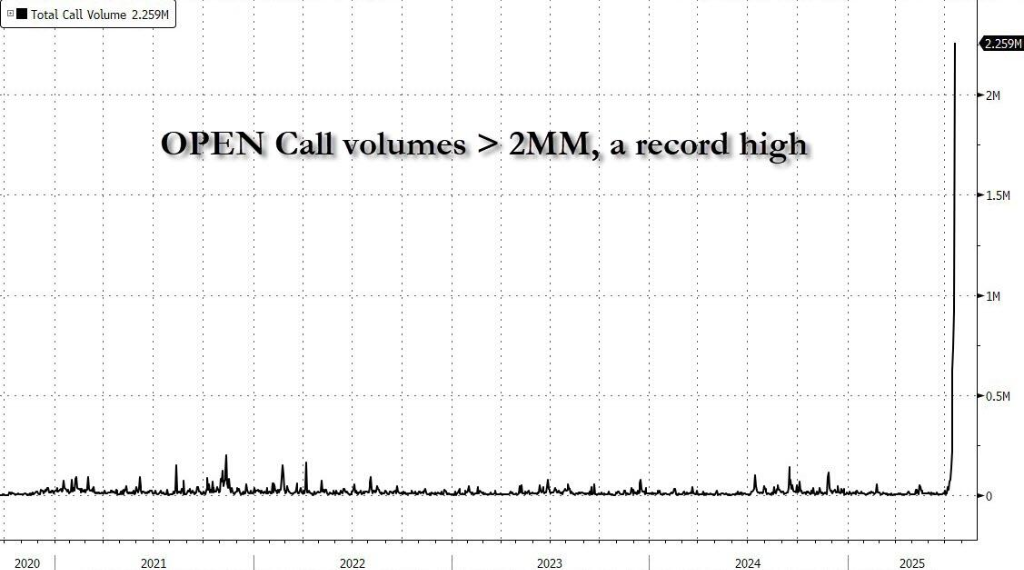
Group 1 - The current market is experiencing a resurgence of retail investor enthusiasm reminiscent of 2021, with a focus on "Meme stocks" and a significant increase in options trading [1][5] - Retail investors are targeting small-cap stocks with high short interest, aiming to replicate the previous success of forcing short sellers to cover their positions [4][8] - The proportion of call options in the market has surged to 70%, the highest level since the "Meme stock" phenomenon began in 2021, indicating a rise in speculative sentiment [5][8] Group 2 - Small-cap stocks with market capitalizations between $10 million and $1.5 billion and short interest exceeding 25% are becoming the new targets for retail investors [4][6] - Notable high short interest stocks include BEELINE HOLDINGS with 166.77% short interest and a market cap of $18 million, and NEOVOLTA with 81.22% short interest and a market cap of $160.4 million [4][7] - Analysts highlight that many of these companies have poor fundamentals, but high short interest provides ample fuel for potential short squeezes, creating a self-reinforcing cycle of price increases [6][9]
OpenDoor“见光死”后,“昔日百货巨头”Kohl周二被炒上天,美股散户火力全开
Hua Er Jie Jian Wen· 2025-07-23 00:40
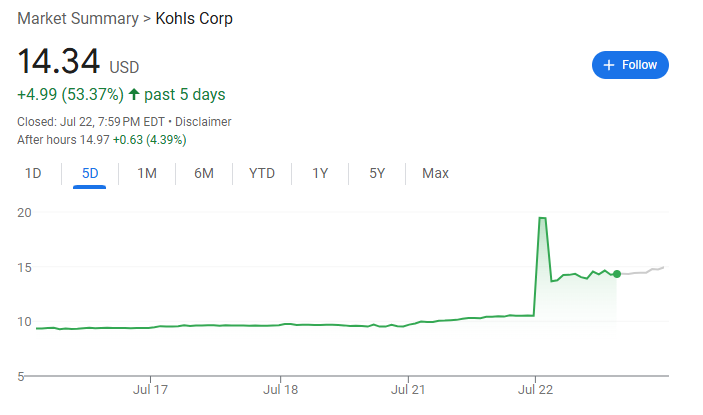
Group 1 - The core narrative revolves around a resurgence of retail investor enthusiasm, targeting heavily shorted stocks like Kohl's Corp, reminiscent of the 2021 GameStop saga [1][3] - Kohl's stock price surged by 38% to close at $14.34, with trading volume reaching 183 million shares, approximately 25 times its 25-day moving average [1] - The options market saw a significant increase in activity for Kohl's, with total contract volume hitting 360,000, a 12-fold increase compared to the daily average [1][4] Group 2 - Retail investors are shifting focus from large-cap stocks to low-priced, speculative stocks, aiming to exploit short positions for excess returns [2][4] - Social media platforms, particularly Reddit's WallStreetBets, have become a rallying point for retail investors, amplifying sentiments to buy and hold stocks like Kohl's [3] - Approximately 49% of Kohl's tradable shares are shorted, making it an ideal target for a short squeeze, as the company's fundamentals have deteriorated significantly [5][6] Group 3 - The current market environment differs from 2021, with investors facing challenges such as high inflation and a struggling real estate market, despite the S&P 500 reaching new highs [9] - There are concerns that the enthusiasm for meme stocks is overlapping with cryptocurrency excitement, indicating a potential shift in investor behavior [9][10]