保证金上调

Search documents
散户们把白银玩成了“万人坑”
投中网· 2026-02-06 06:53
Core Viewpoint - The article discusses the dramatic collapse of silver prices, highlighting the role of retail investors and institutional players in creating a volatile market environment that led to significant losses for many individual investors [6][10][43]. Group 1: Market Dynamics - Retail investors injected a record $1 billion into silver ETFs in January, with trading volumes reaching $39.4 billion on January 26, nearly matching the S&P 500 ETF [15][16]. - The surge in interest was fueled by social media platforms, particularly Reddit, where discussions about silver reached 20 times the five-year average [19]. - Analysts noted that silver became severely overvalued, likening its rise to a speculative bubble detached from industrial demand [19][20]. Group 2: Triggering the Collapse - On January 30, silver experienced a massive sell-off, with prices dropping significantly before the announcement of Kevin Warsh's nomination as Fed Chair, which was incorrectly blamed for the crash [21][22][24]. - The real catalyst for the collapse was the Chicago Mercantile Exchange's (CME) decision to raise margin requirements for silver futures by 50%, forcing many retail investors to liquidate their positions [27][36]. Group 3: Institutional Advantage - While retail investors faced forced liquidations due to margin calls, institutional players were positioned to benefit from the chaos, utilizing emergency liquidity from the Federal Reserve [30][32]. - Institutions like JPMorgan were able to exploit the situation by buying silver at depressed prices during the sell-off, showcasing a structural advantage over retail investors [39][42]. Group 4: Conclusion on Market Fairness - The article concludes that financial markets are not a level playing field, with retail investors often at a disadvantage against institutional players who can leverage their resources and market knowledge [44][46].


摩根大通等机构悄然离场 黄金4600防线破探坑
Jin Tou Wang· 2026-02-04 06:02
Core Viewpoint - Recent fluctuations in international gold prices have been characterized by extreme volatility, with prices experiencing a "roller coaster" effect, dropping to $4,400 per ounce and then rebounding to $5,000 per ounce shortly after [1][2]. Group 1: Market Dynamics - On February 2, gold futures fell sharply to $4,400 per ounce, reflecting the market's vulnerability amid high volatility [2]. - The surge in gold prices since January has led to a historical peak in volatility, with a significant increase in trading activity among short-term bullish traders [2]. - The nomination of a hawkish Federal Reserve chair by Trump was identified as a trigger for the price drop, but the primary cause was attributed to forced liquidations and margin increases [2][3]. Group 2: Institutional Behavior - Major financial institutions, including JPMorgan and Goldman Sachs, have reduced their net long positions in gold from 35% to 22% since January 23, indicating a significant sell-off [2]. - Retail investors continued to buy at high prices, creating a scenario where institutions were "harvesting" profits while retail investors were left holding positions [2]. - Institutions sold off high-risk assets, including gold, to meet margin calls, further exacerbating price volatility [2]. Group 3: Technical Analysis - Key support levels for gold prices are identified between $4,600 and $4,700 per ounce, which is crucial for maintaining market stability [4]. - If prices fall below this support range, further declines could target $4,400 to $4,500 per ounce, which is viewed as a strong support level by market participants [4]. - As the Chinese New Year approaches, physical demand for gold is expected to increase, potentially leading to a technical rebound if prices reach the identified support levels [4].


惊心动魄!金价深夜飙涨至5000美元,过山车行情背后:投行精准狙击散户|大宗风云
Hua Xia Shi Bao· 2026-02-04 02:51
Core Viewpoint - The recent volatility in international gold prices, characterized by sharp fluctuations, is primarily driven by market uncertainties and a combination of factors including policy expectations, dollar rebound, and increased margin requirements [2][3][4]. Market Dynamics - On February 2, gold and silver futures experienced significant declines due to a reversal in policy expectations, a rebound in the dollar, and forced liquidations triggered by increased margin requirements [3][4]. - The Chicago Mercantile Exchange announced an increase in trading margin requirements for precious metals, which contributed to the market's forced deleveraging and heightened volatility [5][6]. Investor Behavior - The market has seen a shift from passive selling to active repositioning by institutions, with a notable reduction in long positions among major financial institutions like JPMorgan and Goldman Sachs, while retail investors continued to increase their positions [7][8]. - The crowded long positions in silver, particularly, were a key factor in the recent dramatic price drop, as any negative news led to a rush to liquidate positions [7][8]. Future Outlook - Despite the recent volatility, analysts believe that the long-term bull market for gold is not over, as the fundamental support factors remain intact, including central bank purchases and a potential decline in real interest rates [11][12]. - The upcoming market dynamics will be influenced by various factors, including U.S. government developments, geopolitical tensions, and economic data releases [11][12][13].
洪灏:东方聪明钱并未大幅抛售 坚定看多黄金白银的长期投资价值
Ge Long Hui· 2026-02-03 07:40
Core Viewpoint - The recent significant drop in gold and silver prices is viewed as a healthy correction within a long-term bull market, rather than a collapse of faith in the intrinsic value of hard assets [2]. Group 1: Market Analysis - The chief investment officer of Lianhua Asset Management, Hong Hao, believes that the recent price drop is similar to the "cash squeeze" event in March 2020, rather than structural bear markets seen in 1980 or 2013 [1]. - The drop in prices is attributed to liquidity traps in market trading and margin increases, rather than a sudden loss of confidence in hard assets [2]. - Hong Hao maintains a bullish long-term outlook on gold and silver, suggesting that the story of these precious metals is just beginning [2]. Group 2: Historical Context - The article references the infamous "Silver Thursday" on March 27, 1980, when silver prices plummeted by over 50% due to market manipulation by the Hunt brothers, who attempted to monopolize the silver market [1]. - The Hunt brothers' inability to meet margin calls led to forced liquidations, causing a market crash from approximately $21 to $10.8 per ounce [1]. Group 3: Future Outlook - Hong Hao has set a target price of $150 for silver, indicating a strong belief in the future demand for gold as the myth of the dollar fades due to high U.S. debt levels [2].
金信期货日刊-20260203
Jin Xin Qi Huo· 2026-02-02 23:39
1. Report Industry Investment Rating - No relevant information provided. 2. Core Viewpoints - The sharp decline in precious metals is due to forced liquidation and margin hikes triggered by the initial spark of the Wash nomination, with Shanghai silver expected to be volatile and bearish in the short - term. A - shares are expected to continue adjusting, and the operation strategy is to sell on rallies. Gold is likely to remain volatile, so caution is advised. Iron ore is in the process of finding a bottom, and a volatile approach is recommended. Glass is expected to turn volatile and bearish in the short - term. Methanol trading will likely focus on overseas situation developments. Pulp futures are in a range - bound trend [3][5][10][12][15][19][21]. 3. Summary by Related Catalogs 3.1 Shanghai Silver - Core decline drivers include regulatory strict control (the Shanghai Futures Exchange raised the margin to 18% and limited opening positions to 800 lots), a hawkish macro - environment (the Fed maintained the interest rate at 3.5% - 3.75% and Powell's hawkish stance), profit - taking due to a previous over 30% increase and a 12% reduction in CFTC non - commercial net long positions, and the substitution effect of copper for silver. In the short - term (1 - 2 weeks), it is volatile and bearish; in the medium - term (1 - 3 months), the price may recover under certain conditions. Operation advice is to avoid blind bottom - fishing and short at resistance levels [3]. 3.2 A - shares - The overall A - share market declined unilaterally with significantly reduced trading volume. Technically, there is a need for further adjustment at the daily - line level, and the operation strategy is to sell on rallies [5]. 3.3 Gold - Gold prices continued to fall sharply, and it is expected that the volatility will continue for some time. Caution is advised when participating [10]. 3.4 Iron Ore - With the commissioning of the Simandou project, the expectation of a loose supply is further fermented. On the demand side, except for exports, the domestic demand support from real estate and infrastructure is weak. Technically, it closed lower today, and a volatile approach is recommended, paying attention to the lower platform support [12][13]. 3.5 Glass - The daily melting volume changed little, and inventory decreased slightly. The main drivers are policy - side stimulus and supply - side clearance. Technically, it rose and then fell today, and a short - term volatile and bearish approach is adopted [15][16]. 3.6 Methanol - Fundamentally, the state of both supply and demand reduction does not support the market. Although the reduction in imports is gradually being realized, the negative impact of coastal olefin plant shutdowns has also occurred as expected. The de - stocking progress is average, and the relatively high port inventory suppresses the market. Overseas geopolitical uncertainties remain, especially the situation in Iran is undetermined, so short - term trading will likely focus on overseas situation developments [19]. 3.7 Pulp - The pulp spot market is operating stably, with some pulp and paper mills undergoing maintenance shutdowns. The domestic port inventory is still under pressure, and the downstream demand for base paper lacks the driving force to increase, mainly maintaining rigid procurement. As the production cost decreases, the paper mills' gross profit has rebounded. The pulp futures have shown a range - bound trend recently [21].
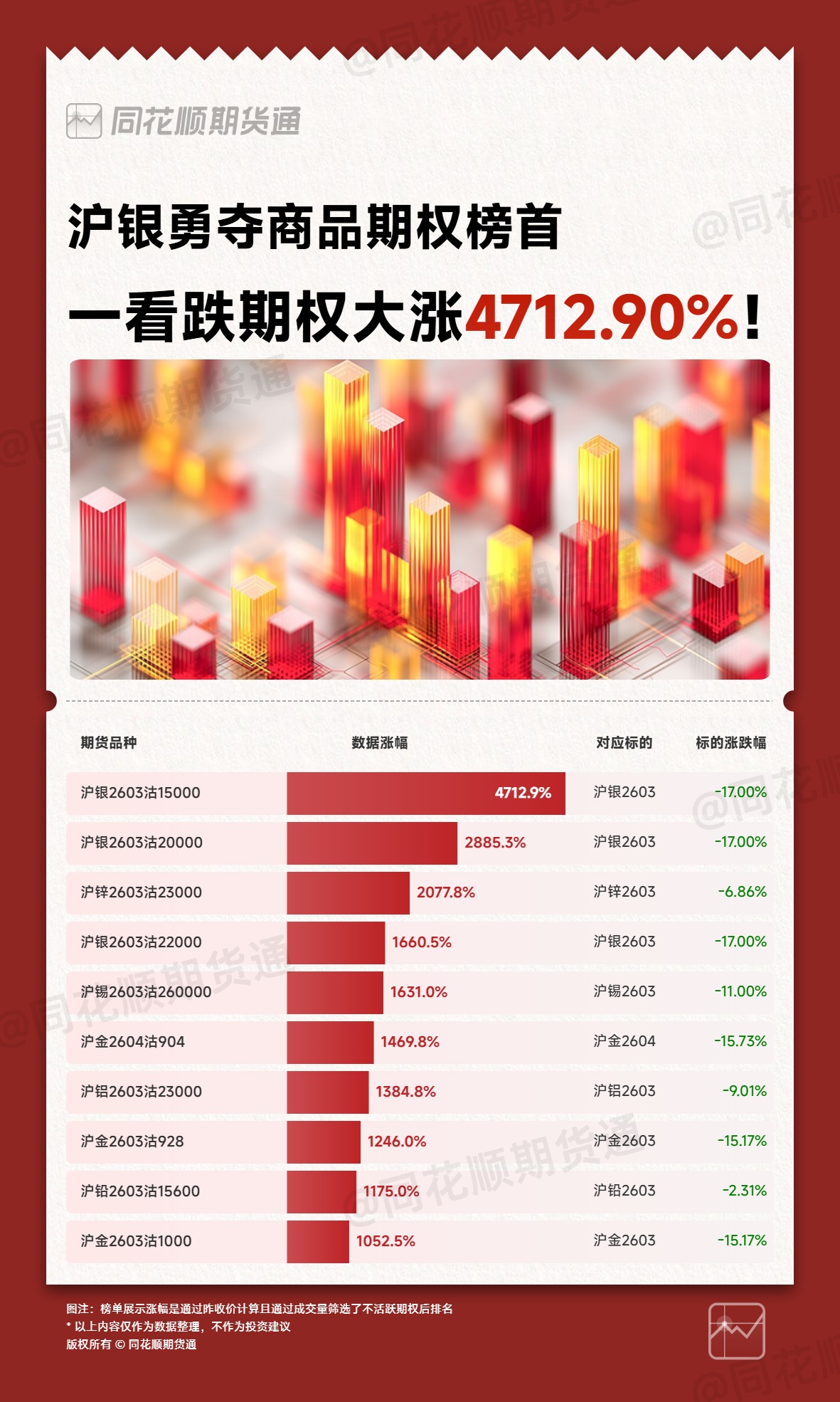
沪银勇夺期权榜首 一看跌期权大涨4712.90%!
Xin Lang Cai Jing· 2026-02-02 10:49
Core Viewpoint - The silver put options have experienced an unprecedented surge in value, with the leading contract,沪银2603沽15000, increasing by 4712.90%, amidst a significant downturn in the commodity market driven by margin increases and forced liquidations [5][13]. Group 1: Market Dynamics - The commodity market faced a "Black Monday," with precious metals leading a widespread decline, triggering a historic surge in short put options [5][13]. - The沪银2603 contract saw a dramatic drop of 17%, leading to a corresponding explosive rise in put option prices due to the exchange's risk control policies [5][13]. - Margin requirements were raised simultaneously on both domestic and international exchanges, exacerbating the situation for long positions and leading to forced liquidations [5][14]. Group 2: Impact of Margin Increases - The increase in margin requirements created a vicious cycle of "the more it drops, the more it needs to be liquidated," further driving down prices and providing fertile ground for short options [6][14]. - Historical patterns indicate that significant margin increases often signal the end of bullish trends, as seen in previous peaks in silver prices [6][14]. Group 3: Broader Commodity Market Trends - The decline in precious metals quickly spread to base metals, with multiple contracts hitting their daily limit down, including沪锌 and沪铝, which fell by over 6% and 9% respectively [7][15]. - The sensitivity of short options in a declining market was highlighted, with put options on沪锡 and沪铝 seeing increases of over 1300% despite their underlying assets experiencing smaller declines [7][16]. Group 4: Leverage in Options Trading - The surge in put options is attributed to their near-expiry nature, which amplifies their sensitivity to underlying asset movements, exemplified by the沪银2603沽15000 option [8][16]. - A small decline in the underlying asset resulted in a massive increase in option value, showcasing the leverage effect inherent in options trading [8][16].
【首席观察】沃什提名冲击波 黄金流动性“休克”
Sou Hu Cai Jing· 2026-02-01 09:49
Core Viewpoint - The recent sharp decline in gold prices, attributed to macroeconomic factors and changes in market sentiment, has transformed gold from a "safe haven asset" to a "risk source" [3][10]. Macroeconomic Factors - The Federal Reserve's decision to maintain interest rates between 3.50% and 3.75% and the cautious tone of its statements contributed to market uncertainty, leading to increased volatility [5][10]. - The nomination of Kevin Warsh as the next Fed Chair has raised concerns about potential changes in monetary policy, impacting market perceptions of the Fed's "reaction function" [8][10]. Market Dynamics - Prior to January 29, the market appeared stable, with gold prices comfortably positioned between $5300 and $5400 per ounce [6][7]. - The sudden announcement of Warsh's nomination caused a significant market reaction, leading to a sharp sell-off in gold [9][10]. Trading Behavior - On January 30, gold futures experienced an 8.35% drop, plummeting from above $5300 to around $4900 per ounce [11]. - The trading volume surged, but open interest decreased, indicating that the sell-off was primarily driven by long positions being liquidated rather than new short positions being established [12][13]. Margin Requirements - The Chicago Mercantile Exchange (CME) raised margin requirements for gold and silver futures, increasing the margin for gold from 6.6% to 8.8%, which adds pressure on leveraged accounts [14][15]. - This increase in margin requirements is seen as a necessary measure to prevent systemic risk amid heightened volatility [15][16]. Future Outlook - Analysts suggest that while the immediate risk of a "nuclear-style chain reaction" of forced liquidations may have decreased, there remains a risk of gradual selling pressure due to the new margin requirements [17]. - The pricing model for gold is now influenced by expectations around real interest rates, dollar strength, and risk aversion, with the market shifting from a "buying frenzy" to one dominated by liquidity and risk management concerns [18].
崩盘后火速再出手!CME一周内第二次上调贵金属期货保证金
Zhi Tong Cai Jing· 2026-01-31 06:58
Core Viewpoint - The Chicago Mercantile Exchange (CME) has raised margin requirements for gold and silver futures following significant price declines, indicating a response to market volatility and ensuring adequate coverage of trading risks [1][2]. Group 1: Margin Adjustments - CME announced an increase in margin requirements for gold futures from 6% to 8% for non-high-risk accounts and from 6.6% to 8.8% for high-risk accounts [1]. - Silver futures margin requirements were raised from 11% to 15% for non-high-risk accounts and from 12.1% to 16.5% for high-risk accounts [1]. - The adjustments will take effect after the market closes on the following Monday, reflecting a routine assessment of market volatility [1]. Group 2: Market Reaction - The precious metals market experienced one of the most severe single-day adjustments in decades, with gold prices dropping over 11% and COMEX silver prices plummeting more than 31% [1][2]. - The decline was attributed to the nomination of Kevin Warsh as the next Federal Reserve Chairman, which led to a stronger dollar and rising real yields, prompting rapid liquidation of leveraged positions in gold and silver [2]. - The margin increase may pressure smaller investors who lack sufficient capital to meet the new requirements, potentially forcing them out of the market [2]. Group 3: Expert Insights - Experts suggest that the margin increases will continue to exert pressure on precious metal prices, following previous adjustments made earlier in the week due to rising prices [2]. - The adjustments are seen as a standard response to extreme market movements, but they may have significant implications for market participants, particularly those with limited financial resources [2].

铁矿日报:港口库存往下游转移,年底补库博弈较强-20260105
Guan Tong Qi Huo· 2026-01-05 11:25
Report Summary 1) Report Industry Investment Rating No relevant content provided. 2) Core Viewpoints of the Report - The iron ore market shows an overall trend of gradual strengthening. The futures contract presents a back structure and positive basis, with the futures price at a discount, resulting in a short - term resonance between the futures and the spot market [1][5]. - The iron ore price is supported by the expected resumption of blast furnaces in January, the recovery of molten iron, and pre - holiday restocking, but attention should be paid to the significant fluctuations in the sentiment of the commodity market [2]. 3) Summary by Relevant Catalogs Market行情态势回顾 - **Futures Price**: The main contract of iron ore futures fluctuated and strengthened slightly during the day, closing at 797 yuan/ton, up 7.5 yuan/ton or 0.95% from the previous trading day's closing price. The trading volume was 195,000 lots, the open interest increased by 25,000 lots to 619,000 lots, and the settled funds were 10.85 billion yuan. The disk price remained in a slightly strong oscillating state [1]. - **Spot Price**: The mainstream varieties of port spot goods, such as PB powder at Qingdao Port, remained unchanged at 808 yuan/ton, and Super Special powder remained unchanged at 685 yuan/ton. The main swap contract was at 105.4 (+0.95) US dollars/ton. The swap price showed a strong upward breakthrough, and the spot market oscillated slightly stronger [1]. - **Basis and Spread**: The price of PB powder at Qingdao Port converted to the futures price was 836.8 yuan/ton, with a basis of 39.8 yuan/ton, and the basis narrowed slightly. The spread between Iron Ore 1 - 5 was 17.5 yuan, and the spread between Iron Ore 5 - 9 was 22 yuan. The iron ore futures contracts presented a back structure and positive basis, with certain support below the futures price, continuing the trend of gradual strengthening [1]. Fundamental Analysis - **Supply**: The supply side was relatively stable, with the year - end rush for volume completed. Attention should be paid to the weather disturbances in the first quarter [2]. - **Demand**: The sample molten iron production increased month - on - month, the profitability rate improved slightly. There was an expectation of blast furnace复产 in January, and steel mills' restocking had gradually started, but the overall pace was still slow. Attention should be paid to the recovery height of molten iron before the holiday and the release rhythm of restocking demand [2]. - **Inventory**: Port inventories continued to accumulate, and steel mills' inventories increased slightly month - on - month but were still at a relatively low level year - on - year. The game for year - end restocking was intense, and the overall inventory pressure was building up [2]. Macroeconomic Analysis - **Domestic**: The manufacturing PMI in December reached 50.1%, returning to the expansion range for the first time since April, significantly exceeding seasonal expectations and market expectations. The core driver was the simultaneous recovery of both supply and demand. The price side showed that the anti - involution policy was crucial for price stabilization and recovery. The construction industry PMI also rebounded significantly due to weather and construction progress factors. In the future, attention should be paid to the support of ultra - long - term special treasury bond funds and the rhythm of subsequent fiscal policies [4]. - **Overseas**: In the short term, the key focus was on the candidate for the next Federal Reserve Chairman and the announcement time. Currently, Hassett had a high呼声. If the announcement time was advanced, it might be beneficial for non - ferrous metals, but there were still negative factors such as the adjustment of commodity index parameters and the increase of margins. The silver market was intertwined with long and short factors, and an overall low - buying strategy was maintained [4].
白银反弹4%,此前为何突然暴跌?对冲基金老将警示了五大短期风险
美股研究社· 2025-12-31 11:25
Core Viewpoint - The silver market is experiencing significant volatility, with recent price fluctuations highlighting both short-term risks and long-term bullish fundamentals [2][5]. Short-term Risks - The first risk is tax-driven selling, as investors holding substantial unrealized gains may sell before year-end to benefit from long-term capital gains tax rates, leading to potential profit-taking in early January [8]. - The second risk involves a strengthening dollar, driven by strong GDP growth data, which typically exerts pressure on dollar-denominated commodities like silver [9]. - The third risk is the increase in margin requirements announced by the Chicago Mercantile Exchange, which could reduce leverage and speculative demand, although current margin levels are still lower than those seen during the 2011 silver price crash [10][11]. - The fourth risk is technical selling due to silver being perceived as "overbought," although this assessment is challenged by the underlying demand from the solar industry [12]. - The fifth risk is the potential for copper to replace silver in industrial applications, particularly in solar manufacturing, although this transition would take several years [14]. Market Dynamics - A technical pressure is anticipated from the upcoming rebalancing of the Bloomberg Commodity Index, which may force passive funds to sell approximately 9% of their silver futures positions, coinciding with the tax-driven selling window [17]. Long-term Fundamentals - Despite short-term risks, the long-term outlook for silver remains strong, supported by structural supply-demand imbalances. Current spot prices in markets like Dubai and Shanghai are significantly higher than COMEX futures prices, indicating tightness in the physical market [19]. - Investment demand is also robust, with speculative net long positions in silver being lower than in gold, suggesting room for price increases. Silver ETFs are seeing renewed inflows, indicating a shift towards silver as a monetary asset [21]. - The solar industry is projected to drive substantial increases in silver demand, with expectations of 290 million ounces in 2025 and 450 million ounces by 2030, marking a significant change in the market dynamics after years of stagnant demand [21][24].