断亲潮

Search documents
“中年断亲潮”:父母离世,兄弟姐妹就散了
虎嗅APP· 2025-06-26 10:42
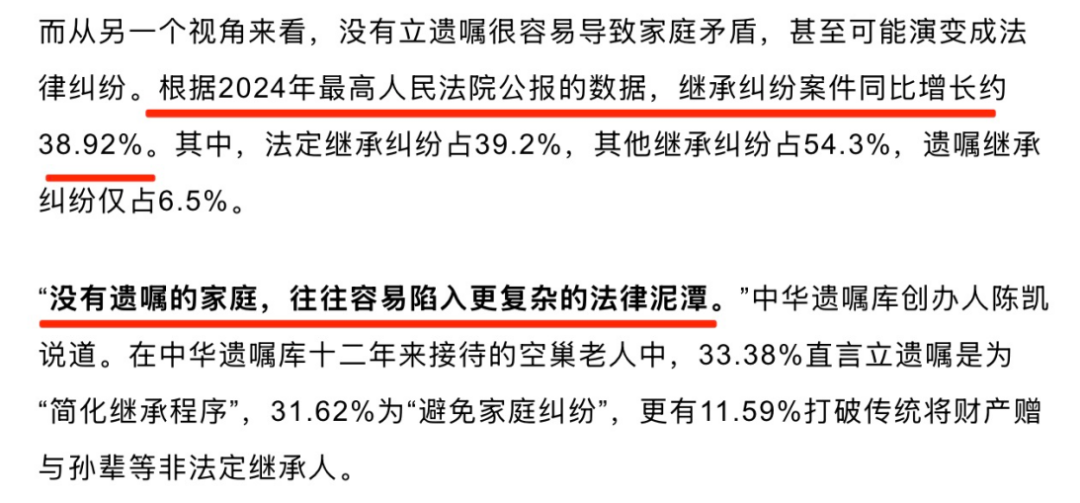
Core Viewpoint - The article discusses the rising trend of "断亲" (cutting ties with relatives) among middle-aged individuals, particularly after the death of parents, highlighting the breakdown of familial bonds and the increase in inheritance disputes as a significant factor in this phenomenon [4][5][9]. Summary by Sections The Rise of "断亲" - Increasingly, middle-aged individuals are choosing to sever ties with siblings, often triggered by the death of parents and subsequent inheritance disputes [4][5]. - The Supreme People's Court reported a year-on-year increase of approximately 38.92% in inheritance dispute cases, indicating a significant rise in familial conflicts [6][7]. Inheritance Disputes - In multi-child families, parents often serve as the last emotional bond among siblings, which dissolves upon their passing, leading to conflicts over inheritance [6][7]. - The low percentage of elderly individuals who have wills (approximately 0.14%) contributes to chaotic inheritance situations, with many families facing "disorderly division" of assets [6][7]. Gender Dynamics in Care and Inheritance - Women often bear a greater burden in caregiving roles, yet traditional views still favor sons in inheritance, leading to feelings of neglect among daughters who have provided more care [8]. - Research indicates that while the influence of birth order on inheritance is diminishing, gender still plays a significant role in how assets are distributed [8]. Social Changes and Family Dynamics - The article notes a broader societal shift towards smaller, more dispersed family structures, with traditional strong familial ties weakening [9][10]. - Urbanization and population mobility have led to many individuals experiencing "passive断亲," where emotional connections fade due to physical distance and reduced contact [10]. Emotional Support and Family Size - Contrary to the belief that having more children leads to greater emotional support for parents, studies show a negative correlation between the number of children and the emotional support received by parents [14]. - The phenomenon of "responsibility dispersion" suggests that with multiple children, the perceived obligation to care for parents is diluted, resulting in less actual support [14]. Changing Nature of Relationships - The article highlights a shift from traditional family structures to "chosen families," where individuals form close bonds with non-relatives, reflecting a broader trend in society [21][22]. - New social networks and support systems are emerging, such as mutual aid groups and co-living arrangements, as people seek meaningful connections beyond blood relations [21][22].

“中年断亲潮”:父母离世,兄弟姐妹就散了
Hu Xiu· 2025-06-24 04:01
Core Viewpoint - The phenomenon of "断亲" (cutting ties) is increasingly observed among middle-aged individuals, reflecting a shift in familial relationships and emotional bonds as traditional family structures evolve [1][2][23]. Group 1: Trends in Family Relationships - The number of inheritance disputes in China has risen significantly, with a reported year-on-year increase of approximately 38.92% [3][5]. - The loss of parents often leads to a breakdown in sibling relationships, as the emotional glue provided by parents is removed, resulting in diminished contact among siblings [4][10]. - The traditional view of "多子多福" (more children means more blessings) is challenged by the reality that having more siblings can lead to increased conflicts and misunderstandings during critical family events [12][15]. Group 2: Gender Dynamics in Family Care - Women are more likely to bear the burden of caregiving for aging parents, yet often find themselves overlooked in inheritance distributions, which tend to favor sons [7][8]. - Research indicates that the gender factor in inheritance distribution is still significant, despite a gradual shift towards more equitable practices [9][10]. Group 3: Societal Changes and Emotional Bonds - The concept of "chosen family" is gaining traction, where individuals form close bonds outside of traditional blood relations, reflecting a broader societal shift towards emotional connections based on choice rather than obligation [29][34]. - Urbanization and population mobility contribute to the weakening of familial ties, leading to a phenomenon where many elderly individuals experience emotional detachment from their relatives [10][26]. Group 4: Implications for Future Relationships - The ongoing transformation in familial relationships suggests a move towards more voluntary and chosen connections, as individuals seek meaningful relationships that are not solely defined by blood ties [34][36]. - The rise of alternative support networks, such as mutual aid groups and co-living arrangements, indicates a reimagining of what constitutes family in contemporary society [33][34].
80后死亡率高是假,心理困境大是真
虎嗅APP· 2025-03-01 04:22
Core Viewpoint - The article discusses the psychological dilemmas faced by the post-80s generation, highlighting their survival and security anxieties rooted in childhood experiences and familial relationships [1][2][3]. Group 1: Psychological Dilemmas - The post-80s generation experiences significant survival and security anxieties, stemming from their childhoods marked by economic struggles and familial pressures [3][4]. - Many in this generation grew up in families that were just beginning to meet basic needs, leading to a deep-seated sense of insecurity and anxiety [4][5]. - The lack of secure attachment figures during childhood has contributed to ongoing psychological issues, as many did not form stable emotional bonds with caregivers [6][7]. Group 2: Cultural Relationships - The post-80s generation is characterized by a strong sense of filial piety, despite having had challenging familial experiences [12]. - There is a cultural shift as their children challenge traditional notions of family loyalty, leading to a growing trend of "cutting ties" with relatives [13][16]. - This generational conflict creates feelings of fear and helplessness among the post-80s, as they worry about being rejected or abandoned by their children [16][24]. Group 3: Parenting Challenges - The post-80s parents often provide materially for their children but struggle with emotional and relational nurturing due to their own upbringing [18][20]. - Many children of the post-80s generation are facing mental health issues, including depression, leading to school dropout and family distress [22][23]. - The inability of post-80s parents to connect emotionally with their children exacerbates the tension in parent-child relationships, resulting in feelings of helplessness [21][24]. Group 4: Pathways to Resolution - To address their psychological dilemmas, the post-80s generation is encouraged to engage in self-reflection and personal growth activities, such as outdoor activities and arts [25]. - Learning from traditional Chinese culture and philosophies can provide insights and coping mechanisms for their emotional struggles [25]. - Building connections with others and helping those in need can foster a sense of community and self-worth, aiding in their psychological healing [25].