自选家庭

Search documents
2025中国消费者价值取向指数观察报告
Sou Hu Cai Jing· 2026-02-20 07:35
Core Insights - The report titled "2025 Chinese Consumer Value Index Observation Report" highlights the evolution of consumer values in China from 2019 to 2025, emphasizing a reconstruction and diversification of consumption values, with significant upgrades across core value dimensions [1][2]. Group 1: Key Consumer Values - The top 10 consumer values for 2025 are family, success, simplicity, recognition, freedom, health, nature, community, safety, and transparency, with family and recognition seeing significant increases in ranking, indicating a stronger consumer demand for emotional connection and self-identity [1][2]. - The concept of family is evolving from traditional paradigms to more emotional and individualized forms, with "self-selected families" becoming a new trend, where emotional connections replace physical cohabitation as the core [1][2]. - The definition of success is shifting from macro to micro, focusing on small, tangible personal achievements, with the value of ordinary workers increasingly recognized by society [1][2]. Group 2: Emerging Trends - Simplicity is no longer just about minimalism but has evolved into a value proposition of "precision is more," where consumers seek accurate and efficient solutions, rejecting information overload [1][2]. - The recognition dimension reflects a shift in consumer evaluation systems, with the rise of private label and affordable alternatives, as consumers are more willing to pay for self-identity, moving the value anchor towards service and experiential consumption [1][2]. - Freedom is being redefined as a sense of control and self-actualization, particularly among younger generations, as seen in trends like civil service examinations and full-time children [2]. Group 3: Health and Nature - Health concerns now exceed 50%, evolving from a focus on clean labels to encompass mental health and emotional value, with traditional wellness practices gaining importance [2]. - Nature has become a reset point for consumers, integrating with outdoor activities as a new status symbol for the middle class, prompting brands to align with authentic values that leverage natural trends [2]. Group 4: Community and Safety - Community dynamics are shifting from goal-oriented to expression-driven, serving as emotional stabilizers and identity transformers for consumers, fulfilling their needs for emotional resonance and self-expression [2]. - The safety dimension emphasizes the need for certainty in life, with an increased trust in national guarantees among consumers [2]. - Transparency, while still a low-discussion topic, has seen significant growth in attention across various fields, indicating a potential demand for this consumer value [2]. Group 5: Industry Implications - These evolving consumer values present new business opportunities across various industries such as automotive, technology, dining, and beauty, necessitating brands to align with consumer value orientations through precise product development, marketing communication, and service experiences [2].

“中年断亲潮”:父母离世,兄弟姐妹就散了
虎嗅APP· 2025-06-26 10:42
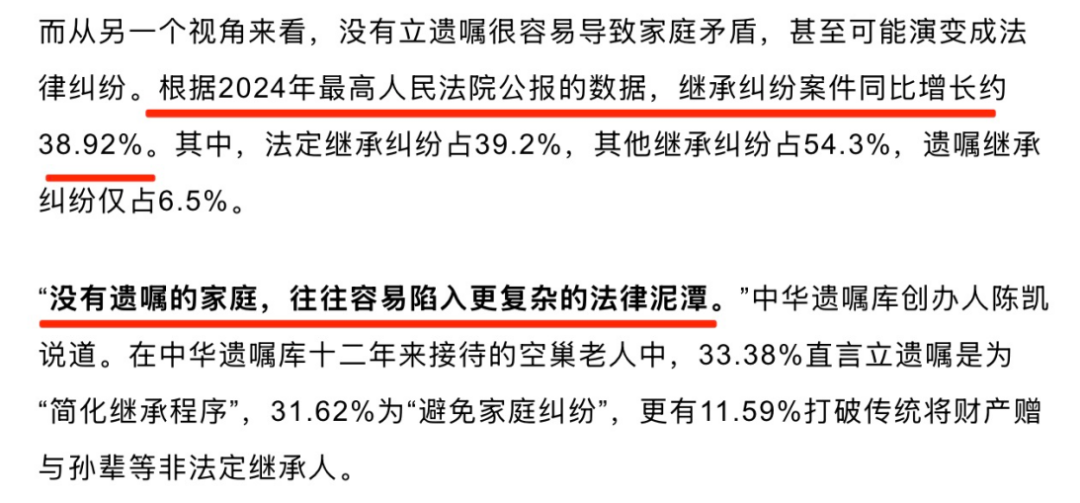
Core Viewpoint - The article discusses the rising trend of "断亲" (cutting ties with relatives) among middle-aged individuals, particularly after the death of parents, highlighting the breakdown of familial bonds and the increase in inheritance disputes as a significant factor in this phenomenon [4][5][9]. Summary by Sections The Rise of "断亲" - Increasingly, middle-aged individuals are choosing to sever ties with siblings, often triggered by the death of parents and subsequent inheritance disputes [4][5]. - The Supreme People's Court reported a year-on-year increase of approximately 38.92% in inheritance dispute cases, indicating a significant rise in familial conflicts [6][7]. Inheritance Disputes - In multi-child families, parents often serve as the last emotional bond among siblings, which dissolves upon their passing, leading to conflicts over inheritance [6][7]. - The low percentage of elderly individuals who have wills (approximately 0.14%) contributes to chaotic inheritance situations, with many families facing "disorderly division" of assets [6][7]. Gender Dynamics in Care and Inheritance - Women often bear a greater burden in caregiving roles, yet traditional views still favor sons in inheritance, leading to feelings of neglect among daughters who have provided more care [8]. - Research indicates that while the influence of birth order on inheritance is diminishing, gender still plays a significant role in how assets are distributed [8]. Social Changes and Family Dynamics - The article notes a broader societal shift towards smaller, more dispersed family structures, with traditional strong familial ties weakening [9][10]. - Urbanization and population mobility have led to many individuals experiencing "passive断亲," where emotional connections fade due to physical distance and reduced contact [10]. Emotional Support and Family Size - Contrary to the belief that having more children leads to greater emotional support for parents, studies show a negative correlation between the number of children and the emotional support received by parents [14]. - The phenomenon of "responsibility dispersion" suggests that with multiple children, the perceived obligation to care for parents is diluted, resulting in less actual support [14]. Changing Nature of Relationships - The article highlights a shift from traditional family structures to "chosen families," where individuals form close bonds with non-relatives, reflecting a broader trend in society [21][22]. - New social networks and support systems are emerging, such as mutual aid groups and co-living arrangements, as people seek meaningful connections beyond blood relations [21][22].
“中年断亲潮”:父母离世,兄弟姐妹就散了
Hu Xiu· 2025-06-24 04:01
Core Viewpoint - The phenomenon of "断亲" (cutting ties) is increasingly observed among middle-aged individuals, reflecting a shift in familial relationships and emotional bonds as traditional family structures evolve [1][2][23]. Group 1: Trends in Family Relationships - The number of inheritance disputes in China has risen significantly, with a reported year-on-year increase of approximately 38.92% [3][5]. - The loss of parents often leads to a breakdown in sibling relationships, as the emotional glue provided by parents is removed, resulting in diminished contact among siblings [4][10]. - The traditional view of "多子多福" (more children means more blessings) is challenged by the reality that having more siblings can lead to increased conflicts and misunderstandings during critical family events [12][15]. Group 2: Gender Dynamics in Family Care - Women are more likely to bear the burden of caregiving for aging parents, yet often find themselves overlooked in inheritance distributions, which tend to favor sons [7][8]. - Research indicates that the gender factor in inheritance distribution is still significant, despite a gradual shift towards more equitable practices [9][10]. Group 3: Societal Changes and Emotional Bonds - The concept of "chosen family" is gaining traction, where individuals form close bonds outside of traditional blood relations, reflecting a broader societal shift towards emotional connections based on choice rather than obligation [29][34]. - Urbanization and population mobility contribute to the weakening of familial ties, leading to a phenomenon where many elderly individuals experience emotional detachment from their relatives [10][26]. Group 4: Implications for Future Relationships - The ongoing transformation in familial relationships suggests a move towards more voluntary and chosen connections, as individuals seek meaningful relationships that are not solely defined by blood ties [34][36]. - The rise of alternative support networks, such as mutual aid groups and co-living arrangements, indicates a reimagining of what constitutes family in contemporary society [33][34].