
新会计准则(IFRS17)

Search documents
2026年首批!两家险企获批发债
21世纪经济报道· 2026-01-05 12:52
Core Viewpoint - The issuance of capital supplementary bonds by China United Life Insurance and Great Wall Life Insurance reflects the challenges faced by the insurance industry in capital management, business expansion, and solvency improvement, amid rising regulatory requirements and changing market conditions [1][3]. Group 1: Regulatory Approvals and Issuance - In early 2026, the National Financial Regulatory Administration approved China United Life to issue up to 570 million yuan and Great Wall Life to issue up to 1 billion yuan in capital supplementary bonds [3]. - The issuance of bonds has been a common practice in the insurance industry, with over 100 billion yuan issued annually for the past three years, indicating a strong demand for capital supplementation [6][7]. Group 2: Financial Health and Capital Management - As of the end of Q3 2025, the comprehensive solvency adequacy ratio of insurance companies was approximately 186.3%, a decrease of 13.1 percentage points from the previous year, while the core solvency adequacy ratio was about 134.3%, down 4.8 percentage points [10]. - The implementation of the new accounting standards (IFRS 17) has posed challenges to capital management, leading to a decline in core solvency ratios and increasing capital requirements for insurance companies [10]. Group 3: Market Conditions and Future Outlook - The low interest rate environment has reduced the cost of financing for insurance companies, making bond issuance more attractive [12][13]. - Despite the current capital supplementation through bond issuance, the long-term sustainability of insurance companies relies on their ability to generate internal capital, as external financing alone may not suffice [11].


年初即“补血”!近三年险企发债规模连破千亿
2 1 Shi Ji Jing Ji Bao Dao· 2026-01-05 11:18
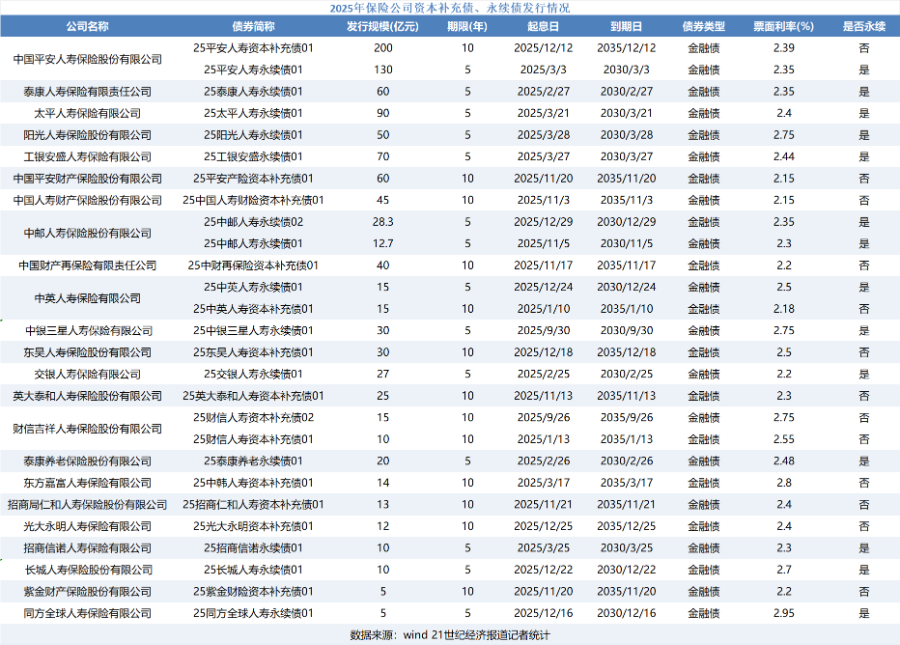
Core Insights - The approval of capital supplement bonds for China United Life Insurance Co. and Great Wall Life Insurance Co. marks the first such issuance in 2026, reflecting ongoing capital pressures in the insurance industry [1][2] - The insurance sector has seen bond issuance exceeding 100 billion yuan annually for the past three years, indicating a trend of capital supplementation driven by regulatory requirements and market conditions [1][4] Regulatory Environment - The issuance of capital supplement bonds is governed by regulations established by the People's Bank of China and the former China Insurance Regulatory Commission, allowing insurance companies to bolster their capital [3] - The "Solvency II Phase II" rules have increased capital management challenges for insurance companies, particularly in a low-interest-rate environment [6][7] Market Dynamics - In 2025, 23 insurance companies issued a total of 1,042 billion yuan in capital supplement and perpetual bonds, with perpetual bonds accounting for 558 billion yuan and capital supplement bonds for 484 billion yuan [4] - The average interest rates for capital supplement and perpetual bonds issued in 2025 did not exceed 3%, with the highest being 2.95% and the lowest at 2.15%, reflecting a favorable borrowing environment [10] Financial Health - As of Q3 2025, the comprehensive solvency adequacy ratio for insurance companies was approximately 186.3%, a decline of 13.1 percentage points from the previous year, indicating increased capital pressure [6] - The core solvency adequacy ratio also decreased by 4.8 percentage points to about 134.3%, highlighting the impact of regulatory changes on capital adequacy [6] Long-term Considerations - While bond issuance provides immediate capital relief, the effective utilization of these funds is crucial for long-term sustainability, especially in a challenging investment environment [8] - The industry faces an "asset shortage," necessitating careful management of capital to ensure that returns cover costs [8]
偿付能力迎大考 险企“补血”金额超千亿
Xin Lang Cai Jing· 2025-12-26 19:01
Core Viewpoint - The insurance industry is experiencing a significant demand for capital replenishment as it approaches the end of 2025, driven by regulatory changes and the need to enhance solvency and capital structure [1][6][8]. Group 1: Capital Replenishment Trends - As of December 24, 2025, the total amount of capital replenishment bonds and perpetual bonds issued and approved by the insurance industry has exceeded 100 billion yuan, continuing the issuance trend from 2024 [1]. - More than ten insurance companies have been approved for capital increases to enhance their capital and solvency [1]. - The issuance of perpetual bonds by various insurance companies has become increasingly prominent, with amounts ranging from 5 million to 90 million yuan [2]. Group 2: Types of Capital Instruments - In addition to perpetual bonds, capital replenishment bonds have also exceeded 50 billion yuan, with significant issuances from companies like Ping An Life and Guangda Yongming Life [3]. - The interest rates for these bonds range from 2.15% to 2.95%, with Ping An Life's issuance being the largest single issuance of 200 billion yuan in 2025 [3][4]. Group 3: Financing Strategies - Insurance companies are primarily using equity and debt financing to replenish capital, with debt financing being attractive due to lower interest rates and minimal dilution of shareholder equity [4]. - The issuance of bonds helps alleviate short-term capital pressures and provides financial buffers for strategic adjustments and business upgrades [4]. Group 4: Regulatory Impact - The upcoming end of the transition period for the "Second Generation" solvency rules and the new accounting standards will increase capital constraints, driving insurance companies to adjust their asset-liability structures [6][7]. - The new accounting standards will lead to a reclassification of many debt assets, increasing the correlation between net assets and interest rate fluctuations, thereby affecting solvency levels [8]. Group 5: Capital Increase Activities - Several insurance companies have engaged in capital increases through public offerings, with notable examples including Guomin Pension and Huagui Life, which are raising significant amounts to enhance their capital bases [5]. - The capital increase strategies are aimed at strengthening partnerships and developing inclusive pension financial products [5].
