新域新质教育

Search documents
探索延长义务教育年限,一图读懂“十五五”里的北京教育红利
Xin Jing Bao· 2025-11-26 07:53
Core Viewpoint - The Beijing education system will focus on "systematic leap" and comprehensive reform over the next five years, aiming to build a high-quality education system that supports national strategies and the capital's "four center" functions [1] Group 1: Educational Structure and Reform - The adjustment of key educational transition points, such as from primary to secondary school, will transform these stages into "launching pads" and "boosters" for student growth, enhancing the efficiency of basic education [2] - A new model of educational group management will be promoted, allowing for better resource allocation and curriculum innovation across different educational stages [2] Group 2: New Educational Ecosystem - The concept of "new domain and new quality" will be explored, extending educational resources beyond traditional school settings to include community parks and social science education bases [4] - Higher education will increasingly involve real-world research and industry engagement, allowing students to participate in practical projects and solve real problems [5] Group 3: Expansion of Educational Access - The range of free education will be gradually expanded, with a focus on improving the structure and quality of educational supply, including the potential extension of compulsory education [6] - Emphasis will be placed on enhancing the quality of higher education and aligning academic programs with national strategic needs and key industries in Beijing [6] Group 4: Innovation and Talent Development - A systematic approach to enhancing science education will be implemented, focusing on reducing rote memorization and increasing hands-on experimental learning [9] - The "Wotu Plan" will be introduced to nurture talented students from basic education through to higher education, ensuring early and continuous support for potential high achievers [9] Group 5: Health and Engagement Initiatives - The success of educational reforms will be measured by improvements in student health, interest in learning, and innovative practical abilities, with plans to host 400,000 "class super" competitions to engage all students [11]


中小学科技教育有哪些重要改变
Bei Jing Ri Bao Ke Hu Duan· 2025-11-25 22:53
Core Viewpoint - The Ministry of Education and six other departments have issued guidelines to strengthen science and technology education in primary and secondary schools, aiming to create a comprehensive educational framework that fosters students' scientific interest and spirit across all educational stages [1][2]. Group 1: Cultivating Scientific Interest and Spirit - The guidelines emphasize a coherent educational goal across all school stages, with specific focuses: early grades on sensory experience and interest cultivation, middle grades on concept understanding and hands-on exploration, junior high on practical inquiry and technology application, and high school on experimental inquiry and engineering practice [1][2]. - Schools are encouraged to develop project-based learning (PBL) courses that integrate knowledge from various subjects while respecting students' growth patterns [2][3]. Group 2: Curriculum Design - The guidelines advocate for innovative curriculum ecosystems that integrate science, technology, engineering, and mathematics (STEM) to enhance students' interdisciplinary skills and innovation capabilities [3][4]. - Schools are developing specialized courses in fields like artificial intelligence, energy and environment, life sciences, and space exploration, ensuring that core competencies are effectively taught [4]. Group 3: Teaching Methods - The guidelines propose transforming teaching methods by implementing a "dual-teacher classroom" model, combining scientists and teachers, and utilizing advanced technologies like virtual laboratories [5][6]. - Schools are adopting project-based learning that emphasizes real-world problem-solving, thereby enhancing students' scientific interest and practical skills [5][6]. Group 4: Evaluating Learning Outcomes - The guidelines introduce the concept of a "digital portrait of scientific literacy," which aims to provide a multifaceted evaluation of students' learning processes beyond traditional exams [8][9]. - Schools are exploring various evaluation methods, including engineering logs and research notes, to reflect students' growth and problem-solving processes [9][10]. Group 5: Challenges and Recommendations - Current challenges in science and technology education include outdated teaching methods, insufficient interdisciplinary integration, lack of evidence-based learning, and uneven distribution of educational resources [11][12]. - Recommendations for improvement include promoting interdisciplinary course integration, enhancing practical and exploratory aspects of the curriculum, and optimizing teacher training and resource allocation [12].
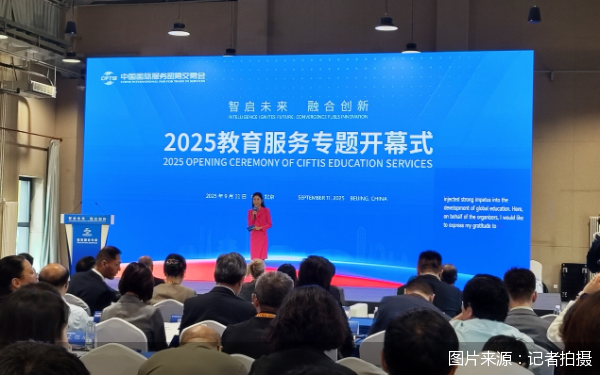
2025服贸会丨教育服务专题开幕:系列智能体落地 北京留学生总规模位居全国第一
Bei Jing Shang Bao· 2025-09-11 15:27
Core Insights - The 2025 Service Trade Fair's education segment focuses on "AI Education+", "Bilateral Study Abroad", and the transformation of university scientific achievements, showcasing Beijing's educational service advancements [1][5] Group 1: AI Education - The "AI Education+" exhibition has become a key attraction, featuring innovative applications of AI in education [3] - A new framework for AI-driven educational consumption was launched, including high-quality educational datasets and the "Jingwa" intelligent service series [3] - Solutions like "Jingxiao Jian" and "Jingxiao Zhuang" integrate various functionalities to enhance personalized learning and smart campus experiences [3] Group 2: Technology Transfer - The establishment of the National University Regional Technology Transfer Center (Beijing) aims to facilitate efficient conversion and industrialization of university scientific achievements [5] - Haidian District is highlighted as a leading innovation platform in AI, with 95 registered large models, accounting for over 70% of the city's total [5] - Fangshan District focuses on green energy, addressing challenges in the conversion of university scientific achievements [5] Group 3: International Education - The "Study in Beijing" promotional system was launched, expanding from a single platform to a comprehensive global network [6] - Beijing hosts over 50,000 international students from 184 countries, the largest scale in China [6] - The city ranks 13th globally in the QS Best Student Cities, enhancing its appeal as a study destination [6] Group 4: Future Plans - Future initiatives will enhance the "Study in Beijing" system, focusing on promotion, enrollment, branding, scholarships, and management services [7] - The aim is to improve international students' understanding and integration into Beijing [7] Group 5: Educational Reform - The education system in Beijing is adapting to changes by promoting a "reduced" development model and integrating AI deeply into educational practices [8] - The emergence of new educational service forms is driven by the need for high-quality educational services [10] - The conference introduced new educational service outcomes and project signings to align with digital and intelligent development trends [10]
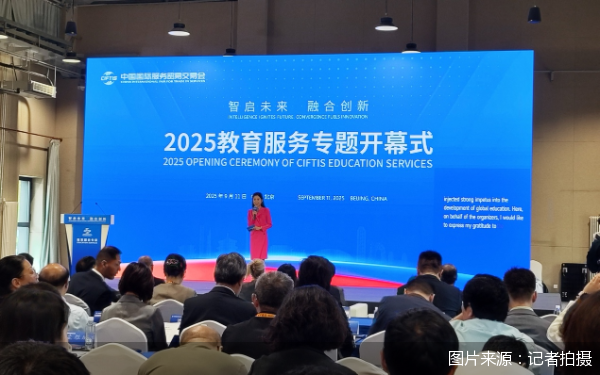
教育服务专题开幕:系列智能体落地,北京留学生总规模位居全国第一
Bei Jing Shang Bao· 2025-09-11 15:02
Group 1 - The 2025 Education Service Trade Fair focuses on "AI Education+" and aims to showcase cutting-edge educational services and practices in Beijing [1] - The "AI Education+" exhibition area has become a key highlight, featuring innovative AI-driven educational solutions and the launch of a new consumption framework [2] - The establishment of the National University Regional Technology Transfer Center in Beijing aims to enhance the efficient transformation and industrialization of university scientific achievements [2] Group 2 - Beijing has over 50,000 international students from 184 countries, making it the largest scale in the country, and plans to further innovate exchange mechanisms to attract talent [1][4] - The "Study in Beijing" promotional system has been launched, expanding from a single platform to a multi-dimensional network, and Beijing ranks 13th globally in the QS Best Student Cities [4][5] - The education system in Beijing is adapting to changes by integrating AI deeply into educational practices, promoting a new paradigm of "AI Education+" [3][7]
2025服贸会丨教育服务专题开幕:系列智能体落地,北京留学生总规模位居全国第一
Bei Jing Shang Bao· 2025-09-11 13:50
Core Insights - The 2025 Education Service Trade Fair in Beijing focuses on "AI Education+", "Bilateral Study Abroad", and the transformation of university scientific achievements, showcasing cutting-edge results and benchmark practices in education services [1][5] - The "AI Education+" exhibition area has become a highlight, featuring innovative scenarios powered by artificial intelligence, including the launch of a new consumption framework driven by AI [3][5] - The "Study in Beijing" promotional system has been officially launched, expanding its reach globally and enhancing the city's appeal as a top destination for international students [6][7] Group 1: AI Education and Innovation - The "AI Education+" exhibition area showcases various AI-driven educational innovations, including personalized health development models and integrated smart campus solutions [3][5] - The establishment of the National University Regional Technology Transfer Center in Beijing aims to facilitate the efficient transformation and industrialization of university scientific achievements [5] - Beijing's education system is adapting to changes by integrating AI deeply into educational practices, promoting a new paradigm of education [8][10] Group 2: International Education and Talent Attraction - Beijing hosts over 50,000 international students from 184 countries, making it the largest scale in the country [6][7] - The "Study in Beijing" initiative includes a comprehensive promotional network and various events to attract and retain international students [6][7] - Future plans involve enhancing the promotional, recruitment, and service systems for international students to foster better integration and collaboration with foreign universities [7]