
中小学科技教育

Search documents
加强中小学科技教育 培育科技创新后备力量
Yang Shi Wang· 2026-02-01 02:26
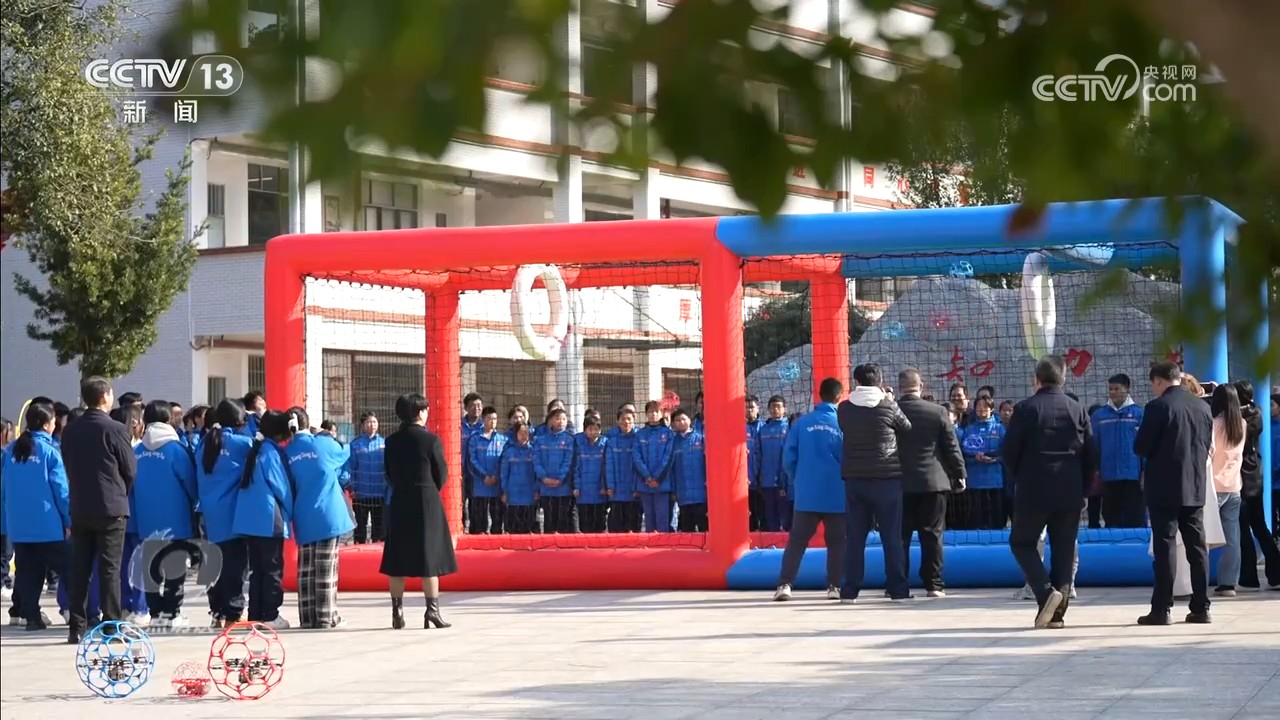
Core Viewpoint - The article emphasizes the importance of strengthening science and technology education in primary and secondary schools to foster innovation and competitiveness in the nation [1]. Group 1: Current Initiatives in Science and Technology Education - The Ministry of Education and six other departments issued a document in November 2025 to enhance science and technology education in schools, encouraging students to think like scientists and practice like engineers [1]. - In Yongzhou, Hunan, a rural school, students engage in drone soccer, showcasing hands-on technology education that has evolved significantly over the past decade [1][2]. - The local education authority has allocated 6 million yuan annually for science education, enabling schools to establish various technology clubs, including drone and robotics teams [3]. Group 2: Challenges and Developments in AI Education - Despite the push for AI education in schools, there is a lack of unified curriculum standards and supporting materials across the country, leading to varied local implementations [4]. - In Inner Mongolia, a "seed teacher" team has been formed to promote AI education, but challenges remain in teacher training and hardware support [5]. - The introduction of AI education is seen as crucial for developing high-quality talent and enhancing national technological competitiveness [6]. Group 3: Diverse Approaches to Technology Education - In Hangzhou, schools are integrating advanced technologies into the curriculum, such as AI assistants in cooking classes, which personalize learning experiences [6][7]. - The article highlights various regional approaches to technology education, from rural explorations to systematic implementations in urban areas, all aiming to cultivate curiosity and innovation among students [7].
焦点访谈|加强中小学科技教育 培育科技创新后备力量
Yang Shi Wang· 2026-01-31 13:22
Core Viewpoint - The article emphasizes the importance of strengthening science and technology education in primary and secondary schools as a means to foster national development and innovation, highlighting various successful initiatives across different regions in China [1][3]. Group 1: Initiatives in Science and Technology Education - The Ministry of Education and six other departments issued a directive in November 2025 to enhance science and technology education in schools, aiming to transform educational methods and encourage hands-on learning [1]. - In Yongzhou, Hunan, a rural school, Yaoxiang Middle School, has developed a range of technology projects, including drone soccer and programming robots, which began with a modest investment of 5,000 yuan in 2015 [3][5]. - The success of Yaoxiang Middle School has inspired other schools in the region to adopt similar technology education initiatives, supported by a dedicated annual budget of 6 million yuan from the local education bureau for technology education [5][7]. Group 2: Broader Trends in Technology Education - Technology education is evolving beyond traditional competitions to include interdisciplinary project-based learning and collaborative scientific practices, integrating various forms of technology into daily teaching [7][11]. - In Baotou, Inner Mongolia, AI education has been introduced in classrooms, with a pilot program for AI courses set to begin in the 2025 academic year, despite challenges in standardization and resource allocation [9][11]. - In resource-rich cities like Hangzhou, innovative technology education is being implemented, utilizing AI tools in cooking classes and engineering practices, fostering curiosity and exploration among students [11][13]. Group 3: Future Implications and Challenges - The article highlights the need for a systematic approach to technology education, addressing challenges in teacher training, curriculum development, and evaluation systems to ensure equitable access to quality education [9][13]. - The overarching goal is to cultivate a generation of students who think like scientists and create like engineers, thereby enhancing China's future technological competitiveness [9][13].

2025年度中国基础教育十大关键词揭晓
Xin Hua Wang· 2026-01-05 04:19
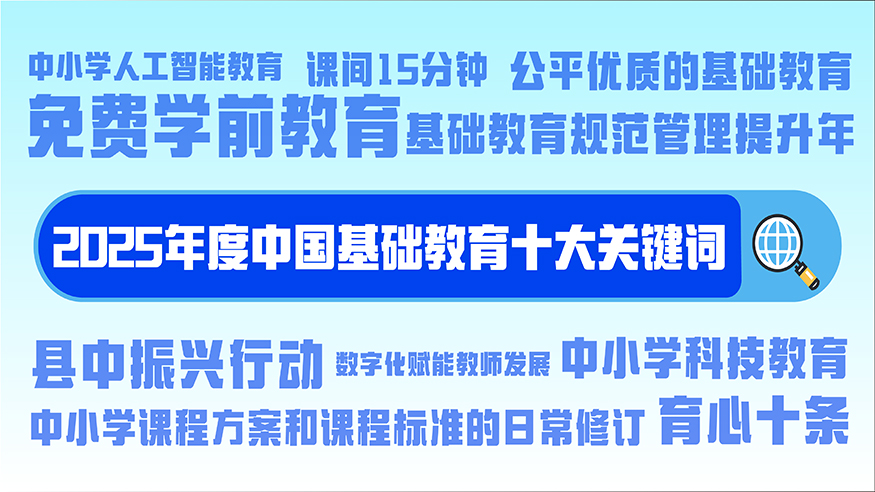
Core Viewpoint - 2025 is a crucial year for implementing the spirit of the National Education Conference and the "Education Power Construction Plan Outline (2024-2035)", focusing on building a fair and high-quality basic education system [2] Group 1: Key Developments in Basic Education - The Ministry of Education's Basic Education Department has guided the selection of the "Top Ten Keywords in China's Basic Education for 2025" to summarize significant events and trends in the field [2] - The "Top Ten Keywords" include: fair and high-quality basic education, free preschool education, county-level high school revitalization actions, artificial intelligence education in primary and secondary schools, and daily revisions of curriculum plans and standards [3][4][6][8][10][11] Group 2: Policy Initiatives and Goals - The "Education Power Construction Plan Outline" emphasizes the establishment of a fair and high-quality basic education system as a key goal, addressing issues of educational quality and equity [19] - The government plans to gradually implement free preschool education starting from the 2025 autumn semester, which is a significant step towards improving public education services and promoting educational equity [22] - The "County-Level Ordinary High School Revitalization Action Plan" aims to address resource allocation, teaching quality, and support mechanisms in county-level high schools, with specific goals and actions outlined for improvement [24] Group 3: Technological Integration and Curriculum Development - The introduction of artificial intelligence education is seen as a transformative step in cultivating high-quality talent, with guidelines released for comprehensive AI education across all school levels [25] - The Ministry of Education has revised curriculum plans and standards to incorporate innovative theories and enhance the focus on science, engineering, and AI education [27] - Digital empowerment initiatives for teacher development are being implemented to enhance digital literacy and adapt to new teaching methodologies [36] Group 4: Student Well-being and Health - The implementation of a 15-minute break between classes is aimed at promoting holistic student development, addressing health issues such as obesity and eye strain [30] - Measures to strengthen mental health support for students have been introduced, focusing on alleviating exam-related anxiety and ensuring adequate physical activity [32] Group 5: Governance and Management Improvements - The "Normative Management Improvement Year" initiative aims to enhance the governance and management of basic education, addressing issues that violate educational regulations and harm public interests [37]
中小学科技教育有哪些重要改变
Bei Jing Ri Bao Ke Hu Duan· 2025-11-25 22:53
Core Viewpoint - The Ministry of Education and six other departments have issued guidelines to strengthen science and technology education in primary and secondary schools, aiming to create a comprehensive educational framework that fosters students' scientific interest and spirit across all educational stages [1][2]. Group 1: Cultivating Scientific Interest and Spirit - The guidelines emphasize a coherent educational goal across all school stages, with specific focuses: early grades on sensory experience and interest cultivation, middle grades on concept understanding and hands-on exploration, junior high on practical inquiry and technology application, and high school on experimental inquiry and engineering practice [1][2]. - Schools are encouraged to develop project-based learning (PBL) courses that integrate knowledge from various subjects while respecting students' growth patterns [2][3]. Group 2: Curriculum Design - The guidelines advocate for innovative curriculum ecosystems that integrate science, technology, engineering, and mathematics (STEM) to enhance students' interdisciplinary skills and innovation capabilities [3][4]. - Schools are developing specialized courses in fields like artificial intelligence, energy and environment, life sciences, and space exploration, ensuring that core competencies are effectively taught [4]. Group 3: Teaching Methods - The guidelines propose transforming teaching methods by implementing a "dual-teacher classroom" model, combining scientists and teachers, and utilizing advanced technologies like virtual laboratories [5][6]. - Schools are adopting project-based learning that emphasizes real-world problem-solving, thereby enhancing students' scientific interest and practical skills [5][6]. Group 4: Evaluating Learning Outcomes - The guidelines introduce the concept of a "digital portrait of scientific literacy," which aims to provide a multifaceted evaluation of students' learning processes beyond traditional exams [8][9]. - Schools are exploring various evaluation methods, including engineering logs and research notes, to reflect students' growth and problem-solving processes [9][10]. Group 5: Challenges and Recommendations - Current challenges in science and technology education include outdated teaching methods, insufficient interdisciplinary integration, lack of evidence-based learning, and uneven distribution of educational resources [11][12]. - Recommendations for improvement include promoting interdisciplinary course integration, enhancing practical and exploratory aspects of the curriculum, and optimizing teacher training and resource allocation [12].
划重点!中小学科技教育将有这些新变化
Xin Hua She· 2025-11-13 13:41
Core Viewpoint - The recent joint issuance of opinions by seven departments aims to strengthen science and technology education in primary and secondary schools, focusing on enhancing students' innovative capabilities from a young age [1] Group 1: Educational Framework - The opinions follow the cognitive development of students and aim to establish a "step-by-step" educational system, starting from basic education to systematically improve youth's science and technology innovation abilities [2] - In primary education, the focus is on igniting curiosity through life-related and game-based scenarios; in middle school, the emphasis is on solving real problems through interdisciplinary project-based learning; and in high school, students are encouraged to engage with cutting-edge technology and conduct experimental inquiries [2] Group 2: Curriculum and Learning Methods - The opinions propose specific requirements to promote educational reform by emphasizing interdisciplinary integration, nurturing humanistic feelings while exploring scientific laws, and fostering rational thinking and innovative spirit through humanistic immersion [3] - There is a call to enhance the conversion of cutting-edge scientific achievements into teaching resources and to develop high-quality science and technology education curriculum resources [3] - Students are encouraged to take initiative in learning, engage in discussions, conduct hands-on experiments, and apply multidisciplinary knowledge and skills to solve problems [3] Group 3: Collaborative Efforts - The implementation of enhanced science and technology education in primary and secondary schools requires collaboration from various sectors to form a cohesive effort [4] - Current challenges in primary science education include a lack of professional teachers, limited practical venues, and fragmented curriculum resources; the opinions provide clear requirements to strengthen the teaching workforce and promote collaborative education [4] Group 4: Resource Integration - The China Association for Science and Technology will continue to strengthen the co-construction and sharing of science education resources both inside and outside schools, promoting high-quality development in science education [5]
教育部详解《关于加强中小学科技教育的意见》 “引导学生像科学家一样思考、像工程师一样实践”
Zhong Guo Qing Nian Bao· 2025-11-13 07:12
Core Viewpoint - The Ministry of Education and seven other departments have issued the "Opinions on Strengthening Science and Technology Education in Primary and Secondary Schools," aiming to enhance students' engagement in science and technology by establishing a comprehensive educational framework by 2030 and a fully developed ecosystem by 2035 [1][2]. Group 1: Educational Framework and Goals - By 2030, a basic science and technology education system will be established in primary and secondary schools, with improved curriculum, teaching reforms, and a robust evaluation and support system [1][2]. - By 2035, a comprehensive science and technology education ecosystem will be built, with project-based, inquiry-based, and interdisciplinary teaching methods widely applied, enhancing students' practical problem-solving skills [1][2]. Group 2: Curriculum Development - The curriculum will focus on different educational stages: early primary grades will emphasize experiential learning and interest cultivation, while later stages will focus on concept understanding and hands-on exploration [2]. - Middle school will emphasize practical inquiry and technology application, while high school will focus on experimental inquiry and engineering practice, encouraging students to engage with cutting-edge technology [2]. Group 3: Teaching Methods and Evaluation - The "Opinions" advocate for innovative teaching methods, including tailored educational plans for schools and the exploration of dual-teacher classrooms and future classrooms utilizing advanced technologies [3]. - A reform in evaluation methods is proposed, emphasizing diverse and developmental assessments rather than solely exam-based evaluations, with a focus on tracking students' innovation capabilities [3]. Group 4: Teacher Training and Development - The "Opinions" call for integrating science and technology education into teacher training programs, with a focus on cultivating interdisciplinary educators through master's programs and specialized training [4]. - Support will be provided for higher education institutions and research organizations to involve experts in primary and secondary school science and technology education [4].
打破“学校围墙”构建生态系统,教育部强调中小学科技教育重在实践
Hua Xia Shi Bao· 2025-11-13 00:29
Core Viewpoint - The recent issuance of the "Opinions on Strengthening Science and Technology Education in Primary and Secondary Schools" by the Ministry of Education and six other departments emphasizes the urgent need for innovation talent in the context of a new round of technological revolution and industrial transformation, highlighting the importance of enhancing science and technology education at the primary and secondary school levels to support national innovation-driven development strategies [1] Group 1: Key Tasks and Implementation - The "Opinions" propose six key tasks aimed at achieving a new structure through interdisciplinary integration, a new engine through engineering practice, and a new ecosystem through collaborative openness, encouraging students to think like scientists and practice like engineers [1] - The Ministry of Education has reported positive progress in science and technology education, with improvements in curriculum systems, teaching reforms, teacher quality, and activity platforms [2][3] Group 2: Regional Initiatives and Achievements - Zhejiang Province has integrated general technology and information technology into the college entrance examination and has maintained a comprehensive science curriculum for 37 years, showcasing a commitment to science and technology education [3] - The implementation of the "Three Advances and Three Enhancements" initiative in Hunan Province has led to significant advancements in technology education, including the establishment of a 300 square meter intelligent robotics education laboratory [2] Group 3: Future Goals and Strategies - By 2030, the goal is to establish a basic framework for science and technology education in primary and secondary schools, with a comprehensive ecosystem expected by 2035, focusing on practical, inquiry-based, and interdisciplinary teaching methods [4] - The Ministry of Education plans to guide local schools in integrating science and technology education into their educational reforms, encouraging pilot programs to address challenges such as resource shortages and teacher capacity [5]
改革中小学科技教育,创新从娃娃抓起
Nan Fang Du Shi Bao· 2025-11-13 00:27
Core Viewpoint - The recent issuance of the "Opinions on Strengthening Science and Technology Education in Primary and Secondary Schools" by seven departments, including the Ministry of Education, signifies a commitment to enhance STEM education in China, aiming to cultivate innovative talents and support high-quality development in education, technology, and talent integration [1][2]. Group 1: Focus on STEM Education - The "Opinions" emphasize the importance of practical experience in science and technology education, advocating for the optimization of teaching spaces to provide students with real-world exploration and engineering practice opportunities [1][2]. - The traditional knowledge-based, subject-segregated approach to science education is deemed insufficient for nurturing innovative and interdisciplinary talents, necessitating reforms that begin from early childhood education [1][2]. Group 2: Developmental Framework - A "stair-step" educational system is proposed, tailored to the cognitive characteristics of students at different educational stages, promoting engagement through life and game-based scenarios in elementary school, problem-solving in middle school, and experimental inquiry in high school [2][3]. - The integration of disciplines is a key feature, requiring a coordinated approach to resources across science, technology, engineering, and mathematics, focusing on real-world issues rather than isolated subject knowledge [2][3]. Group 3: Collaborative Implementation - The "Opinions" highlight the need for an "open collaboration" model, encouraging partnerships between schools, families, communities, technology companies, and non-profit organizations to enhance technology education projects [3]. - This collaborative approach aims to bridge the gap between classroom knowledge and real-world applications, addressing the disconnect between educational content and societal needs [3].
中小学科技教育要防止功利化倾向
Bei Jing Qing Nian Bao· 2025-11-12 23:29
Core Viewpoint - The Ministry of Education and six other departments have jointly issued guidelines to strengthen science and technology education in primary and secondary schools, aiming to cultivate innovative talents and support high-quality integrated development in education, science, and talent [1] Group 1: Key Tasks - The guidelines outline six key tasks, including the construction of a collaborative and integrated education system, emphasizing the synergy between science education and humanities education [2] - It calls for the development of an open and integrated curriculum ecosystem, reshaping the teaching ecology through interdisciplinary integration [2] - The establishment of a comprehensive evaluation mechanism for science education is highlighted, promoting the integration of research and teaching [2] Group 2: Educational Approach - The guidelines emphasize a gradual and connected process for cultivating scientific literacy across different educational stages, with specific focuses for each stage from early childhood to high school [3] - Schools are encouraged to develop tailored implementation plans based on real-world problem-solving, utilizing project-based learning and inquiry-based methods [3] - Innovative teaching models such as "dual-teacher classrooms" and "future classrooms" using cutting-edge technologies like virtual labs are promoted [3]
国际油价闪崩4%!黄金涨破4200美元;事关“免密支付” 中国支付清算协会发声;“AI才女”罗福莉加入小米丨每经早参
Mei Ri Jing Ji Xin Wen· 2025-11-12 22:17
Market Overview - US stock indices closed mixed, with the Dow Jones up 0.68% reaching a new closing high, while the Nasdaq fell 0.26% and the S&P 500 rose 0.06% [5] - European indices all rose, with Germany's DAX up 1.22%, France's CAC40 up 1.04%, and the UK's FTSE 100 up 0.12% [8] - International gold prices increased, with spot gold rising 1.62% to $4193.51 per ounce [6] - International oil prices dropped significantly, with WTI crude down 4.28% to $58.43 per barrel and Brent crude down 3.84% to $62.66 per barrel [7] Company News - CATL reported lithium battery exports of 116 GWh in the first three quarters of 2025, with R&D investment exceeding 15 billion yuan [16][17] - Xiaomi announced the recruitment of AI talent, with 95 post-90s AI expert Luo Fuli joining the company to lead AI model research [18] - Luckin Coffee's CEO stated the company is preparing to relist on the US main board, which could enhance its brand image and growth potential [19] - Anthropic, an AI startup backed by Google, plans to invest $50 billion in building data centers in the US, creating approximately 800 permanent jobs [20] - ByteDance terminated an employee for leaking confidential information, raising concerns about information security within the company [21] - Chery Automobile faced a public incident involving a vehicle challenge at Tianmen Mountain, which could impact its brand image [23] - JA Solar clarified that its board secretary did not make any statements regarding circulating rumors, aiming to restore investor confidence [25][24] - Tianqi Lithium announced that a Chilean court dismissed its lawsuit, which may affect its business operations in Chile [26] - North Medical's chairman was arrested for criminal charges, but the company stated that its operations remain normal [27] Industry Developments - The Chinese government is promoting the integration of renewable energy industries, encouraging the establishment of low-carbon parks [10] - The Ministry of Education and six other departments issued guidelines to strengthen science and technology education in primary and secondary schools by 2030 [9] - The China Securities Regulatory Commission reported that foreign investors now hold over 3.5 trillion yuan in A-shares, reflecting the ongoing opening of China's capital markets [14]
