旅游行业内卷

Search documents
携程集团副总裁秦静:做好入境游,做大国内旅游市场
Zhong Guo Jing Ying Bao· 2025-09-25 02:19
Core Insights - The fastest way to address the issue of "involution" in the tourism industry is to expand the domestic tourism market by attracting more consumers, particularly through inbound tourism [1][3] Group 1: Market Dynamics - The supply of high-end hotels in China has been growing steadily at an annual rate of 12% to 13% over the past two years, with an expected increase to 14% this year [3] - There is a significant imbalance between supply and demand in the domestic tourism market, leading to intensified homogeneous competition, which is a phenomenon the government aims to mitigate [3] Group 2: Company Strategies - The company is focusing on three main strategies to effectively capture customers in the international market: 1. **Operational Localization**: Unlike many overseas apps that only switch languages, the company tailors its services to meet local user preferences, such as providing specific hotel features for Japanese users and halal dining options for Muslim travelers [3][4] 2. **Service Capability**: The company employs approximately 15,000 customer service staff globally, offering 24/7 human support and has integrated AI technology to enhance the efficiency of addressing issues faced by inbound travelers [4] 3. **Supply Chain Empowerment**: The company assists businesses in better capturing inbound tourism opportunities by translating hotel information into over 20 languages and integrating AI plugins to enable real-time responses to inquiries in multiple languages [4] Group 3: Industry Goals - The company aims to continuously expand the domestic tourism market, support ecosystem partners in attracting international traffic, and promote high-quality growth in the industry while avoiding low-level competition [4]



父母邦旅行爆雷了
Hu Xiu· 2025-08-28 23:56
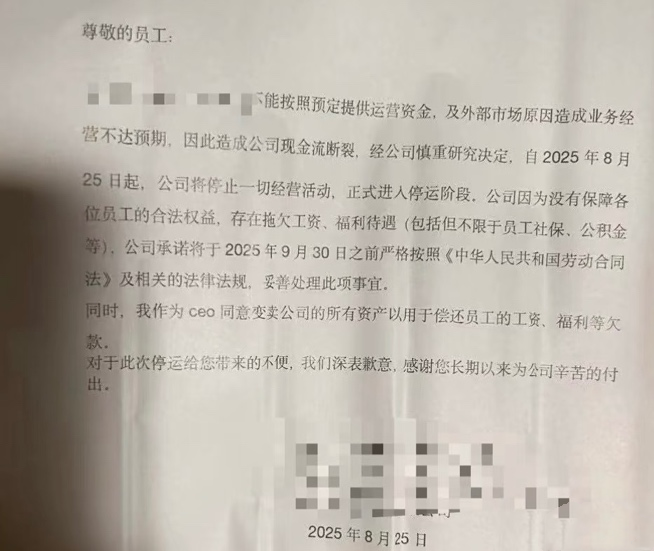
Group 1 - The core issue is that the parent-focused travel company, 父母邦旅行, has declared bankruptcy and will cease operations starting August 25, 2025, due to cash flow problems and unmet business expectations [2][10][32] - The company has acknowledged that it owes employees wages and has committed to resolving these issues by September 30, 2025, including selling all assets to pay off debts [3][21] - The company has faced a surge in refund requests from consumers, leading to significant operational challenges and ultimately contributing to its downfall [11][20][27] Group 2 - 父母邦旅行 has been unable to process refunds efficiently, with reports of consumers waiting up to nine months for refunds, which has led to widespread dissatisfaction [13][15][19] - The company is also in debt to numerous travel suppliers, with claims of over 2 million yuan owed, and is facing multiple lawsuits from these suppliers [21][24][26] - The competitive landscape in the parent-child travel market has intensified, with many small platforms struggling to survive amid aggressive pricing strategies from larger competitors [27][28][31]
旅游业深陷线路与价格“内卷”,导游称游客难辨好坏|反内卷风暴
Sou Hu Cai Jing· 2025-07-10 14:48
Core Viewpoint - The tourism industry is facing severe "involution," necessitating self-rescue by companies as highlighted by industry leaders [2][6] Group 1: Industry Challenges - The central government has emphasized the need to combat low-price disorderly competition and improve product quality in the tourism sector [2][6] - The phenomenon of "involution" manifests through homogeneous competition across various dimensions, including products, pricing, and marketing [2][4] - Price competition has escalated to a point where many companies engage in "loss-leader" strategies, leading to a decline in service quality [4][5] Group 2: Market Dynamics - The number of travel agencies has increased significantly, from 56,275 in 2023 to 64,616 in 2024, while revenue growth has not kept pace, indicating a supply-demand imbalance [6][7] - The average revenue for travel agencies rose from 4,442.7 billion yuan in 2023 to 5,657.7 billion yuan in 2024, but profits remained relatively stagnant [6][7] Group 3: Consumer Behavior - Tourists are increasingly seeking personalized and thematic travel experiences, yet the market lacks sufficient offerings to meet these demands [7][8] - The rise of free travel has pressured traditional group tours, which are often unable to adapt to changing consumer preferences [6][9] Group 4: Innovation and Competition - Many companies are hesitant to innovate due to tight cash flow and declining profits, leading to a reliance on low-cost strategies [7][8] - The lack of copyright protection for travel products exacerbates the issue, as successful innovations are easily replicated by competitors [7][8] Group 5: Recommendations for Improvement - Experts suggest that the tourism industry needs reforms in technology, sales channels, and personnel training to create a fair and orderly market environment [10][11] - Enhancing service quality through employee training and establishing a reward system for high service standards is crucial for improving customer satisfaction [10][11]