晶圆产能

Search documents
全球芯片产能分布,仅供参考
半导体行业观察· 2025-12-29 01:53
Core Insights - The OECD report highlights the geographical distribution of wafer fabrication capacity, indicating that five major economies (China, Taiwan, South Korea, Japan, and the USA) account for 87% of global wafer production capacity as of September 2025 [2][6]. Geographical Distribution of Production Capacity - The report illustrates the concentration of production capacity by technology node, with South Korea having nearly 80% of its capacity in the 6nm to less than 22nm range, primarily due to investments from major suppliers like SK Hynix and Samsung [5][6]. - In contrast, the USA's wafer production capacity is more diversified across various technology nodes [6]. Concentration of Production Capacity Among Companies - The top ten semiconductor companies account for approximately 50% of global wafer production capacity [7]. - In Japan, five companies dominate with over 3 million wafer production capacity, representing 58% of the country's total [7]. Planned and Under Construction Capacity Growth - The majority of capacity investments are concentrated in the largest semiconductor-producing economies, driven by major companies operating in those regions [10]. - The USA, China, South Korea, Taiwan, Japan, Germany, and Singapore are identified as the countries with the largest expected capacity growth [10]. Wafer Capacity by Chip Type - The report emphasizes that assessing wafer capacity distribution requires considering both technology nodes and chip types, revealing significant differences in production capabilities [12][19]. - China and Taiwan rank among the top five producers for all six chip types analyzed, with the USA and Japan following closely [19]. Expansion Potential by Chip Type - Capacity expansion potential varies significantly across chip types and economies, with notable growth in power chips and analog chips primarily occurring in China [21][22]. - The USA leads in advanced logic chip capacity growth, while South Korea shows the largest increase in general storage chip capacity [22]. Mixed Manufacturing Capabilities - Many fabs can produce multiple chip types, complicating the analysis of geographical distribution based on chip types [25][28]. - The prevalence of mixed-capacity fabs, especially in the analog and mature logic chip sectors, presents challenges in evaluating market capacity [28]. Average Wafer Fab Size by Chip Type - The average size of fabs varies by chip type, with power, analog, and mature logic chips averaging between 30,000 to 50,000 WSPM, while advanced logic and general storage fabs are significantly larger [31]. Ownership and Wafer Capacity - Most wafer production capacity in the top five economies is owned by domestic companies, although foreign investment is increasing in some regions [34]. - The report notes the complexity of ownership structures in the semiconductor industry, which can affect capacity assessments [34]. Wafer Capacity by Business Model - The semiconductor manufacturing business model is evolving, with some integrated device manufacturers (IDMs) also providing foundry services [38][39]. - The report categorizes wafer capacity into IDM, pure foundry, and IDM-foundry capacities, highlighting the importance of understanding these distinctions in capacity distribution [39].

中芯国际各foundry的产能
傅里叶的猫· 2025-05-25 10:02
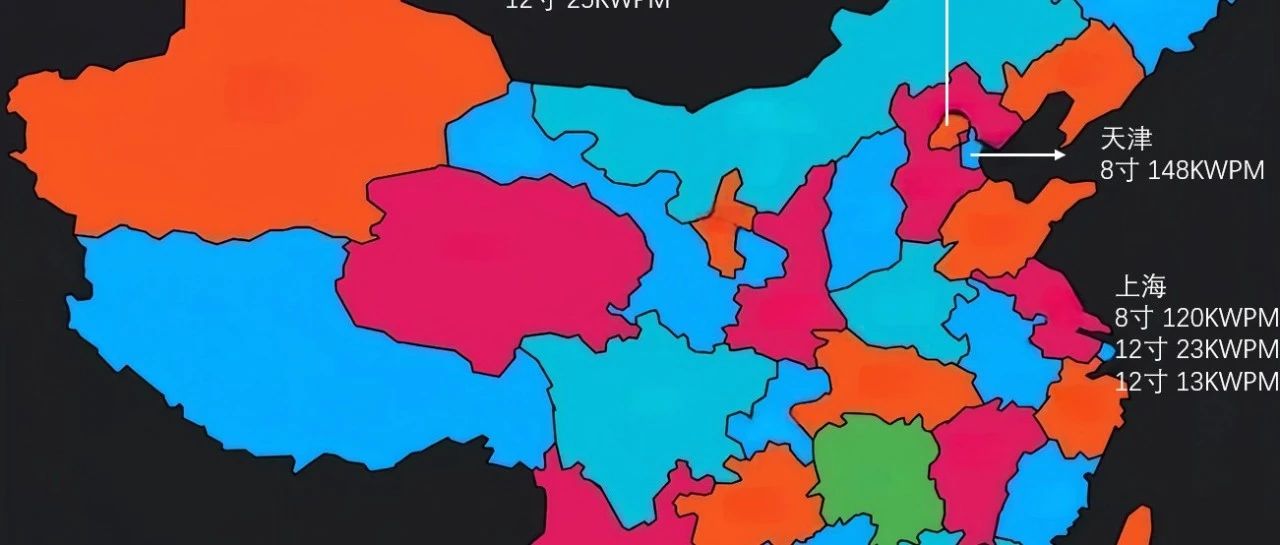
Summary of Key Points Core Viewpoint - The article provides an analysis of the foundry capacities of SMIC (Semiconductor Manufacturing International Corporation) across its facilities in Beijing, Tianjin, Shanghai, and Shenzhen, focusing on the production capacity of 8-inch and 12-inch wafers in the first quarter of the year and projections for the upcoming quarters. Group 1: Beijing - Beijing has three 12-inch wafer fabs with capacities of 56, 76, and 25 KWPM in Q1 of this year. The production capacity for the last two quarters of the year is expected to remain consistent with Q1, with a slight decline anticipated [2]. Group 2: Tianjin - Tianjin has one 8-inch wafer fab with a Q1 capacity of 148 KWPM. A slight decrease in capacity is expected for the upcoming two quarters [3][4]. Group 3: Shanghai - Shanghai, being the main hub for SMIC, has one 8-inch fab and two 12-inch fabs. The capacities in Q1 are 120 KWPM for the 8-inch fab, and 23 and 13 KWPM for the two 12-inch fabs, respectively. The 8-inch fab's capacity is expected to decline, while the 12-inch fabs are projected to increase their capacities in the latter half of the year [5][6]. Group 4: Shenzhen - Shenzhen has one 8-inch fab and one 12-inch fab, with Q1 capacities of 67 KWPM and 33 KWPM, respectively. Projections for future quarters indicate a slight increase for the 12-inch fab and a decrease for the 8-inch fab [7][8].