
智慧化养殖

Search documents
“智慧化养殖+保姆式服务”加速丰盈“蓝色粮仓” 海洋经济释放强劲动能
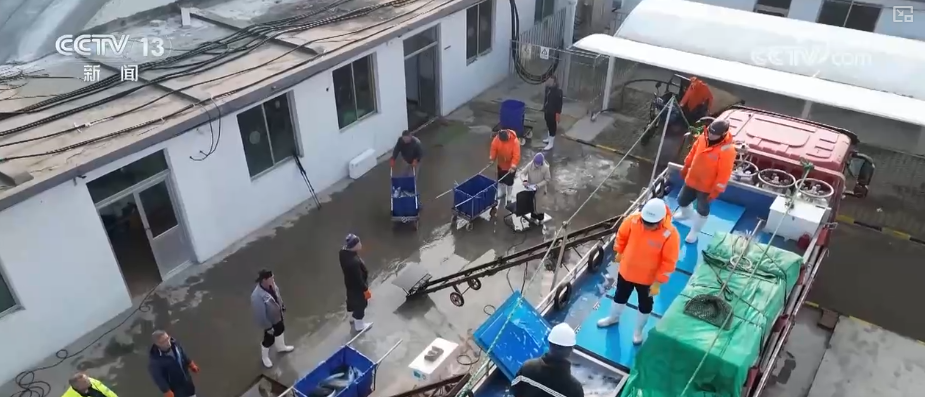
Yang Shi Wang· 2026-01-10 06:49
Core Viewpoint - The article highlights the innovative deep-sea aquaculture practices being implemented at the Yellow Sea and Bohai Sea junction, focusing on the transfer of fish fry to deep-sea cages to enhance marine resource utilization and increase production capacity [1][18]. Group 1: Fish Fry Transfer and Preparation - Over one million fish fry are being transferred from land to deep sea, marking a significant step in enhancing the "blue granary" [1]. - The first batch of nearly 20,000 fish fry is being carefully transported to deep-sea cages, with meticulous counting and coordination to ensure their health and survival during transit [3]. - Special preparations have been made to help the new species of rainbow trout adapt to the deep-sea environment, including the use of saline water in the acclimatization process [4][12]. Group 2: Deep-Sea Aquaculture Innovations - The deep-sea aquaculture platform has a water capacity of 90,000 cubic meters, capable of supporting 300,000 fish, with only four staff members required for maintenance and operations due to advanced technology [12][14]. - An intelligent deep-sea cage system is in place to guide feeding based on real-time monitoring of fish behavior, optimizing resource use [16]. - The establishment of eight intelligent deep-sea aquaculture platforms is part of a broader strategy to scale up production, with plans to introduce over one million fish fry by the end of January 2026 [18]. Group 3: Industry Growth and Policy Support - The company aims to achieve a sales volume of 2,000 tons of rainbow trout in 2026, leveraging the new aquaculture model to tap into deep-sea resources [19]. - The local government has introduced policies to support deep-sea aquaculture, with a target to increase production from over 2,000 tons to 10,000 tons within three years [24]. - The development of deep-sea aquaculture is expected to accelerate the growth of related industries, including breeding, processing, and storage, contributing to a modern fishery industry base [21].

推动我国水产养殖迈向深海 “湛江湾1号”交付使用
Yang Shi Xin Wen· 2025-11-20 06:34
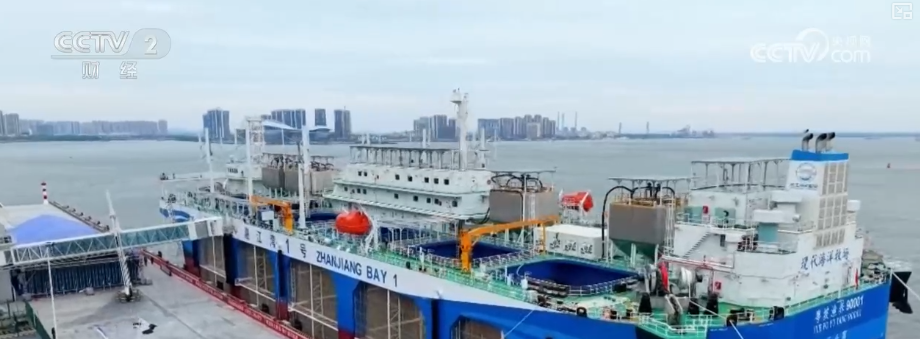
Core Insights - The floating dynamic positioning aquaculture platform "Zhanjiang Bay No. 1" has been delivered for use in Guangdong, showcasing advanced technology in aquaculture [1] Group 1: Platform Specifications - "Zhanjiang Bay No. 1" measures 154 meters in length and 44 meters in width, featuring 12 independent aquaculture zones with a water capacity of 80,000 cubic meters, allowing for simultaneous cultivation of multiple fish species [1] - The platform has an annual production capacity ranging from 2,000 tons to 5,000 tons, utilizing a large-scale intensive aquaculture model suitable for deep-sea farming [1] Group 2: Technological Innovations - The platform incorporates a pioneering ship-net integration design that reduces construction and operational costs while enhancing fish quality [1] - It is equipped with an electric propulsion system enabling autonomous navigation to avoid typhoons, optimizing the combination of dynamic and static farming methods [1] - The platform features automation and intelligence, with systems for green energy self-supply, intelligent feeding, and real-time monitoring, achieving comprehensive smart management throughout the entire lifecycle of aquaculture [1] Group 3: Industry Impact - The delivery of "Zhanjiang Bay No. 1" is expected to advance China's aquaculture from shallow waters to deep-sea environments, providing significant technological support for the construction of modern marine ranches [1]
创新成果众多!智慧化养殖平台赋能 我国海水养殖业迈向深远海
Yang Shi Wang· 2025-11-20 06:04
Core Insights - The "Zhanjiang Bay No. 1" floating aquaculture platform is the world's first of its kind, marking a significant advancement in China's marine aquaculture industry [1][9] - This platform is designed for deep-sea aquaculture, featuring advanced technology and a large capacity for sustainable fish farming [4][7] Group 1: Platform Specifications - "Zhanjiang Bay No. 1" measures 154 meters in length and 44 meters in width, with a total aquaculture water volume of 80,000 cubic meters [4] - It is equipped with 12 independent aquaculture zones, allowing for the simultaneous farming of multiple fish species, with an annual production capacity ranging from 2,000 to 5,000 tons [4] - The platform has a design lifespan of 20 years [4] Group 2: Technological Innovations - The platform employs a large-scale intensive aquaculture model suitable for deep-sea environments, with a transition capability of up to 1,000 nautical miles [7] - It operates in water depths exceeding 20 meters and incorporates systems for green energy self-supply, intelligent feeding, and real-time monitoring, enabling comprehensive smart management throughout the entire lifecycle of the aquaculture process [7] Group 3: Industry Impact - The delivery of "Zhanjiang Bay No. 1" signifies a pivotal step for China's marine aquaculture sector, facilitating the transition to deep-sea farming and providing essential technological support for the development of modern marine ranching [9]
新疆七十年|蓄势而发 牧歌新唱谱新篇
Yang Shi Wang· 2025-10-31 13:00
Core Viewpoint - The livestock industry in Xinjiang is undergoing a significant transformation from traditional practices to a more technology-driven and sustainable model, with a projected output value exceeding 112.2 billion yuan in 2024, indicating a complete industrial chain from breeding to processing and sales [1] Industry Transformation - The shift from "relying on nature for livestock" to "technology-driven animal husbandry" is highlighted, showcasing the integration of modern technology in livestock management [1] - The implementation of automated feeding systems and real-time data recording through electronic ear tags demonstrates the industry's move towards smart farming practices [1] Economic Impact - The establishment of a complete industrial chain encompassing breeding, processing, and sales is expected to enhance the economic output of the livestock sector significantly [1] - The transformation is contributing to high-quality development, improving both the industry and the livelihoods of local communities [1]