
智慧绿色转型

Search documents
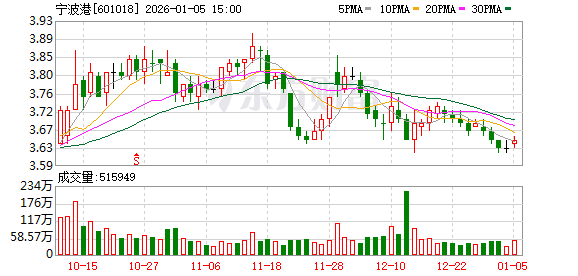
全球首个14亿吨大港诞生 宁波舟山港2025年成绩亮眼
Xin Hua Cai Jing· 2026-01-05 12:52
Core Insights - Ningbo-Zhoushan Port has achieved a remarkable milestone by surpassing 1.4 billion tons in cargo throughput, becoming the first port globally to reach this scale, and is expected to maintain its position as the world's largest port for 17 consecutive years [2] - The port's container throughput has also exceeded 40 million TEUs for the first time, securing its position as the third-largest port globally [2] - The port has made significant advancements in the "International Shipping Center Development Index," ranking seventh globally, marking a notable improvement of four positions in five years [2] Infrastructure Development - The port is following the "World-Class Strong Port Construction Implementation Plan (2023-2027)" and the "Ningbo-Zhoushan Port Overall Plan (2035)" to enhance its infrastructure [3] - Key terminal capabilities have been fully utilized, with the unique dual "10 million TEU" terminals and the world's only terminal capable of accommodating 400,000-ton bulk carriers contributing significantly to throughput growth [3] - The completion of the 300,000-ton expansion project of the Zhaozhoumen Channel has improved the passage capacity for ultra-large vessels by over 50%, enhancing the efficiency of bulk and container transportation [3] Port Opening and Connectivity - The port has significantly improved its opening capabilities, with multiple terminals in the Chuan Mountain and Meishan areas becoming operational, providing extensive docking facilities for international vessels [4] - By the end of 2025, the port's container shipping routes have reached 309, connecting over 700 ports in more than 200 countries and regions, maintaining a high connectivity index globally [5] Regional Collaboration and Global Expansion - The port's sea-rail intermodal network has expanded, with over 110 routes covering 69 cities across 16 provinces, facilitating deep integration with inland economies [6] - The port has established a robust overseas logistics network, with operations in Germany and Dubai, and has opened offices in Singapore and Japan, enhancing its global operational footprint [6] Service Quality Improvement - The port has innovated logistics channels, with the "Ningbo-Zhoushan Port-William Port" fast shipping route reducing transit times to Europe by over 10 days [7] - The port has optimized its business environment, implementing a one-stop service that has saved over 25,000 hours of waiting time for vessels, translating to cost savings of over 867 million yuan for shipping companies [7] - Significant progress has been made in green transformation, with the port achieving substantial breakthroughs in clean energy supply, including the first bonded high-sulfur biofuel oil refueling in East China [7] Future Outlook - The achievement of 1.4 billion tons in cargo throughput not only marks a milestone but also reflects the port's critical role in the global supply chain and its commitment to becoming a world-class strong port [8]


砥砺奋进“十四五”,山东绘就陆海空立体交通新图景
Da Zhong Ri Bao· 2025-11-24 08:58
Core Viewpoint - Shandong has made significant progress in transportation infrastructure development since the "14th Five-Year Plan," becoming the first provincial demonstration area for a strong transportation nation in China, with various key indicators ranking among the top in the country [1] Group 1: High-Speed Rail Development - Shandong's high-speed rail has achieved leapfrog development, with total railway operating mileage reaching 8,073 kilometers, an increase of 1,013 kilometers compared to the end of the "13th Five-Year Plan" [3] - The high-speed rail operating mileage has grown from 2,110 kilometers at the end of the "13th Five-Year Plan" to 3,055 kilometers, ranking among the top in the country [3] - Six high-speed rail lines are under construction, totaling over 1,340 kilometers, with plans to complete them by 2028, bringing the total high-speed rail mileage to 4,400 kilometers [3] Group 2: Investment and Financing Models - Shandong has established a railway investment and financing model with a total scale of 100 billion yuan, including 30 billion yuan from government guidance and 70 billion yuan from social capital [5] - A total of 1,180.28 billion yuan in railway special bonds has been issued, providing stable funding for railway project construction [5] - Nine high-speed rail projects have successfully signed cooperation agreements, with a total signed amount of 33.9 billion yuan [5] Group 3: Port Development - Shandong's coastal ports are expected to have a total of 396 berths of 10,000 tons or more by the end of the year, an increase of 56 compared to the end of the "13th Five-Year Plan" [7] - The coastal port throughput is projected to exceed 2.1 billion tons by the end of 2025, maintaining the top position in the country for several consecutive years [7] - The integration of seven major ports into the Shandong Port Group has promoted the one-stop development of ports, addressing issues of homogenization and disorderly competition [8] Group 4: Rural and Urban Transportation - Over the past five years, Shandong has upgraded more than 40,000 kilometers of rural roads, with a total of 266,000 kilometers of rural roads, ranking fourth in the country [11] - Public transportation service capabilities have improved, with six cities, including Jinan and Qingdao, recognized as national "bus cities" [11] - The total mileage of highways is expected to increase by 10,000 kilometers by the end of the "14th Five-Year Plan," reaching 297,000 kilometers, with a highway density of 188.8 kilometers per 100 square kilometers, ranking first in the country [12] Group 5: Smart and Green Transportation - Shandong has implemented a digital transformation of transportation infrastructure, establishing a "new infrastructure" network with 600 kilometers of smart highways and 22 smart ports [15] - The first fully automated container terminal in China has been put into operation at Qingdao Port, achieving a record-breaking loading and unloading efficiency [15] - The green energy generation capacity from photovoltaic and wind power in the port area has reached 200 million kilowatt-hours per year [16]
6月9日周一《新闻联播》要闻20条
news flash· 2025-06-09 12:02
Group 1 - China's goods trade import and export increased by 2.5% year-on-year in the first five months [4] - The consumer price index (CPI) for May showed a slight year-on-year decline, while the core CPI growth rate expanded [5] - The industrial transformation towards smart consumption goods in China is accelerating [6] Group 2 - Ports in China are speeding up their transition to smart and green operations [7] - The application of the Beidou system in Hunan is being accelerated to empower high-quality development [9]