智能体组织

Search documents
智能体是新宠,但非万能药——专访麦肯锡全球资深董事合伙人周宁人
麦肯锡· 2025-12-24 08:07
Core Viewpoint - The article discusses the current state and future potential of AI deployment in various industries, particularly in finance, highlighting the challenges and opportunities associated with scaling AI applications effectively [5][14]. Group 1: AI Deployment Status - Despite 88% of global enterprises using AI in at least one business function, only 39% report profitability from these applications, indicating a significant gap between adoption and effective implementation [5][16]. - In China, 83% of enterprises regularly use generative AI in at least one function, surpassing the global average, with 45% achieving large-scale or comprehensive deployment, higher than the global average of 38% [8][9]. - The financial sector is seen as a leading area for AI application, yet many institutions report that the effectiveness of AI does not meet expectations, primarily due to the exploratory phase of AI integration [14][16]. Group 2: AI Agent and Agentic AI - AI Agents, which enable machines to take action, are becoming popular, with 62% of organizations experimenting with them, but less than 10% have fully integrated them into business processes [10][11]. - The emergence of Agentic AI, which allows AI to autonomously complete tasks, is identified as a key trend, driven by reduced inference costs and the rise of smaller models that can operate on local devices [12][14]. - Successful AI organizations tend to have clear AI roadmaps and actively integrate AI into their core processes, moving beyond mere experimentation [14][15]. Group 3: Challenges and Recommendations - Organizations must redesign workflows to effectively leverage AI, focusing on identifying core pain points to enhance collaboration between AI and human workers [16][17]. - It is crucial to avoid a one-size-fits-all approach to AI deployment; instead, organizations should tailor AI applications to specific business needs and ensure proper governance and monitoring [18][20]. - The financial sector must balance innovation with risk management, employing a mixed strategy of rule-based AI for predictable tasks and AI-assisted processes for more complex scenarios [18].


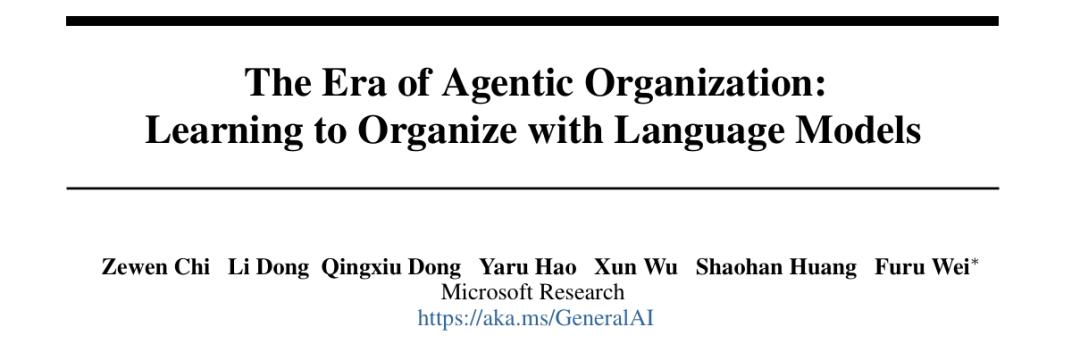
AI「智能体组织」时代开启,微软提出异步思考AsyncThink
3 6 Ke· 2025-11-05 10:52
Core Insights - The article discusses the transition from large language models (LLMs) to agentic organizations, highlighting the need for LLMs to not only think independently but also collaborate as organized systems to achieve the vision of "agentic organization" [1][20]. Group 1: AsyncThink Methodology - The AsyncThink method introduces an "Organizer-Worker" thinking protocol, where LLMs act as both organizers that decompose complex problems into sub-tasks and workers that execute these tasks [2][4]. - The training of the AsyncThink model involves a two-phase process: cold-start format fine-tuning and reinforcement learning [5][6]. Group 2: Cold-Start Format Fine-Tuning - In the cold-start phase, existing LLMs undergo fine-tuning to master the syntax and action structure of the AsyncThink framework, utilizing synthetic training data generated by GPT-4o [5][6]. - The model learns to issue effective organizer actions but does not yet generate correct answers using asynchronous thinking [5][18]. Group 3: Reinforcement Learning - The reinforcement learning phase guides the model to learn efficient and accurate strategies through rewards, ensuring the final answers are correct and the generated trajectories are executable [7][9]. - The model's output is structured as a "thinking structure" composed of organizers and multiple workers, optimizing towards a common goal [9][10]. Group 4: Experimental Evaluation - AsyncThink demonstrated superior performance in multi-solution countdown tasks, achieving a full accuracy rate of 89.0%, significantly higher than parallel (68.6%) and sequential thinking (70.5%) models [11][10]. - In mathematical reasoning tasks, AsyncThink achieved an accuracy of 38.7% on AIME-24 and 73.3% on AMC-23, with a reduction in reasoning latency by approximately 28% compared to traditional parallel reasoning [14][15]. - The model also excelled in cross-task generalization, achieving an accuracy of 89.4% in a 4x4 Sudoku task, indicating the learned organizational thinking pattern is transferable [16][17]. Group 5: Ablation Studies - Ablation studies revealed that format fine-tuning teaches the LLM the "language" of Fork and Join, while reinforcement learning imparts the "strategy" for efficient execution [18][19]. - The removal of key components in the AsyncThink model resulted in decreased accuracy and increased latency, underscoring the importance of each element in the training process [19]. Group 6: Future Work - Future research will focus on scaling and diversifying the number of workers in the agentic organization, exploring how accuracy-latency trade-offs evolve as the pool of agents increases [21][20]. - The concept of recursive agentic organizations will be explored, allowing any worker to become a sub-organizer, enhancing flexibility in problem-solving [22][20]. - Integrating human agents into the organization will create a collaborative framework, allowing for mixed intelligence where humans can act as organizers or workers [23][20].