智能体能力

Search documents
OpenAI发布其最强模型GPT-5.4,直指Anthropic核心市场
财富FORTUNE· 2026-03-09 13:04
Core Insights - OpenAI has launched its new AI model GPT-5.4, which is claimed to be the most capable AI system for professional scenarios to date, integrating advanced reasoning, programming, and autonomous operation capabilities [1] - The model combines various capabilities previously spread across different models, including programming abilities from GPT-5.3-Codex and enhanced reasoning skills, allowing it to operate autonomously across desktop, browser, and software applications [1] - The release of GPT-5.4 is expected to intensify competition in the enterprise AI market, previously dominated by Anthropic [1][2] Model Features - GPT-5.4 introduces "out-of-the-box" agent capabilities, enabling it to autonomously operate computers and software, search for and call external tools, and handle complex multi-step tasks without requiring developers to build underlying infrastructure [4] - Compared to GPT-5.2, the new model has significantly reduced the probability of generating "hallucinations," with a 33% decrease in the likelihood of individual statements being incorrect and an 18% reduction in overall error probability [4][5] - The model has shown improvements in token usage efficiency, allowing it to solve problems with fewer tokens, which may offset the slight increase in token pricing for some users [5] Competitive Landscape - OpenAI's new model release has raised concerns among investors regarding the potential disruption of traditional financial data providers by AI technologies, leading to previous declines in SaaS stock prices [3] - OpenAI has also introduced ChatGPT versions for Excel and Google Sheets, integrating AI directly into spreadsheets for building and analyzing complex financial models, further intensifying competition with Anthropic [2] - The market is witnessing a growing preference for AI systems capable of managing long workflows with minimal human intervention, as evidenced by the rise of products like OpenClaw [5]


美团又上新模型,8个Thinker齐开工,能顶个诸葛亮?
机器之心· 2026-01-16 08:13
Core Insights - The article discusses the latest advancements in AI models, specifically focusing on Meituan's LongCat-Flash-Thinking-2601, which features 560 billion parameters and is built on an innovative MoE architecture [1][41][62] - The model introduces a Heavy Thinking Mode that allows for simultaneous multi-path reasoning, enhancing the reliability and comprehensiveness of conclusions [4][48][62] - LongCat-Flash-Thinking-2601 demonstrates significant improvements in agent capabilities, achieving top performance in various benchmark tests and showing enhanced generalization in out-of-distribution (OOD) scenarios [6][62] Model Features - LongCat-Flash-Thinking-2601 employs a Heavy Thinking Mode that activates eight independent thinkers to explore different reasoning paths, thereby reducing errors and improving answer quality [4][48][50] - The model's architecture supports parallel thinking and iterative summarization, allowing for a broader and deeper exploration of complex problems [41][50] - A new evaluation method for agent model generalization has been introduced, which generates complex tasks based on given keywords, enhancing the model's adaptability to unknown scenarios [8][10][11] Performance Testing - Real-world testing of the model showed its capability in logical reasoning tasks, where it effectively utilized the Heavy Thinking Mode to arrive at reliable answers through collaborative reasoning [12][15][16] - The model's programming abilities were tested by generating games like Flappy Bird and Conway's Game of Life, showcasing its versatility despite the high computational cost of using multiple thinkers [26][32][32] - In a comparative analysis with Claude 4.5 Opus, LongCat-Flash-Thinking-2601 achieved a 100% standard coverage rate, outperforming its competitor in handling complex tool dependencies [38][62] Technological Innovations - The model incorporates advanced techniques such as environment scaling and multi-environment reinforcement learning, which enhance its training and performance in diverse scenarios [41][51][53] - LongCat's training process includes the introduction of noise to improve robustness, allowing the model to perform well in real-world conditions that are often imperfect [60][62] - The upcoming LongCat ZigZag Attention mechanism aims to support a context of up to 1 million tokens, further expanding the model's capabilities [63] Development Timeline - Meituan's AI model development has been rapid, with consistent updates since its initial launch in September 2025, focusing on enhancing response speed, logical reasoning, and multi-modal capabilities [65][67] - The company aims to create a model that can effectively solve real-world problems, aspiring towards a future where "model as a service" becomes a reality [68]

展望2026,AI行业有哪些创新机会?
3 6 Ke· 2025-11-28 08:37
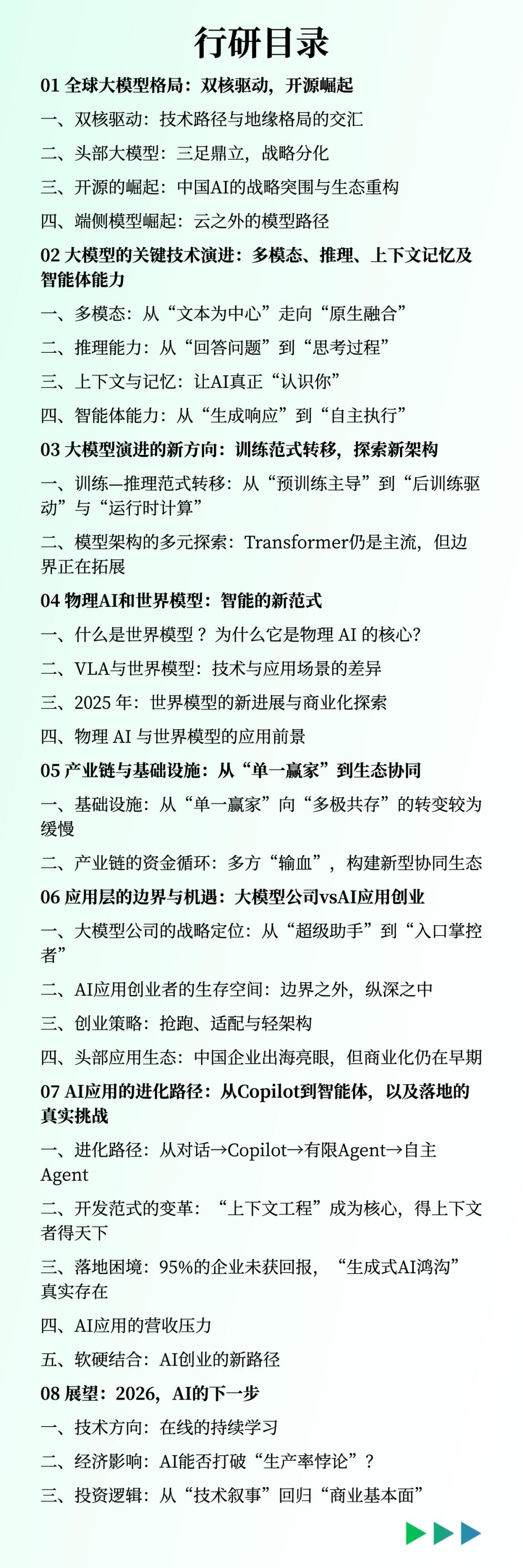
Core Insights - The AI industry is entering a rapid change cycle, with 2025 being a pivotal year for the development of large models, particularly with the emergence of DeepSeek, which is reshaping the global landscape and promoting open-source initiatives [1][10][18] - The dual-core driving force of AI development is characterized by the United States and China, each following distinct paths, with key technologies accelerating towards engineering applications [1][10][11] - Despite advancements in model capabilities, challenges in real-world application remain prevalent, indicating a shift in focus from "large models" to "AI+" [1][10][19] Group 1: Global Large Model Landscape - The global large model development is driven by a dual-core approach, with the U.S. leading in closed-source models and China focusing on open-source models [10][11][13] - OpenAI, Anthropic, and Google represent the leading trio in the large model arena, each adopting differentiated strategic paths [17] - DeepSeek's emergence marks a significant breakthrough for China's large model development, showcasing the potential of open-source models [18][19] Group 2: Key Technological Evolution - The evolution of large models is marked by four major technological trends: native multimodal integration, reasoning capabilities, long context memory, and agentic AI [22][24] - Native multimodal architectures are replacing text-centric models, allowing for seamless integration of various modalities [23] - Reasoning capabilities are becoming a core feature of advanced models, enabling them to demonstrate their thought processes [24][26] Group 3: Industry Chain and Infrastructure - The AI infrastructure is still dominated by Nvidia, with a slow transition towards a multi-polar ecosystem despite the emergence of alternatives like Google’s TPU and AMD’s chips [47][48] - The AI industry is shifting from reliance on a few cloud providers to a more collaborative funding model, with Nvidia and OpenAI acting as dual cores driving the ecosystem [51][52] Group 4: Application Layer Opportunities - Large model companies are positioning themselves as "super assistants" while also aiming to control user entry points through various products and services [53][54] - Independent application companies can find opportunities in vertical markets that require deep industry understanding and complex workflow integration [55][56] - The evolution of AI applications is moving towards intelligent agents capable of autonomous operation, indicating a significant shift in application development paradigms [61][62]