
智能化生态

Search documents
观察|1月车市三把“王座”全部易主
Guang Zhou Ri Bao· 2026-02-13 03:15
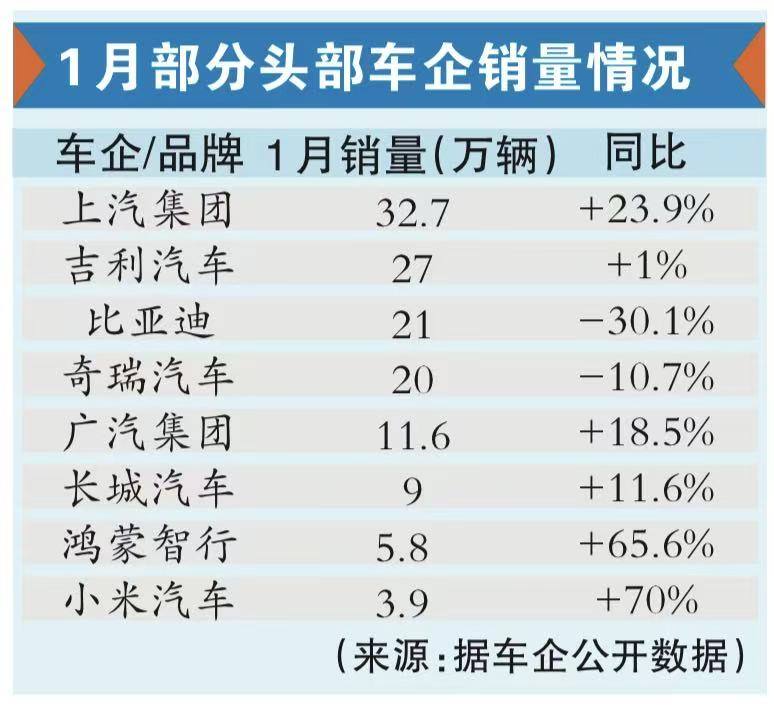
Core Insights - The January sales figures indicate a significant shift in the competitive landscape of the Chinese automotive market, with traditional giants like SAIC and Geely reclaiming leadership positions, while BYD's dominance is challenged [1][3][4] Group 1: Sales Performance - SAIC Group achieved sales of 327,000 vehicles in January, marking a year-on-year increase of 23.9% [2][4] - Geely Automotive sold 270,100 vehicles, a year-on-year growth of 1%, surpassing BYD to become the top-selling domestic brand [2][4] - BYD's sales fell to 210,000 vehicles, experiencing a significant year-on-year decline of 30.1% [2][4] - New energy vehicle sales for SAIC reached 85,000 units, growing by 39.7% [4] - The overall automotive production and sales in January were 2.45 million and 2.346 million units, respectively, with a slight year-on-year production increase of 0.01% [7] Group 2: New Players and Market Dynamics - The new energy vehicle segment saw a reshuffling, with Hongmeng Zhixing leading the new force with 57,915 units sold, a remarkable year-on-year increase of 65.6% [6] - Xiaomi Automotive followed closely with over 39,000 units sold, achieving a year-on-year growth of approximately 70% [6] - The previous leaders in the new force segment, such as Leap Motor, have seen a decline, with their sales dropping to 32,059 units [6] Group 3: International Market Growth - The overseas market is identified as a key growth area for automotive companies, with January exports reaching 681,000 vehicles, a year-on-year increase of 44.9% [7] - Exports of new energy vehicles doubled to 302,000 units, highlighting the importance of global expansion for competitive advantage [7]




粤海饲料与中农科龙腾签约 推动水产饲料智能化
Zheng Quan Shi Bao Wang· 2025-12-09 08:10
Core Viewpoint - The third A+ Aquaculture Feed Summit highlighted the importance of low-protein feed innovation to address the industry's challenges of high protein dependency, rising costs, and environmental pressures [1][2]. Group 1: Low-Protein Feed Innovation - The core principle of the industry transformation is "reducing protein without compromising nutrition," which requires precise formulation and optimization across the entire supply chain to ensure the health of fish and shrimp as well as farming efficiency [1]. - The collaboration between Yuehai Feed and the domestic smart feed software "Zhongnongke Longteng" marks a significant leap from "catching up" to "running alongside" in China's aquaculture feed software industry [1]. - The partnership is based on over 30 years of technological accumulation from Yuehai Feed and the independent innovation of Zhongnongke Longteng, breaking a 20-year technical monopoly held by Western companies [1]. Group 2: Strategic Significance of the Partnership - The partnership addresses three major challenges in the aquaculture industry: weak consumer demand, high dependence on imported raw materials, and increasing environmental pressures [2]. - Yuehai Feed has validated the feasibility of low-protein technology across various products, achieving excellent results such as a protein content of 42%-44% in shrimp feed, which is lower than the industry norm, yet yielding 18,409 pounds per acre with a feed conversion ratio of 0.9 [2]. - The AI capabilities of Zhongnongke Longteng will further optimize formulation accuracy, providing nearly a thousand raw material recommendations and reducing energy consumption by 12%, thus supporting cost reduction and efficiency for farmers [2]. Group 3: Future Outlook - The collaboration is seen as a model for industrial win-win scenarios, with both parties aiming to refine low-protein feed standards and deepen digital applications to benefit more farmers with efficient and environmentally friendly farming practices [3]. - This partnership is viewed as a new starting point for high-quality industry development, with a focus on technological innovation to drive sustainable growth and profitability [3].
极氪携手第二十届全国大学生智能汽车竞赛,共创智能化生态发展
Zhong Guo Qi Che Bao Wang· 2025-08-21 02:24
Core Insights - The 20th National College Student Intelligent Car Competition concluded at Hangzhou University of Electronic Science and Technology, with Zeekr Intelligent Technology as a key supporter, showcasing its commitment to technological investment and talent strategy in the smart driving sector [1][11]. Group 1: Event Overview - The National College Student Intelligent Car Competition, recognized as a national A-level competition by the Ministry of Education, has evolved over 20 editions, covering over 30 provinces and municipalities and involving more than 500 universities, attracting over 650,000 participants [4]. - This year's competition featured over 700 teams and more than 3,000 contestants, highlighting the innovative capabilities and technical pursuits of Chinese university students in the field of intelligent vehicles [4]. Group 2: Company Involvement - Zeekr's participation in the event reflects its commitment to core technology research and development, aligning with the competition's focus on smart driving and chip applications, which resonate with Zeekr's core technologies [9]. - The event serves as a platform for Zeekr to enhance brand recognition among university students in automation, computer science, and mechanical engineering, which aligns with the company's talent needs in the smart automotive sector [9]. Group 3: Strategic Goals - Zeekr emphasizes that technological innovation is the core driving force behind the development of smart mobility and plans to deepen collaboration with universities and industry associations to enhance the research and development of smart automotive technologies and talent cultivation systems [11].
