多极竞合

Search documents
观察|1月车市三把“王座”全部易主
Guang Zhou Ri Bao· 2026-02-13 03:15
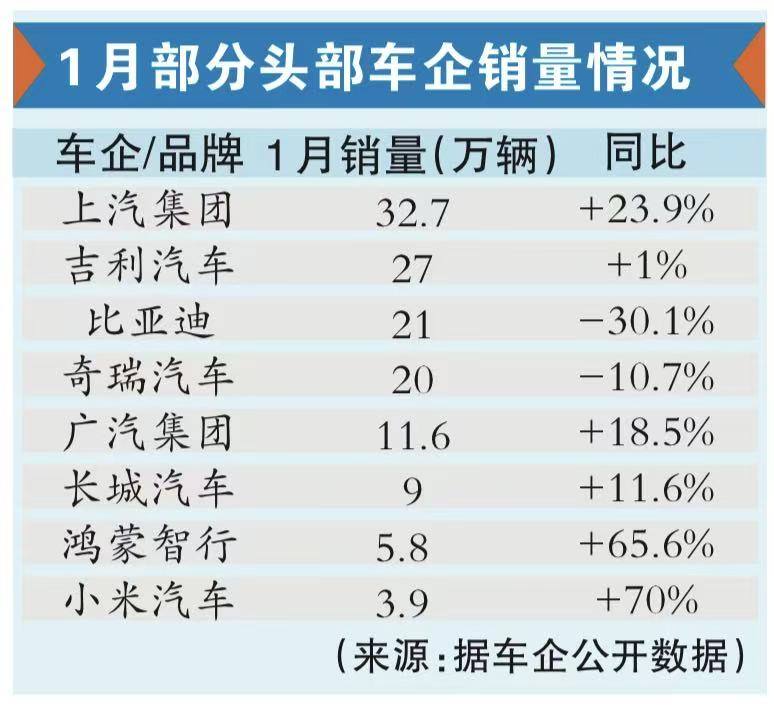
Core Insights - The January sales figures indicate a significant shift in the competitive landscape of the Chinese automotive market, with traditional giants like SAIC and Geely reclaiming leadership positions, while BYD's dominance is challenged [1][3][4] Group 1: Sales Performance - SAIC Group achieved sales of 327,000 vehicles in January, marking a year-on-year increase of 23.9% [2][4] - Geely Automotive sold 270,100 vehicles, a year-on-year growth of 1%, surpassing BYD to become the top-selling domestic brand [2][4] - BYD's sales fell to 210,000 vehicles, experiencing a significant year-on-year decline of 30.1% [2][4] - New energy vehicle sales for SAIC reached 85,000 units, growing by 39.7% [4] - The overall automotive production and sales in January were 2.45 million and 2.346 million units, respectively, with a slight year-on-year production increase of 0.01% [7] Group 2: New Players and Market Dynamics - The new energy vehicle segment saw a reshuffling, with Hongmeng Zhixing leading the new force with 57,915 units sold, a remarkable year-on-year increase of 65.6% [6] - Xiaomi Automotive followed closely with over 39,000 units sold, achieving a year-on-year growth of approximately 70% [6] - The previous leaders in the new force segment, such as Leap Motor, have seen a decline, with their sales dropping to 32,059 units [6] Group 3: International Market Growth - The overseas market is identified as a key growth area for automotive companies, with January exports reaching 681,000 vehicles, a year-on-year increase of 44.9% [7] - Exports of new energy vehicles doubled to 302,000 units, highlighting the importance of global expansion for competitive advantage [7]




达沃斯论坛对大宗商品的影响
Sou Hu Cai Jing· 2026-01-22 06:43
Group 1 - The new order revealed at the Davos Forum indicates intensified competition and resource battles, with commodities showing a "polarized" pattern driven by supply-demand mismatches and policy expectations [1] - Precious metals are in a solid bull market, with silver showing better elasticity due to rising Fed rate cut expectations, a weaker dollar, and geopolitical risks enhancing gold's safe-haven appeal [1] - Silver's demand is surging due to photovoltaic needs and global inventory shortages, with domestic export controls widening the supply-demand gap, targeting a price of 25,000 yuan/kg for silver [1] Group 2 - The energy and industrial metals sector is experiencing significant structural differentiation, with a confirmed oversupply in crude oil leading to a downward price adjustment [1] - Copper is supported by AI computing power and electricity grid investment demand, with limited supply growth from mines, making it a strategic long position [1] - Aluminum benefits from reduced costs and capacity constraints, presenting a stable long position choice [1] Group 3 - Current data shows that U.S. employment and inflation are slowing, but some sectors are improving under the influence of Fed rate cuts, leading to a cautious outlook [3] - Concerns over trade friction and geopolitical risks are driving funds to preemptively allocate to precious metals, supporting prices amid rising forecasts from major global institutions [4] - The market is expected to be influenced more by U.S. economic data affecting Fed policy expectations and geopolitical disturbances, with gold maintaining a strong oscillating trend above the 20-day moving average [4]
中国这次不再仁慈,特朗普无计可施,可能决定“弄死”大债主?
Sou Hu Cai Jing· 2025-05-19 05:50
Group 1 - The U.S. Treasury Secretary has warned that the federal government's cash reserves and measures to keep debt within the legal limit may be exhausted by August, urging Congress to raise or suspend the debt ceiling before mid-July [1] - The U.S. has reached its current debt ceiling of $36.1 trillion as of early January, and the Treasury has been employing "extraordinary measures" to avoid a potential default [1] - A potential debt default could lead to a downgrade in the U.S. credit rating, increasing borrowing costs and triggering a sell-off of U.S. Treasuries, which are considered a safe asset globally [3] Group 2 - The ongoing trade tensions and tariff wars initiated by the Trump administration have prompted many countries to seek "de-dollarization," reducing reliance on the U.S. dollar for transactions [3] - China is shifting its focus towards promoting a multipolar global order, aiming to support the development of global South countries rather than prioritizing U.S. interests [4] - The independence of the Federal Reserve is being challenged by political pressures, which could undermine global trust in the U.S. dollar as a reserve currency [6] Group 3 - The S&P 500 index has dropped 11% since the beginning of the year, and small business confidence has reached its lowest level since 2009, indicating significant economic repercussions [8] - The 30-year mortgage rate has surpassed 7.2%, dampening the housing market, while suggestions to hold Chinese yuan assets are emerging as a risk hedge [8]