有色矿业投资

Search documents
美联储降息预期持续升温,矿业ETF(561330)大涨超4%
Sou Hu Cai Jing· 2025-12-01 02:04
Core Viewpoint - The recent rise in expectations for a Federal Reserve interest rate cut has significantly boosted the performance of the mining ETF (561330), which has increased over 90% year-to-date, with a recent surge of over 4% [1][2]. Group 1: Federal Reserve and Economic Indicators - The Federal Reserve's dovish comments from multiple officials have led to a notable increase in rate cut expectations, rising from below 40% to over 80% [2]. - Recent economic data, including a lower-than-expected retail sales growth of 0.2% in September and a decrease in private sector jobs, supports the case for a rate cut [2]. Group 2: Mining Sector Performance - The mining sector has experienced a comprehensive rise, with spot gold reaching a two-week high of $4226.56 per ounce and silver hitting a historical record [2]. - The demand for industrial metals is expected to rise due to liquidity easing from the Federal Reserve and increased physical demand from A-shares, particularly for copper and aluminum [2]. Group 3: ETF Performance and Composition - The mining ETF (561330) has outperformed the CSI Nonferrous Metals Index by over 10% year-to-date, attributed to a more concentrated selection of leading stocks [3]. - The mining ETF tracks the CSI Nonferrous Metals Mining Theme Index, which has 37 components with the top ten stocks accounting for 56.34% of the index, compared to 47.62% for the CSI Nonferrous Index with 60 components [3]. Group 4: Sector Composition and Trends - The CSI Nonferrous Metals Mining Theme Index has a higher proportion of gold, copper, and rare earths at 53.4%, compared to 49.8% in the CSI Nonferrous Index, indicating a stronger response to favorable market conditions [5]. - The supply constraints in the nonferrous mining industry are expected to drive prices higher, with copper and cobalt prices anticipated to continue rising due to supply tightness [11]. Group 5: Future Outlook - The mining ETF (561330) currently has a scale of 826 million yuan, ranking first among similar index ETFs, indicating superior liquidity and investment opportunities in gold, copper, and rare earths [11].


涨超稀土和有色,矿业ETF(561330)是怎么练成的?
Sou Hu Cai Jing· 2025-10-15 02:49
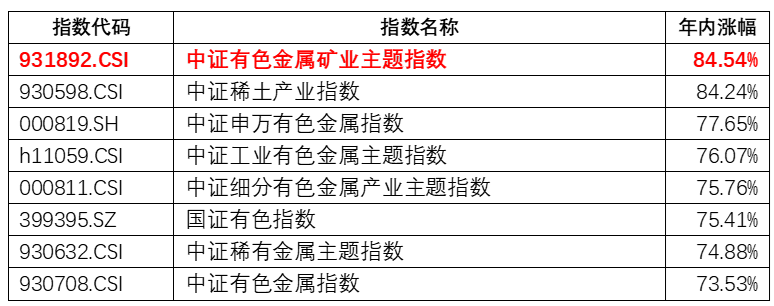
Core Viewpoint - Recent US-China trade tensions and China's export controls on rare earths have reignited market interest in the non-ferrous metals sector, particularly in mining ETFs, which have significantly outperformed traditional non-ferrous metal ETFs this year [1][3]. Performance Summary - The year-to-date performance of various indices shows that the CSI Non-ferrous Metal Mining Theme Index has increased by 84.54%, surpassing other indices including the CSI Rare Earth Industry Index at 84.24% and the CSI Industrial Non-ferrous Metal Theme Index at 76.07% [2]. Market Dynamics - The non-ferrous sector's fundamentals present long-term investment value, with mining ETFs focusing on companies with substantial non-ferrous metal resource reserves, demonstrating stronger price elasticity in the current macroeconomic environment [3]. - Recent developments, including detailed export controls on rare earths and renewed US tariffs, alongside the Federal Reserve's interest rate cuts, have collectively strengthened the mining sector [5]. Sector Composition - The mining ETF (561330) has a significant focus on gold, copper, and rare earths, with these three categories accounting for 56% of its total composition [4]. - The top ten holdings in the mining ETF are all leading resource companies, collectively representing over 57% of the ETF, indicating a high concentration of resource-rich firms [4]. Supply Chain Influences - Recent accidents at major copper mines, such as Escondida and Grasberg, have disrupted supply, with expectations of a 35% decrease in copper production by 2026 compared to previous forecasts [6]. - The overall outlook for the non-ferrous metal industry remains positive, driven by supply disruptions and favorable macroeconomic conditions, including the potential for rising gold prices due to geopolitical tensions and monetary policy changes [6].