期权风险管理

Search documents
期权策略总结与案例分析
Qi Huo Ri Bao Wang· 2025-12-22 02:29
Core Viewpoint - Options strategies play a significant role in financial markets, providing investors with flexible investment methods for risk management, asset allocation optimization, and enhanced returns [1] Group 1: Four Dimensions of Options Strategies - The theoretical research on options can be categorized into pricing, trading strategies, and risk management, with pricing serving as the foundation for the other two [2] - The four key dimensions affecting options pricing are direction (delta), acceleration (gamma), volatility (vega), and time value (theta), which explain most price changes [2][3] - Various options strategies can be classified based on these dimensions, such as bull spreads and bear spreads under directional strategies, and calendar spreads and selling put options under time value strategies [3] Group 2: Relationship Among the Four Dimensions - Direction and volatility are often the primary focus for investors due to their significant impact on options pricing and potential returns [4] - The relationship between acceleration and time value is typically one of opposition, requiring a balance between the two [8] Group 3: Volatility Strategy Framework - Volatility is crucial in options research, with various strategies based on volatility, including timing strategies and the "volatility smile" arbitrage strategy [9] - Historical and implied volatility are interrelated, with market conditions affecting their dynamics [9] Group 4: Application Case Study - A case study involving a polypropylene production company illustrates the use of a collar strategy to hedge against price declines, where the company bought a put option and sold a call option [10][11] - The company calculated the necessary options to hedge 200 tons of polypropylene, resulting in the purchase of 40 put options and the sale of 40 call options [11][12] - The strategy was executed on June 18, with a closing price of 7214 yuan/ton, establishing a collar with strike prices of 7200 yuan/ton for the put and 7300 yuan/ton for the call [13] Group 5: Risk Management - The primary risks in the collar strategy include the underlying price rising significantly, which could lead to losses on the sold call option, and liquidity issues as the expiration date approaches [12][14] - The company can adjust its options positions based on market trends to mitigate potential losses [12]


玻璃期权产业参与度显著提升
Qi Huo Ri Bao Wang· 2025-12-17 02:12
Group 1 - The glass industry is experiencing a surge in participation in glass options, indicating a strong demand for refined risk management tools [1] - In the first half of the year, the trading volume of glass options reached 19.89 million contracts, making it the most traded option on the Zhengzhou Commodity Exchange, with a transaction value of 4.864 billion yuan [1] - Factors contributing to the increased participation include heightened price volatility due to macroeconomic changes, the maturity of the futures-options combination model, and ongoing market education efforts by exchanges and futures companies [1][2] Group 2 - Downstream companies are adopting a "futures hedging + options enhancement" strategy to lock in costs and increase profits amid fluctuating prices [2] - During price declines, glass companies utilized put options for hedging, effectively mitigating losses from falling prices [2] - In a volatile market, companies are employing various strategies such as three-way options combinations and cumulative options to capitalize on price trends and reduce procurement costs [2][3] Group 3 - The non-linear profit and loss characteristics of options provide significant appeal to industry players, allowing them to limit maximum losses while retaining potential upside [3] - The fastest-growing participant group in the Zhengzhou Commodity Exchange's glass options market consists of industry clients, including glass manufacturers, processors, and traders [3][4] - Successful experiences of leading companies in using options for stable operations have created a strong demonstration effect, encouraging smaller enterprises to follow suit [3] Group 4 - The glass options market is on a healthy growth trajectory, with applications expanding from simple hedging to diverse areas such as inventory management and profit locking [4] - Companies are focusing on building specialized options teams and enhancing collaboration between research and operational departments to provide comprehensive risk management solutions [4] - As industry awareness and application scenarios for options continue to evolve, the glass options market is expected to see further growth, supporting the high-quality development of the glass industry [4]
期权市场中的做市商,你了解多少?
Bao Cheng Qi Huo· 2025-11-10 08:52
Group 1: Report Industry Investment Rating - No relevant content found Group 2: Core Viewpoints of the Report - Market makers play a crucial role in the options market by providing continuous two - sided quotes, ensuring market liquidity and stability. However, they often face risk exposure due to unequal market buying and selling forces, and effective risk management is the core issue for them [2][4]. - Market makers use volatility strategies to manage risks and achieve profits. They can take long or short volatility strategies according to their expectations of future market volatility, and also construct volatility - neutral strategies [4][5][8]. - Market makers need to manage risks from Greek letters (Delta, Gamma, Vega) through dynamic hedging strategies, and also pay attention to skew risk [8][9][12]. - Market makers face challenges such as insufficient market liquidity, regulatory policy uncertainty, and technological progress, but they can also seize opportunities brought by technology to enhance their competitiveness [13][14][16]. Group 3: Summary by Relevant Catalogs A. Application of Options Volatility Strategies - Market makers' main responsibility is to provide continuous two - sided quotes, which helps improve market liquidity, stability, and efficiency. But they often have net long or short positions, leading to risk exposure [2]. - Market makers manage risks by monitoring and adjusting Greek letters (Delta, Gamma, Vega). They use underlying assets or other options to hedge risk exposures, and need to consider factors such as liquidity and operational risk [3]. - Market makers use volatility strategies. When expecting rising volatility, they can use long volatility strategies like Long Straddle and Long Strangle; when expecting falling volatility, they can use short volatility strategies like Short Straddle and Short Strangle. They can also construct volatility - neutral strategies [5][7][8]. B. Risk Management Mechanisms and Practices - Market makers face risks from Greek letters (Delta, Gamma, Vega). They use dynamic hedging strategies to keep the portfolio neutral under different market conditions [8]. - To hedge Delta risk, market makers buy or sell underlying assets; to hedge Gamma risk, they introduce other options; to hedge Vega risk, they buy or sell other options. In practice, they need to comprehensively consider multiple risk factors and construct complex option portfolios [9][10][11]. - Market makers also need to pay attention to skew risk, which is the deviation of option relative volatility pricing, and adjust option portfolios to hedge this risk [12]. C. Future Challenges - Market makers face challenges such as insufficient market liquidity, which may lead to price risks and affect profitability. They need to take measures to improve market liquidity [13]. - Regulatory policy uncertainty exists due to differences among countries and regions, and frequent policy changes may affect long - term planning and investment decisions [14]. - Technological progress brings both opportunities and challenges. Market makers can use advanced technologies to improve risk management and trading efficiency, but they also need higher technical levels and innovation capabilities [14].
鸡蛋、玉米淀粉、生猪期权上市一周年,产业有序参与
Sou Hu Cai Jing· 2025-08-22 11:22
Group 1 - The launch of egg, corn starch, and live pig options on the Dalian Commodity Exchange has been stable, with orderly industry participation and steady functionality over the past year [1] - As of August 22, 2025, the average daily trading volume, trading value, and open interest for egg options were 46,000 contracts, 13.21 million yuan, and 79,000 contracts respectively [1] - For corn starch options, the average daily trading volume, trading value, and open interest were 15,000 contracts, 3.474 million yuan, and 44,000 contracts respectively [1] - Live pig options had an average daily trading volume of 8,000 contracts, trading value of 16.019 million yuan, and open interest of 29,000 contracts [1] Group 2 - Sichuan Green Science Poultry Co., Ltd. has utilized options to lock in profits and reduce costs amid market volatility, successfully generating fixed income by selling at-the-money or slightly out-of-the-money call options [2] - The company also purchases out-of-the-money call options to hedge against extreme market conditions, demonstrating effective risk management strategies [2] Group 3 - Zhu Cheng Xingmao Corn Development Co., Ltd. has adopted various hedging strategies using corn starch options to lower costs and maintain operational efficiency in a challenging market environment [3] - The company employs strategies such as selling call options to reduce inventory costs and selling put options to hedge against unexecuted locked-price orders [3] Group 4 - Sichuan Dekang Agricultural and Animal Husbandry Food Group has integrated live pig options as a supplementary tool for futures hedging, focusing on locking in breeding profits and enhancing hedging returns [4] - In April, the company sold a call option with a strike price of 15,000 yuan per ton, receiving a premium of 300 yuan per ton, which helped offset losses from falling spot prices [4] Group 5 - The Dalian Commodity Exchange aims to optimize option contract rules and enhance industry participation through training and promotional activities, supporting stable and healthy market development [4]
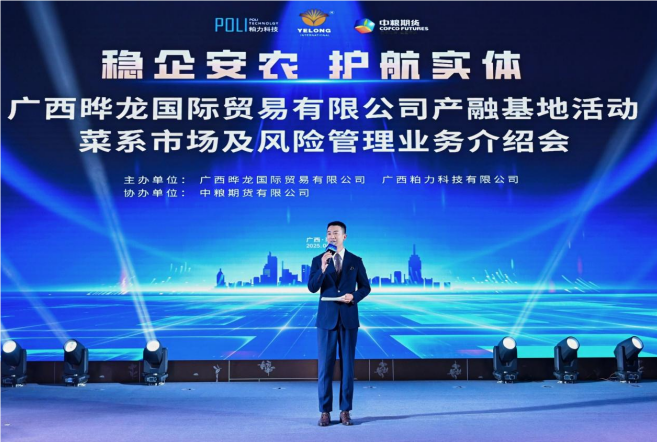
“稳企安农 护航实体”菜系市场及风险管理业务介绍会顺利举办
Qi Huo Ri Bao Wang· 2025-07-02 03:48
Core Insights - The conference "Stabilizing Enterprises and Ensuring Agriculture" focused on key issues such as global macroeconomics, options risk management, and supply-demand dynamics of rapeseed meal and oil [1] Group 1: Conference Overview - The event was successfully held in Nanning, Guangxi, attracting over 400 experts, industry representatives, and financial practitioners from the oilseed and feed raw materials sectors [1] - The conference was organized by Guangxi Yelong International Trade Co., Ltd. and co-organized by COFCO Futures Co., Ltd. [1] Group 2: Company Insights - Zhang Derong, General Manager of Guangxi Yelong, expressed gratitude for the support received over the years and shared the company's mission to deepen market research and explore the integration of production and finance in the rapeseed meal trade [3] - Wang Lin, Assistant General Manager of COFCO Futures, highlighted the company's role as a leading financial service provider in the industry, promoting a collaborative business model based on market-oriented, professional, and product-driven principles [7] Group 3: Market Analysis and Expert Insights - Pan Jianzhuang, Deputy Director of the Market Development Department of Zhengzhou Commodity Exchange, emphasized the importance of rapeseed meal futures in supporting the development of the oilseed industry and the role of leading enterprises like Guangxi Yelong in guiding the industry to utilize futures and derivatives markets effectively [5] - Industry experts provided insights on various topics, including global oilseed supply-demand dynamics and the outlook for the protein meal market in Q3, analyzing key variables and data trends [9][10] - The conference served as an efficient platform for communication and collaboration between upstream and downstream enterprises in the meal industry and financial institutions [11]