期货市场监管

Search documents
市场波动加剧!期交所持续强化监管
券商中国· 2026-03-18 08:45
Core Viewpoint - The article discusses the recent volatility in domestic energy and chemical products due to the Middle East situation and highlights the regulatory measures taken by futures exchanges to mitigate market risks [1]. Group 1: Regulatory Actions - The Shanghai Futures Exchange (SHFE) has intensified the management of actual control relationship accounts, implementing restrictions on opening positions for accounts that exceed trading limits [2]. - As of March 18, the SHFE has issued 9 announcements regarding the imposition of restrictions on opening positions, all related to violations by actual control relationship accounts [4]. - In February, the SHFE processed 83 cases of abnormal trading behavior, including 21 cases of excessive self-dealing and 45 cases of excessive intraday opening volume, with 45 actual control relationship account groups subjected to restrictions [4]. Group 2: Violations in Other Exchanges - The Zhengzhou Commodity Exchange (ZCE) reported 7 cases of abnormal trading in February, including 4 cases of self-dealing and 3 cases of frequent order cancellations, along with 6 disciplinary actions for violations of self-regulatory rules [5]. - The Dalian Commodity Exchange (DCE) handled 6 cases of abnormal trading in February, all related to excessive self-dealing, and investigated 7 leads on violations, including 5 cases of fund transfer between controlled accounts [5]. - The Guangxi Futures Exchange (GFE) processed 8 cases of abnormal trading in February, including 3 cases of excessive self-dealing, and initiated investigations into 3 leads on violations related to self-dealing affecting contract prices [5].

严监管亮剑!期交所年内多番出手,实控账户违规、交易超限成重灾区
Sou Hu Cai Jing· 2026-02-19 10:22
Core Viewpoint - The futures market has experienced significant activity since the beginning of 2026, prompting multiple exchanges to enhance regulatory measures to prevent market risks and ensure stable operations [1] Regulatory Actions - Major futures exchanges, including SHFE, DCE, CFFEX, and CZCE, have intensified their regulatory efforts, issuing numerous penalties to deter violations [2] - SHFE has focused on abnormal trading and actual control account supervision, handling 125 cases of abnormal trading in January, including 44 cases of self-dealing and 41 cases of frequent order cancellations [2] - DCE has targeted agreed trading and position limits violations, processing 9 cases of abnormal trading in January, with significant penalties imposed on entities involved in mutual trading [3] - CFFEX has addressed violations in the financial futures sector, processing 49 cases of trading limit violations and implementing restrictions on 19 clients [3] - CZCE issued a notable penalty on February 2, 2026, against three corporate clients for exceeding position limits, resulting in a total fine of 4.1563 million yuan [4] Market Development and Regulatory Strategy - The current regulatory approach aligns with the CSRC's focus on risk prevention, strong regulation, and promoting high-quality development in the futures market [5] - The CSRC has emphasized the need for strict enforcement of regulations, particularly against price manipulation and insider trading, while also expanding the range of futures options available [5] - As of January 2026, the total funds in the futures market reached approximately 2.57 trillion yuan, reflecting a 20% increase from the end of 2025, indicating robust market growth [6]
读懂“严监管”背后的逻辑
Sou Hu Cai Jing· 2026-02-08 23:53
Core Viewpoint - The recent fluctuations in lithium carbonate prices are attributed to a cooling market sentiment, with the Guangxi Futures Exchange's stringent regulatory measures being a focal point of attention [1][2]. Group 1: Regulatory Measures - Guangxi Futures Exchange emphasizes strict regulation to curb excessive speculation while not interfering with reasonable pricing, aiming to protect the futures market's service to the real economy [1][2]. - Specific measures include raising transaction fees, increasing the minimum opening order quantity from 1 to 5 contracts, and adjusting margin requirements for speculative and hedging trades to 13% and 12% respectively, targeting excessive speculative behavior [1][2]. - The exchange's approach is characterized by a focus on maintaining order rather than price intervention, ensuring that the market returns to a rational state following a period of excessive optimism [2][3]. Group 2: Market Dynamics - The recent price decline in lithium carbonate is seen as a correction of previous overly optimistic sentiments, with the market returning to fundamentals after curbing speculative tendencies [2]. - The rapid price increase was driven by unrealistic expectations regarding storage demand and supply constraints, which lacked sustainability, highlighting the importance of regulatory measures in stabilizing market emotions [2][3]. - The exchange's regulatory actions have allowed the market to realign with supply and demand dynamics, reinforcing the core functions of the futures market [2][3]. Group 3: Future Outlook - The Guangxi Futures Exchange will maintain a strict regulatory stance against violations such as exceeding position limits and failing to report actual control relationships, ensuring a fair and transparent trading environment [3]. - The exchange's role is to act as a "gatekeeper" for the market, balancing the need to prevent excessive speculation while facilitating risk management for real entities [3][4]. - The future of the futures market is expected to be robust under careful regulatory oversight, contributing significantly to the high-quality development of the real economy [4].
坚持严监管主基调 护航实体稳健发展
Qi Huo Ri Bao Wang· 2026-02-08 18:33
Core Viewpoint - The recent fluctuations in lithium carbonate prices are attributed to a cooling market sentiment and stringent regulatory measures by the Guangxi Futures Exchange, which aims to curb excessive speculation while supporting the real economy [1][2]. Regulatory Measures - Guangxi Futures Exchange has implemented strict regulations to manage excessive speculation, including raising transaction fees and increasing the minimum order size from 1 to 5 contracts [1]. - The margin requirements for speculative and hedging trades have been adjusted to 13% and 12% respectively, creating a differentiated margin system to effectively constrain speculative behavior [1][2]. Market Dynamics - The recent price decline in lithium carbonate is seen as a correction of overly optimistic sentiments, returning the market to a more rational state following the curtailment of speculative activities [2]. - Previous surges in lithium carbonate prices were driven by unrealistic expectations regarding storage demand and supply constraints, which lacked sustainability [2]. Role of Regulation - The Guangxi Futures Exchange emphasizes that its regulatory role is not to interfere with price movements but to maintain market order and protect the legitimate rights of enterprises [2][3]. - The exchange has signaled a commitment to strict regulation against violations while respecting market dynamics, ensuring a fair and transparent trading environment [3]. Future Outlook - The regulatory framework aims to enhance the functionality of the futures market, providing stronger financial support for the high-quality development of the real economy [4].
涉黄金、白银、铜等!上海期货交易所最新通知
Sou Hu Cai Jing· 2026-02-06 00:49
Core Viewpoint - The Shanghai Futures Exchange announced adjustments to the price fluctuation limits and margin requirements for various futures contracts, effective February 9, 2026, in response to extreme market conditions [1][5]. Group 1: Adjustments to Futures Contracts - The fluctuation limit for gold futures contracts will be adjusted to 17%, with margin requirements set at 18% for hedging positions and 19% for general positions [3]. - The fluctuation limit for silver futures contracts will be increased to 20%, with margin requirements of 21% for hedging positions and 22% for general positions [3]. - For non-ferrous metals, the fluctuation limit for copper, aluminum, lead, and zinc will be set at 10%, with margin requirements of 11% for hedging and 12% for general positions [3]. - The fluctuation limit for aluminum alloy, wire, and stainless steel will be adjusted to 8%, with margin requirements of 9% for hedging and 10% for general positions [3]. - Nickel and tin futures will have a fluctuation limit of 12%, with margin requirements of 13% for hedging and 14% for general positions [3]. Group 2: Market Response and Implications - The adjustments are seen as a necessary response to current extreme market conditions, aiming to alleviate market pressure and reduce risks associated with high-leverage speculation [5]. - The measures are intended to maintain overall market stability and prevent risk spillover from volatile overseas markets, particularly in the context of rising international commodity prices [5]. - The regulatory approach emphasizes stability and proactive management of market expectations, especially ahead of the Chinese New Year and amid high overseas uncertainties [5]. Group 3: Market Performance and Outlook - On February 5, domestic commodity futures saw significant declines, with silver dropping over 10% and copper, gold, and other metals also experiencing losses [7]. - International precious metal prices adjusted, with silver seeing a drop of over 17% and gold falling by more than 3% during the same period [8]. - Analysts suggest that while the current adjustments may present buying opportunities for long-term investors, caution is advised due to high volatility and potential for further price corrections [9].

贵金属价格剧烈波动 上期所再度对黄金、白银等期货提保扩板
Sou Hu Cai Jing· 2026-02-06 00:49
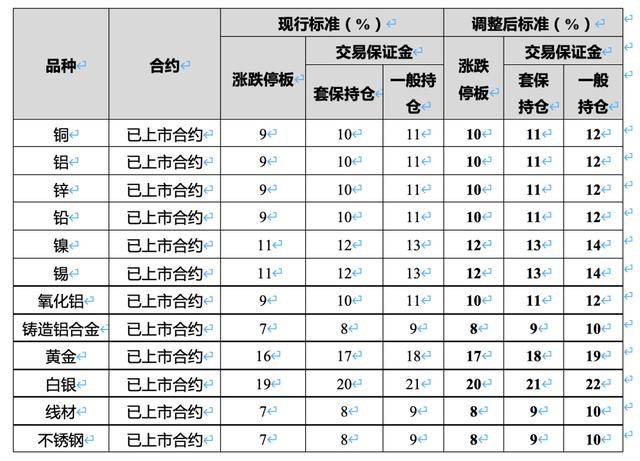
Core Viewpoint - The Shanghai Futures Exchange (SHFE) has announced an adjustment to the price limits and margin requirements for various futures contracts, including gold and silver, effective from February 9, 2026, in response to extreme market conditions [1][4]. Group 1: Adjustments to Futures Contracts - The price limit for gold futures contracts has been adjusted to 17%, with the margin requirement for hedging positions set at 18% and for general positions at 19% [2][3]. - The price limit for silver futures contracts has been increased to 20%, with the margin requirement for hedging positions at 21% and for general positions at 22% [2][3]. - For non-ferrous metals, the price limit for copper, aluminum, lead, and zinc has been set at 10%, with corresponding margin requirements of 11% for hedging and 12% for general positions [2][3]. Group 2: Market Response and Regulatory Intent - Industry insiders indicate that the adjustments are a timely and necessary response to current extreme market conditions, aimed at alleviating market pressure and reducing risks associated with high-leverage speculation [4][5]. - The measures are designed to maintain overall market stability and prevent risk spillover from extreme volatility in individual commodities, particularly in the context of heightened international market sentiment [4][5]. - The regulatory approach emphasizes stability and proactive management of market expectations, especially as the Chinese New Year approaches and uncertainties in overseas markets remain high [5]. Group 3: Market Performance and Outlook - On February 5, domestic commodity futures saw significant declines, with silver dropping over 10% and gold falling by nearly 3% [6]. - International precious metal prices also adjusted, with silver experiencing a drop of over 17% at one point during the day [6]. - Analysts suggest that while the long-term outlook for gold remains strong due to factors like de-globalization and central bank purchases, short-term volatility driven by crowded trading positions poses risks [6][7].
上期所:再次对黄金、白银等期货品种提保扩板
Sou Hu Cai Jing· 2026-02-05 15:58
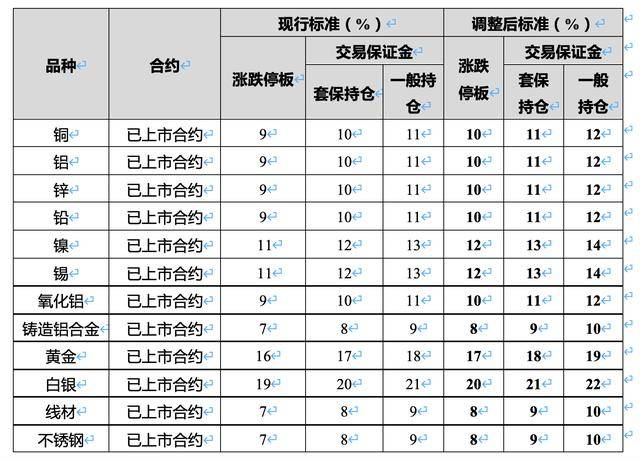
Core Viewpoint - The Shanghai Futures Exchange (SHFE) has announced an adjustment to the price limits and margin requirements for various futures contracts, including gold and silver, effective from February 9, 2026, in response to extreme market conditions [1][4]. Group 1: Adjustments to Futures Contracts - The price limit for gold futures contracts has been adjusted to 17%, with the margin requirement for hedging positions set at 18% and for general positions at 19% [2][3]. - The price limit for silver futures contracts has been increased to 20%, with the margin requirement for hedging positions at 21% and for general positions at 22% [2][3]. - For non-ferrous metals, the price limit for copper, aluminum, lead, and zinc has been set at 10%, with corresponding margin requirements of 11% for hedging and 12% for general positions [2][3]. - The price limit for aluminum alloy, wire, and stainless steel has been adjusted to 8%, with margin requirements of 9% for hedging and 10% for general positions [2][3]. - Nickel and tin futures contracts have a price limit of 12%, with margin requirements of 13% for hedging and 14% for general positions [2][3]. Group 2: Market Response and Implications - Industry experts indicate that the SHFE's decision to raise price limits and margin requirements is a timely and necessary measure to address current extreme market conditions, aiming to alleviate market pressure and reduce risks associated with high-leverage speculation [4]. - The adjustments are seen as a preventive measure to maintain overall market stability and to prevent risks from overseas market fluctuations, particularly in the context of heightened market sentiment in international precious metals [4]. - The measures reflect China's regulatory approach to prioritize stability in the commodity futures market, especially as the Spring Festival approaches and uncertainties in overseas markets increase [4]. Group 3: Market Performance - On February 5, domestic commodity futures saw significant declines, with silver dropping over 10% and other metals like copper and aluminum also experiencing declines of more than 2% [5]. - International precious metal prices continued to adjust, with spot silver experiencing a drop of over 17% at one point, and spot gold down by nearly 3% [5].
上期所处理两起违规行为并提示市场风险
Qi Huo Ri Bao· 2026-01-29 18:08
Core Viewpoint - The Shanghai Futures Exchange has announced regulatory measures against a client for violating trading rules, highlighting the need for compliance and risk awareness in the current volatile market environment [1] Group 1: Regulatory Actions - A client executed a self-trade for the third time, violating Article 12 of the Shanghai Futures Exchange's regulations, leading to restrictions on opening positions in relevant contracts [1] - A group of accounts under common control exceeded the daily trading volume limits, violating Article 16 of the same regulations, resulting in similar restrictions on opening positions [1] Group 2: Market Conditions - The exchange noted that the international situation is complex and unpredictable, contributing to increased market volatility [1] - In light of the upcoming Spring Festival, the exchange urged relevant parties to enhance compliance management and advised investors to improve risk awareness and invest rationally to maintain market stability [1]
交易所连续出手!对部分客户限制开仓、调整涨跌停板幅度
Jin Rong Shi Bao· 2026-01-28 11:01
Core Viewpoint - The Shanghai Futures Exchange (SHFE) has implemented strict regulatory measures to curb excessive trading and ensure market stability, reflecting a zero-tolerance stance towards illegal trading activities [1][4][5]. Group 1: Regulatory Actions - On January 28, SHFE announced restrictions on certain clients due to excessive trading volumes that exceeded the exchange's limits, violating the abnormal trading behavior management regulations [1]. - Multiple regulatory measures have been taken recently, including a one-month restriction on opening new positions and withdrawal limits for clients suspected of failing to declare actual control relationships in tin and silver futures [4]. - On January 27, SHFE identified 18 clients in three groups engaging in suspicious trading activities in tin and silver futures, leading to further restrictions [4]. Group 2: Margin and Price Limit Adjustments - Effective from January 30, SHFE adjusted the price limit and margin requirements for various futures contracts, including nickel, aluminum, lead, zinc, stainless steel, and precious metals [2][3]. - Specific adjustments include a price limit of 11% for nickel futures and a margin requirement of 12% for hedged positions, while gold and silver futures have a price limit of 16% and a margin requirement of 17% for hedged positions [3]. Group 3: Market Impact and Industry Response - Industry insiders indicate that SHFE's ongoing regulatory announcements signal a clear message to the market about the exchange's commitment to maintaining orderly trading and risk management [5].
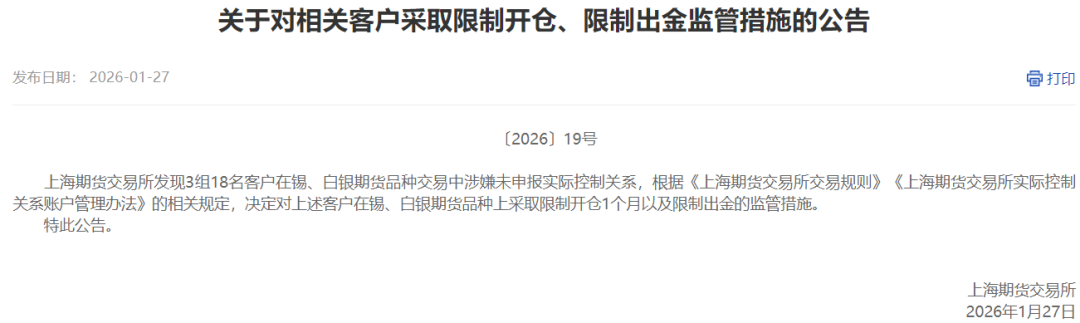
再出手!18名客户被限制开仓和出金!交易所精准亮剑 守护市场“安全感”
Qi Huo Ri Bao· 2026-01-27 13:36
Core Viewpoint - The Shanghai Futures Exchange (SHFE) has implemented regulatory measures in response to significant market volatility in precious and non-ferrous metals, aiming to maintain trading order and protect investors' rights [4][6]. Group 1: Regulatory Actions - On January 27, SHFE announced that nine groups of accounts exceeded trading limits, leading to restrictions on opening new positions for these accounts and withdrawal limitations for 18 clients suspected of failing to declare actual control relationships [1]. - Between January 26 and 27, SHFE issued four regulatory announcements and two notifications regarding upgraded risk control measures due to increased trading risks influenced by fluctuating U.S. tariff policies and geopolitical conflicts [4]. - SHFE has publicly released ten regulatory announcements as of January 27, with a focus on monitoring trading behaviors and verifying actual control relationships to combat market manipulation [6]. Group 2: Market Conditions - From December 2022 to January 2023, prices for gold, silver, copper, and tin reached historical highs, with gold futures surpassing 1,100 yuan per gram and silver futures exceeding 30,000 yuan per kilogram [4]. - Market analysts attribute the surge in precious and non-ferrous metal prices to a combination of macroeconomic and fundamental factors, although the rapid price increases have raised concerns about potential risks, particularly from high-leverage funds and irrational buying behavior [4]. Group 3: Risk Control Measures - SHFE has upgraded its risk control measures, including adjustments to trading margins and fees to increase trading thresholds and curb high-leverage and short-term speculative behaviors [5]. - The exchange has modified the price fluctuation limits for various metals, with silver's limit set at 16% and tin's at 11%, to mitigate extreme market conditions [5]. - Daily opening limits have been established, such as an 800-hand limit for silver and a 200-hand limit for tin, to prevent concentrated capital inflows that could lead to abnormal price fluctuations [5].