本土化研发与运营

Search documents
从“全球车”到“中国定制” BBA在华转型路径渐明
Xin Lang Cai Jing· 2026-01-19 23:21
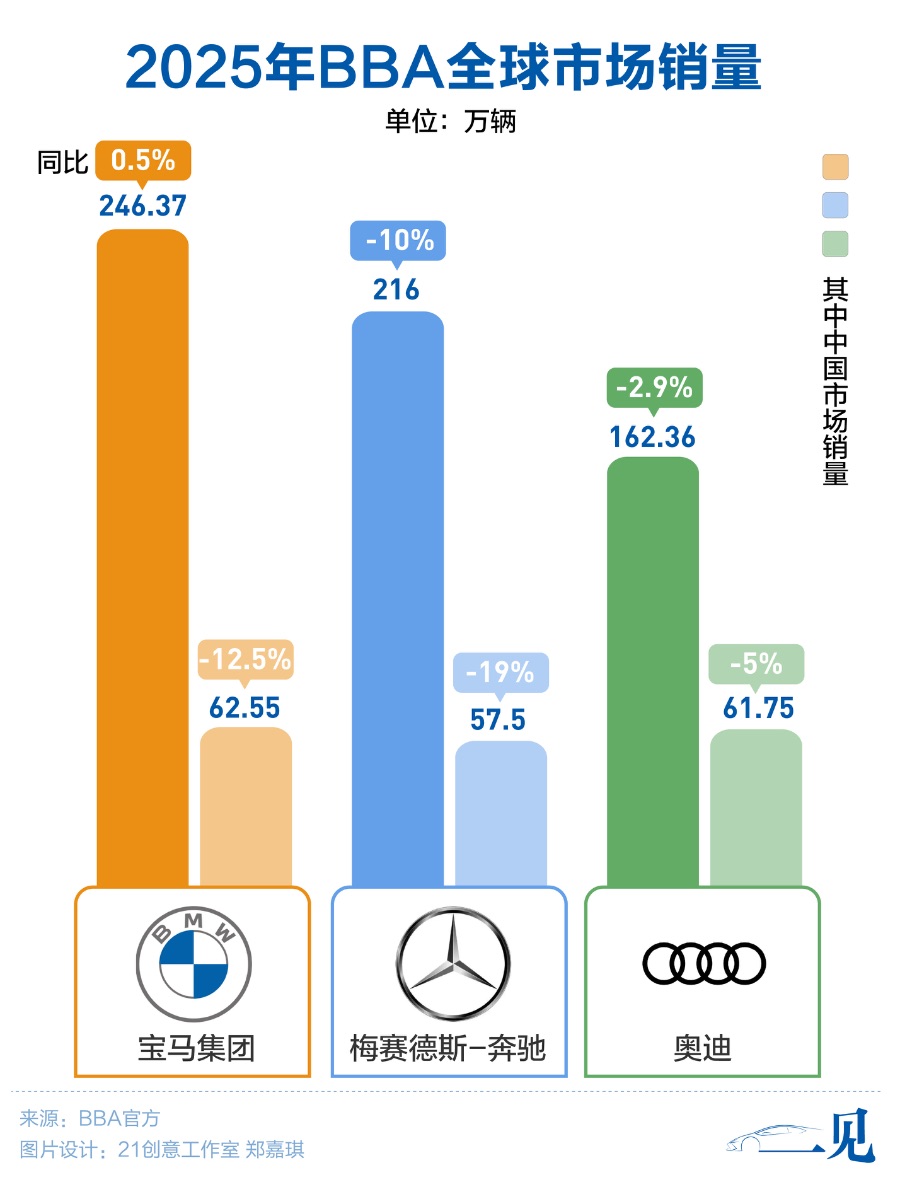
Core Insights - The traditional luxury car brands are losing their appeal in the wave of new energy vehicles, as evidenced by the sales data from BBA (Benz, BMW, Audi) [1] - BBA's global sales fluctuations are closely tied to their weak performance in the Chinese market, which remains their largest single market but has seen a significant reduction in contribution [2] Group 1: Sales Performance - BMW leads with global sales of 2.4637 million units in 2025, a slight increase of 0.5% year-on-year; Mercedes-Benz sold 2.16 million units, down 10%; Audi's sales were 1.6236 million units, down 2.9% [1] - In China, BMW's sales fell to 625,500 units in 2025, a decline of 12.5%; Mercedes-Benz's sales dropped to 575,000 units, down 19%; Audi's sales decreased to 617,500 units, down 5% [2] - BMW's sales in China have seen a continuous decline from 825,000 units in 2023 to 714,500 units in 2024, and further to 625,500 units in 2025, losing approximately 200,000 units in two years [2] Group 2: Market Dynamics - The core models of BBA, such as the BMW 3 Series, Mercedes-Benz C-Class, and Audi A4L, are facing significant threats as the market for fuel vehicles in the 300,000 to 400,000 yuan price range is declining [4] - In 2025, the market share of Chinese brands in passenger vehicles reached 69.5%, while the share of German brands shrank to 12.1% [4] Group 3: Electric Vehicle Transition - BBA is facing a dual challenge of a shrinking fuel vehicle market and a lack of presence in the electric vehicle segment, with traditional fuel vehicle sales declining by 4% in 2025 [5] - In 2025, Mercedes-Benz sold 168,800 pure electric vehicles, accounting for only about 11% of its total sales, while BMW's new energy vehicle sales reached 642,100 units, making up about 26% [6] Group 4: Strategic Responses - BMW plans to implement aggressive price cuts starting January 1, 2026, with 24 models seeing price reductions of over 10%, and flagship models like the i7 M70L seeing a drop of 301,000 yuan [7] - Mercedes-Benz aims to focus on product upgrades and intelligent transformation, planning to launch over 15 new and updated models in 2026 [8] - Audi is also defining 2026 as a "product year," continuing its localization strategy with new models set to launch [8] Group 5: Future Outlook - BBA is shifting from a "global car" approach to a "China customization" strategy, emphasizing the importance of local development and operations [9] - The success of BBA's transformation in 2026 will depend not only on product improvements but also on the courage to disrupt traditional manufacturing thinking and restructure their organizations [9]


奔驰、宝马、奥迪在华销量集体下滑,开启自救
21世纪经济报道· 2026-01-19 14:45
Core Viewpoint - The traditional luxury car brands, particularly BBA (BMW, Benz, Audi), are losing their appeal in the face of the new energy wave, as evidenced by their declining sales figures in the Chinese market, which is their largest single market [1][4]. Sales Performance - In 2025, BMW led with global sales of 2.4637 million units, a slight increase of 0.5% year-on-year; Mercedes-Benz sold 2.16 million units, down 10%; and Audi sold 1.6236 million units, down 2.9% [1]. - In China, BMW's sales fell to 625,500 units, a decrease of 12.5%; Mercedes-Benz's sales dropped to 575,000 units, down 19%; and Audi's sales decreased to 617,500 units, down 5% [1]. Market Dynamics - BMW's sales in China have been on a continuous decline, dropping from 825,000 units in 2023 to 714,500 units in 2024, and further to 625,500 units in 2025, resulting in a loss of approximately 200,000 units over two years [3]. - Mercedes-Benz's sales have seen a steeper decline, falling from a peak of 774,000 units in 2020 to 575,000 units in 2025 [3]. Strategic Challenges - The decline in sales is attributed to the slow transition to electrification and a weakening brand premium. BBA must reassess its strategy in China as its traditional competitive advantages are being challenged [4]. - The luxury segment's core models, such as the BMW 3 Series, Mercedes-Benz C-Class, and Audi A4L, are facing significant threats, with the 300,000 to 400,000 yuan price range seeing a market decline of 19.2% and 15% respectively [6]. Electric Vehicle Market - In 2025, China's new energy vehicle sales reached 13.875 million units, with a penetration rate of 54%, while the traditional fuel vehicle market shrank by 4% [7]. - BBA's presence in the electric vehicle market is weak, with Mercedes-Benz selling 168,800 pure electric vehicles (11% of total sales), BMW selling 642,100 (26%), and Audi delivering 223,000 (with a 36% increase) but lacking significant brand impact [7]. Competitive Landscape - Chinese high-end new energy brands are rapidly gaining market share, with brands like Hongmeng Zhixing and Li Auto each surpassing 400,000 units in sales, posing a significant challenge to BBA [7]. - The shift in dealership channels reflects the changing market dynamics, with many traditional luxury brand dealers transitioning to domestic new energy brands due to declining profitability [7]. Strategic Responses - BBA views 2026 as a critical year for transformation. BMW plans aggressive price cuts across 31 models, with reductions exceeding 10% for 24 models and over 20% for 5 models, aiming to stabilize its dealer network and support its electric vehicle transition [10]. - BMW is also set to launch around 20 new models in 2026, focusing on next-generation electric technologies [11]. - Mercedes-Benz is emphasizing product upgrades and smart technology, planning to introduce over 15 new and updated models in 2026 [11]. - Audi aims to enhance its local strategy with new models and technology partnerships, marking 2026 as a significant year for product development [11]. Localization Strategy - BBA is shifting from a "global car" approach to a "China customization" strategy, recognizing the need for localized development to meet the rapidly evolving demands of the Chinese market [12]. - Positive changes are occurring, such as increased involvement of Chinese teams in the development of new technologies, although these efforts are still in the exploratory phase [13].
从“全球车”到“中国定制”,BBA在华转型路径渐明
2 1 Shi Ji Jing Ji Bao Dao· 2026-01-19 12:36
Core Insights - The traditional luxury car brands are losing their appeal in the face of the new energy wave, as evidenced by the sales data from BBA (Benz, BMW, Audi) [1] - BBA's global sales performance is closely tied to their weak performance in the Chinese market, which remains their largest single market but has seen a significant reduction in contribution [1][4] Group 1: Sales Performance - BMW leads with global sales of 2.4637 million units in 2025, a slight increase of 0.5% year-on-year; Mercedes-Benz sold 2.16 million units, down 10%; Audi sold 1.6236 million units, down 2.9% [1] - In China, BMW's sales fell to 625,500 units in 2025, a decrease of 12.5%; Mercedes-Benz's sales dropped to 575,000 units, down 19%; Audi's sales decreased to 617,500 units, down 5% [1] - BMW's sales in China have seen a continuous decline from 825,000 units in 2023 to 714,500 units in 2024, and further down to 625,500 units in 2025, losing approximately 200,000 units in two years [3] - Mercedes-Benz's sales have sharply declined from a peak of 774,000 units in 2020 to 575,000 units in 2025 [3] Group 2: Market Dynamics - The core models of BBA, such as BMW 3 Series, Mercedes-Benz C-Class, and Audi A4L, are facing significant threats as the market for fuel vehicles in the 300,000 to 400,000 yuan price range is declining [6] - In 2025, the market share of Chinese passenger cars reached 69.5%, while the share of German brands shrank to 12.1% [6] - BBA is caught in a dual dilemma of a shrinking fuel vehicle market and a lack of presence in the electric vehicle segment [7] Group 3: Strategic Responses - BMW plans to implement aggressive price cuts starting January 1, 2026, with reductions exceeding 10% for 24 models and over 20% for 5 models, including a significant drop of 301,000 yuan for the flagship electric model i7 M70L [10] - Mercedes-Benz is focusing on product upgrades and smart technology, planning to launch over 15 new and updated products in 2026, including a new generation of S-Class and GLC electric models [12] - Audi aims to continue its localization strategy in 2026, with new models like the Q5L and A6L, and plans to leverage local technology to enhance market competitiveness [12] Group 4: Future Outlook - The year 2026 is seen as a critical period for BBA to transform and recover in the Chinese market, with a focus on localizing product development and enhancing customer experience [13] - Positive changes are occurring, such as increased involvement of local teams in the development of new technologies tailored to Chinese consumer preferences [13]