机器人通用大脑

Search documents
最新估值逼近千亿!英伟达、软银、三星、LG、亚马逊为何同时抢投这家“机器人通用大脑”?
Sou Hu Cai Jing· 2026-01-16 10:44
Core Insights - Skild AI, a startup in the foundational model for robotics, has raised approximately $1.4 billion in Series C funding, achieving a valuation exceeding $14 billion, setting a record in the field [1][5] - The investment round was led by SoftBank Group, with participation from major tech giants like Nvidia, Samsung, LG, Jeff Bezos' family office, and Salesforce, forming a diverse investment alliance across various sectors [5][12] Group 1: Company Background - Skild AI was co-founded by Deepak Pathak and Abhinav Gupta, both professors at Carnegie Mellon University, who previously worked at Meta's advanced robotics lab, providing a unique blend of academic and industry experience [5][7] - The company aims to address the challenges in robotics by creating a universal robotic brain, Skild Brain, capable of running on standard hardware and performing basic tasks like climbing stairs and avoiding obstacles [7][8] Group 2: Technological Innovations - Skild Brain represents a paradigm shift in robotics, utilizing large-scale multimodal data for end-to-end training, moving away from fixed instruction sets [9][11] - The system's architecture decouples hardware from intelligence, allowing it to adapt to various robotic platforms and maintain robust performance even in changing environments [11][19] Group 3: Investment Dynamics - The diverse group of investors reflects strategic interests, with Nvidia aiming to fill gaps in its robotics technology stack, while SoftBank seeks to enhance its influence in the robotics industry [12][14] - For Samsung and LG, this investment signifies a strategic pivot towards robotics as a key growth area amid slowing consumer electronics [14] Group 4: Commercialization and Market Potential - Skild AI's commercialization efforts are accelerating, with plans to serve over eight enterprise clients by the end of 2025, spanning sectors like security, construction, and logistics [15][18] - The company addresses a significant market demand, particularly in industries facing labor shortages, where traditional robotic systems struggle due to high customization costs [15][22] Group 5: Challenges Ahead - Despite promising prospects, Skild AI faces challenges in ensuring the reliability of its technology in complex real-world environments, as well as balancing model performance with cost [19][21] - The fragmented state of the robotics hardware market poses additional challenges for achieving true universality in robotic applications [21][22]


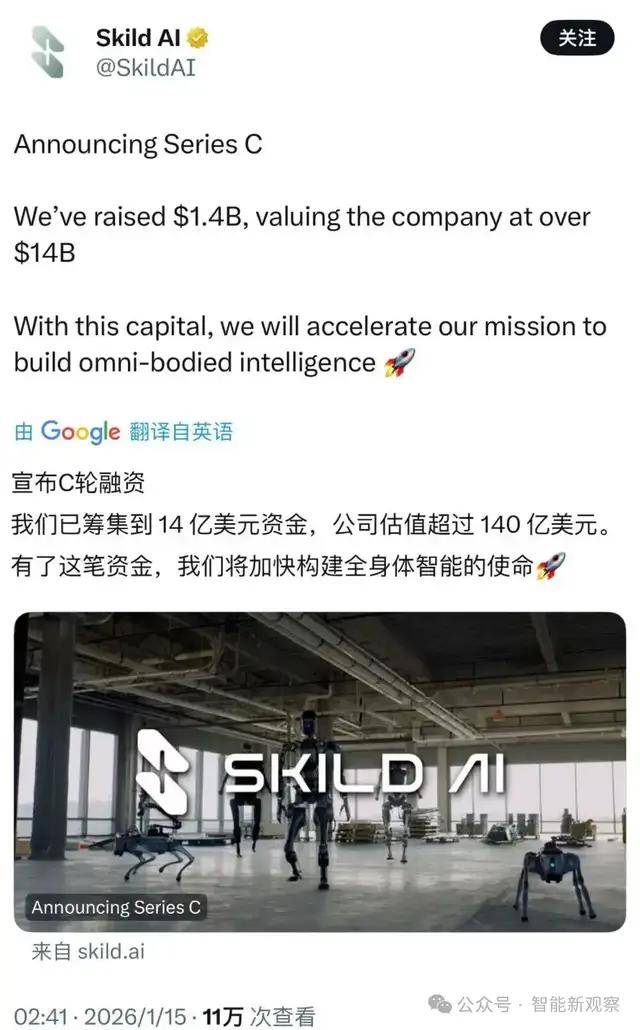
乘特朗普All in机器人东风?软银和英伟达考虑参与Skild AI新融资,估值或140亿
机器人圈· 2025-12-10 09:37
Core Insights - Skild AI is in talks for a new funding round exceeding $1 billion, which could nearly double its valuation to $14 billion from $4.7 billion during its last funding round in June 2023 [1][2] - The U.S. government, under the Trump administration, is actively promoting the robotics industry, with plans for an executive order on robotics next year [2][7] Group 1: Investment and Valuation - SoftBank and NVIDIA are negotiating to invest in Skild AI, which has shown impressive technology in pilot projects [2][3] - Skild AI raised $500 million in its B round of funding, led by SoftBank, with participation from NVIDIA and others, achieving a valuation of $4.7 billion [2][3] - The robotics investment landscape is rapidly growing, with projections indicating that funding in the sector could reach $2.3 billion by 2025, doubling from the previous year [3] Group 2: Company Overview - Skild AI, founded in 2023 by former Meta AI researchers, focuses on developing AI models for various types of robots rather than manufacturing hardware [4][5] - The company released its first general AI model in July 2023, capable of adapting to a wide range of tasks from logistics to household chores [5] - Skild AI collaborates with NVIDIA to develop a foundational model called Skild Brain, which can be trained with minimal additional input to acquire new skills [5] Group 3: Government Initiatives and Industry Trends - The U.S. Department of Commerce is committed to advancing robotics and advanced manufacturing, emphasizing their importance in bringing critical production back to the U.S. [7] - There is a growing interest in robotics within the U.S. Congress, with proposals for establishing a national robotics committee [7] - The global humanoid robot market is projected to reach $38 billion by 2035, highlighting the increasing demand for robotic solutions [3]


320亿估值独角兽Skild AI:两位教授造出「不死」大脑,震撼科技圈
创业邦· 2025-11-26 10:35
Core Insights - Skild AI is revolutionizing the robotics industry with its innovative AI system, Skild Brain, which allows robots to adapt and perform tasks even when physically impaired [2][28] - The company's valuation has skyrocketed from $1.5 billion in July 2024 to $4.5 billion by June 2025, reflecting significant investor interest and confidence in its technology [6][28] Company Overview - Skild AI, founded in May 2023, is a spin-off from Carnegie Mellon University, focusing on developing a universal AI system for various robotic applications [5][6] - The founders, Abhinav Gupta and Deepak Pathak, are renowned professors in robotics and computer science, with extensive academic and industry experience [8] Technology and Innovation - Skild Brain aims to solve the fragmentation issue in the robotics industry by enabling a single AI model to control multiple types of robots for various tasks [10][11] - The technology allows robots to learn from past experiences, significantly enhancing their operational efficiency and adaptability [16][17] Competitive Advantages - Skild AI has established three key barriers to entry: - **Technical Barrier**: Skild Brain possesses a memory capability that far exceeds traditional robots, allowing for improved learning and adaptation [16][17] - **Data Barrier**: The company utilizes a unique data acquisition strategy, including simulation training and real-world data collection, creating a robust feedback loop for continuous improvement [18][20] - **Ecosystem Barrier**: Partnerships with major investors and industry players like SoftBank and Amazon provide Skild AI with resources and support that are difficult for competitors to replicate [21][22] Commercialization Efforts - Skild AI is actively pursuing commercialization, having formed partnerships with HPE and LG CNS to address computational challenges and explore model licensing in logistics and industrial applications [23][24] - The company has demonstrated significant cost advantages, deploying its technology on lower-cost robotic systems compared to traditional custom solutions [26] Future Outlook - The rapid increase in valuation and the innovative approach of Skild AI suggest a promising future for the company as it aims to create a universal brain for robots, enhancing their capabilities in various sectors [28][30]
谷歌创始人:不看好人形机器人,硬件很炫酷,但软件是短板
Robot猎场备忘录· 2025-06-05 05:37
Core Viewpoint - Sergey Brin, co-founder of Google, expresses skepticism about humanoid robots, emphasizing that while the hardware is impressive, the software often falls short. He believes that focusing too much on humanoid forms may underestimate AI's adaptability [1][2]. Group 1: Trends in Robotics - Brin notes that Google has acquired and sold several robotics companies, including Boston Dynamics, and acknowledges the current surge in robotics startups focusing on system development [1][2]. - He highlights that many people are drawn to humanoid robots because they mimic human activities, but he questions the necessity of humanoid forms for effective operation [2][3]. - Major players in the embodied intelligence sector include Tesla, known for its humanoid robot Optimus, and Nvidia, which aims to create a robust development ecosystem [3]. Group 2: Gemini Robotics Models - Google DeepMind has launched two models based on Gemini 2.0: the VLA model for understanding and executing new tasks without specific training, and the VL model for enhancing physical world understanding [5][12]. - The Gemini Robotics models are characterized by their ability to quickly adapt to new environments and tasks, natural language understanding, and the capability to perform complex, precise operations [12]. Group 3: Industry Challenges and Perspectives - Brin and other industry leaders, including Carolina Parada from DeepMind, emphasize that many impressive robot demonstrations are often pre-programmed and do not reflect true intelligence or adaptability [9][10]. - The industry consensus is that while humanoid robots have potential, significant breakthroughs in their "brains" and practical applications are still needed for meaningful commercialization [16][17].