极紫外光刻技术

Search documents
【招商电子】ASML 25Q4跟踪报告:25Q4营收与订单量创历史新高,指引2026年EUV业务大幅增长
招商电子· 2026-01-30 11:47
Financial Performance - In Q4 2025, ASML reported revenue of €9.718 billion, a year-on-year increase of 4.9% and a quarter-on-quarter increase of 29.3%, aligning with guidance expectations of €9.2-9.8 billion [2][3] - Equipment revenue was €7.584 billion, up 6.6% year-on-year and 36.6% quarter-on-quarter, while service revenue was €2.134 billion, down 0.6% year-on-year but up 8.8% quarter-on-quarter [3] - The gross margin for Q4 2025 was 52.2%, which is within the guidance range of 50%-52% [3][14] Orders and Market Demand - Q4 2025 saw a record order intake of €13.158 billion, a year-on-year increase of 85.6% and a quarter-on-quarter increase of 143.7%, with significant contributions from EUV orders [2][3] - The demand for EUV technology is driven by strong growth in AI-related capacity construction in data centers and infrastructure, which is gradually extending to high-end logic and storage chip customers [16] - The order breakdown included €7.4 billion in EUV orders, up 146.7% year-on-year and 105.6% quarter-on-quarter, indicating robust demand in the logic and storage sectors [3][16] Regional Performance - Revenue from mainland China in Q4 2025 was €2.73 billion, a year-on-year increase of 42.1% but a decrease in revenue share to 36% [4] - Revenue from Taiwan was €986 million, up 38.5% year-on-year, while revenue from the US was €1.289 billion, down 35.3% year-on-year [4] Future Guidance - For Q1 2026, ASML expects revenue to be between €8.2 billion and €8.9 billion, with a gross margin forecast of 51%-53% [5][13] - The company anticipates significant growth in EUV business for 2026, with total annual revenue projected between €34 billion and €39 billion [5][6] - Long-term guidance remains unchanged, with expectations for revenue to reach between €44 billion and €60 billion by 2030, and gross margins to improve to 56%-60% [6] Technological Advancements - ASML achieved significant progress in 2025, with the NXE:3800E model becoming a core production device for customers, achieving a wafer throughput of 220 wafers per hour [17] - The company is also enhancing existing EUV equipment to improve capacity, with expectations for increased market utilization of low numerical aperture EUV technology [17] Industry Trends - The market outlook has improved significantly, with strong demand for AI-related capacity in data centers and infrastructure, which is expected to drive growth in high-end logic and storage chips [16] - Customers are transitioning from 4nm to 3nm technology and expanding 2nm capacity to meet future demands in mobile devices and high-performance computing [16]

“光刻机,新机会”
半导体芯闻· 2025-12-19 10:25
Core Viewpoint - The article discusses the potential of Free Electron Lasers (FELs) to overcome current limitations in extreme ultraviolet (EUV) lithography, enabling advancements in semiconductor manufacturing at the atomic scale [2][36]. Group 1: Current Challenges in Semiconductor Manufacturing - The semiconductor industry faces significant challenges as transistor sizes approach atomic scales, necessitating breakthroughs in lithography technology [3]. - EUV lithography operates at a wavelength of 13.5 nm, which presents difficulties due to high absorption rates of materials, leading to expensive equipment and complex manufacturing processes [3][6]. - The current EUV light source, Laser-Produced Plasma (LPP), has low efficiency, requiring approximately 1 MW of power to produce 500 W of usable EUV output, resulting in a mere 0.05% efficiency [7][38]. Group 2: Advantages of Free Electron Lasers (FELs) - FELs can produce significantly higher EUV power with lower energy consumption, offering a fourfold power output with half the energy input compared to traditional methods [2][11]. - The brightness of FELs, a critical performance metric, is vastly superior to that of traditional sources, allowing for better lithography precision [12][16]. - FELs can achieve multi-kilowatt power levels, making them the only verified technology capable of scaling to meet the increasing demands of semiconductor manufacturing [38][39]. Group 3: Technical Mechanisms of FELs - FELs utilize high-energy electron beams that travel close to the speed of light, interacting with electromagnetic waves to produce tunable and exponentially amplified light beams [20][22]. - The unique properties of FELs, such as coherent radiation and high spectral purity, enable them to maintain high image contrast and reduce random defects in lithography processes [37][39]. - The energy recovery linear accelerator (ERL) technology enhances the overall energy efficiency of FEL systems by recycling energy from the electron beams [40][41]. Group 4: Economic and Industrial Implications - Transitioning to FEL technology represents a paradigm shift in lithography, comparable to the move from mercury lamps to excimer lasers [42]. - The operational costs of semiconductor manufacturing can be significantly reduced with FELs, as they eliminate the need for frequent replacement of optical components and lower energy consumption [38][39].

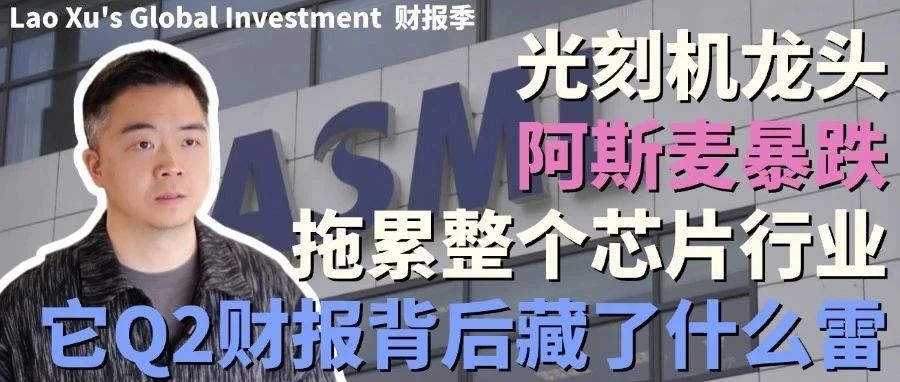
【财报季】光刻机龙头阿斯麦暴跌,拖累整个芯片行业:ASML Q2财报背后藏了什么雷?
老徐抓AI趋势· 2025-07-21 19:25
Core Viewpoint - ASML's Q2 2025 performance was strong, but the stock price fell nearly 10% after the earnings report due to lower-than-expected future guidance and geopolitical uncertainties [1][16][20]. Financial Performance Overview - In Q2 2025, ASML reported total net sales of €7.7 billion (approximately ¥642.13 billion), at the upper end of the forecast range [5][15]. - This figure represents a year-over-year increase of 23.21%, but a slight quarter-over-quarter decline of 0.646% from Q1 [5][15]. - Gross margin reached 53.7%, exceeding the company's guidance of 51%-53% [5][8]. - Net profit was €2.29 billion (approximately ¥191.81 billion), a year-over-year increase of 44.9%, but a slight decline of 2.76% from Q1 [5][15]. Business Composition - Sales from lithography systems accounted for €5.6 billion (approximately 73% of total sales), a year-over-year increase of 17.5% [6]. - Service revenue was €2.1 billion (approximately 27% of total sales), showing a year-over-year growth of 41.4% [6]. Orders and Equipment Sales - New orders in Q2 amounted to €5.541 billion, a significant increase from €3.936 billion in Q1 [6][15]. - EUV lithography machine orders totaled €2.3 billion, accounting for approximately 42% of total orders [6][15]. Factors Driving Gross Margin - The CFO highlighted three main reasons for the better-than-expected gross margin: growth in upgrade service revenue, lower one-time costs, and lower-than-expected tariff impacts [8]. - Despite the dilution effect on gross margin from high-NA EUV system revenue recognition, the overall gross margin remained high at 53.7% [8]. Technological Progress and Market Dynamics - ASML delivered its first TWINSCAN EXE:5200B system, marking a significant advancement in high-NA EUV lithography technology [9]. - Logic chips accounted for 84% of new orders, driven primarily by AI demand, while memory chips made up 16% [10]. Financial Details and Capital Operations - In Q2, ASML repurchased approximately €1.4 billion in stock, with a total buyback plan of €5.8 billion from 2022 to 2025 [11]. - A mid-term dividend of €1.60 per share is scheduled for distribution on August 6, 2025 [11]. Management Comments and Future Outlook - The CEO stated that Q2 performance met expectations, driven by growth in upgrade services and cost reductions [13]. - For Q3 2025, ASML expects net sales between €7.4 billion and €7.9 billion, with a gross margin of 50%-52% [13]. - The company anticipates a 15% revenue growth for the full year compared to 2024, targeting a gross margin of around 52% [13]. Market Reaction and Stock Price Analysis - Following the earnings report, ASML's stock price fell by 8.33%, closing at $754.45, with trading volume significantly above average [16][17]. - The decline was attributed to lower-than-expected future guidance and uncertainties regarding growth prospects for 2026 [18][20]. Geopolitical and Economic Challenges - The company faces uncertainties due to U.S. export controls on the Chinese semiconductor industry, impacting ASML's business in China [21][31]. - The gross margin forecast for Q3 indicates a potential decline, raising concerns about the sustainability of profitability [22]. Conclusion - ASML's Q2 2025 results reflect strong performance, but the stock price drop indicates market concerns about future growth and geopolitical risks [29][30]. - The company remains a leader in the semiconductor equipment sector, but investors should monitor developments in geopolitical policies and market conditions closely [32].