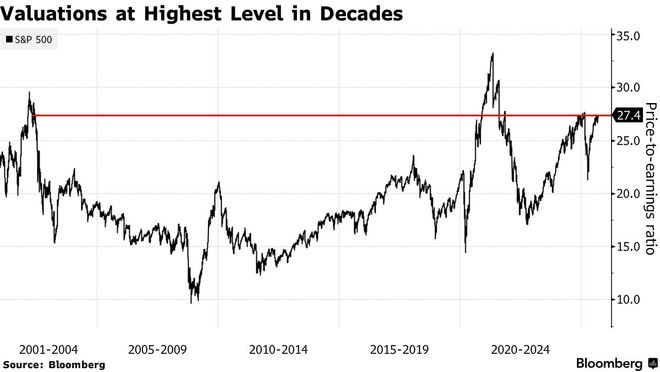
标普500指数估值

Search documents
外资交易台:市场宏观-2026 年的重大课题。 --- markets _ macro __ the big questions of 2026_
2026-01-12 01:41
Summary of Key Points from the Conference Call Industry and Company Overview - The conference call discusses the macroeconomic outlook for the US economy in 2026, focusing on GDP growth, consumer spending, housing market, policy changes, budget deficit, bond market, equity valuations, and the impact of AI on earnings growth. Core Insights and Arguments US GDP Growth - The forecast for US GDP growth in 2026 is optimistic at **2.8%**, compared to a **2.1%** consensus, driven by: - A mechanical rebound from a government shutdown - A fading tariff drag - Significant tax cuts from the OBBA - Easier financial conditions - Expected GDP growth rates are **3.3%** in Q1, **2.6%** in Q2, and a moderation to **2.1%** in Q3 and Q4 [4][5] US Consumer Outlook - Consumer spending growth slowed in 2025 due to slower real income growth and elevated inflation from job gains and moderate tariff-related price increases. - For 2026, a gradual rebound in job growth to **70k/month**, tax cuts, and wealth effects from past equity gains are expected to boost household spending, with a forecast of **2.2%** consumption growth in Q4/Q4, exceeding the consensus of **1.9%** [6][7] US Housing Market - The housing market outlook is challenging, with limited mortgage rate relief expected, leading to low single-digit growth in home prices, housing starts, and home sales throughout 2026 [8][9] Policy Changes from the Trump Administration - The key political issue remains "affordability," with potential policy levers including tariff cuts or another fiscal package. However, the likelihood of a second fiscal package is low due to concerns over deficit expansion. - Deregulation is expected to continue, particularly in energy and financial sectors, with housing affordability likely to remain a focus [10][11] US Budget Deficit Outlook - The federal deficit is expected to remain steady at around **6%** of GDP, though this depends on tariff rates. Discussions of another fiscal package in 2026 exist, but the implementation hurdle is high [13][14] US Bond Market Outlook - The baseline view for long-term UST yields is relatively range-bound, centered around **4.2%** for 10-year bonds, with a steeper yield curve anticipated as the Fed cuts rates further [15][16] Equity Market Valuation - The S&P 500 trades at a **22x** forward P/E multiple, which is high relative to history but aligns with favorable macroeconomic conditions. If the fundamental backdrop deteriorates, valuations may decline, but if earnings growth continues, risks to multiples are skewed higher [17][18] Impact of AI on Earnings Growth - Companies could see revenue increases through demand for AI products or by using AI to enhance productivity. A **0.4%** boost to S&P 500 earnings from AI-related productivity gains is expected in 2026, increasing to **1.5%** in 2027, though uncertainty remains [19][20] Additional Important Insights - Global defense stocks have shown strong performance, with YTD returns of **+13%** in the US, **+21%** in Europe, and **+27%** in Korea, driven by increased defense budgets [24][25] - Concerns about the sustainability of demand in the US market persist, reflecting on the intensity of last year's demand [26] - The consumer discretionary space shows low client exposure, indicating both challenges and opportunities [26] - A report on Asian equities ranks China > Korea > Japan, indicating a positive outlook for China [27]

一部分人悄悄撤退,留下世界接盘
Xin Lang Cai Jing· 2025-10-05 23:02
Group 1 - The S&P 500 index is expected to experience a slight pullback of 3%-4%, with some analysts predicting a potential drop of 5% to 10% [2] - The current valuation of the S&P 500 stands at 23 times expected earnings, comparable to the levels seen during the 2000 internet bubble, raising concerns about sustainability as earnings reports approach [2] - The U.S. government shutdown has created a lack of important economic data, leading traders to adopt a cautious stance, reducing positions and waiting for clearer signals [2] Group 2 - October 15 is a critical date for traders due to the CPI announcement; if the government remains shut down, the delay in CPI release could lead to increased market volatility [3] - Institutional investors are purchasing protective put options to hedge against sudden market declines, indicating a shift in sentiment as they prefer to lock in gains rather than take additional risks [3] - The current market risk is characterized by stagnation rather than a sharp decline, with smart money exiting while latecomers are left to absorb potential losses [3]

标普500估值焦虑转移!盈利增速跟不上股价涨幅 非科技板块浮现泡沫迹象
Zhi Tong Cai Jing· 2025-09-16 10:52
Group 1 - The S&P 500 index has raised concerns among investors about potential bubbles due to high valuations, primarily driven by the technology sector, with five large tech stocks contributing half of the index's 12% gain year-to-date [1] - The profit growth of these tech giants has outpaced their stock price increases, suggesting that their high valuations may be justified, while other sectors appear overvalued [1][2] - Excluding the tech sector, the S&P 500 index has risen 13% over the past year, but profits have only increased by 6.4%, indicating a disparity between stock performance and earnings growth [1] Group 2 - The expected P/E ratio of the S&P 500 index exceeds 27, a level typically seen in extremely bullish markets, with notable high valuations in non-tech stocks [2] - Major tech companies like Nvidia, Microsoft, Meta, and Alphabet have seen a 7.9% decrease in their P/E ratios for 2025, while their stock prices rose by 18%, supported by a projected 20% profit growth over the next 12 months [2] - Concerns about long-term valuations persist, with the S&P 500 index rising 83% since the 2022 bear market low, while earnings have only grown by 16% [7]