
科技股估值

Search documents
海外策略周报:地缘问题引发本周欧美市场波动较多-20260124
HUAXI Securities· 2026-01-24 09:30
Global Market Overview - The global markets experienced significant volatility this week due to geopolitical issues related to Greenland, impacting both European and American markets [1] - The US stock market showed fluctuations, with the TAMAMA Technology Index's P/E ratio at 35.86, remaining above 35, indicating high valuations in tech assets [1][12] - The Philadelphia Semiconductor Index's P/E ratio rose to 46.03, while the Nasdaq Index's P/E ratio stood at 41.47, both indicating elevated valuation levels in the tech sector [1][12] - The S&P 500 Shiller P/E ratio is at 40.65, suggesting continued pressure for a potential correction in the US stock market due to high valuations and uncertainties surrounding Trump's economic and foreign policies [1][12] US Market Performance - The S&P 500, Nasdaq, and Dow Jones Industrial Average all experienced declines this week, with respective drops of 0.35%, 0.06%, and 0.53% [2][12] - The energy sector within the S&P 500 saw the largest increase, rising by 3.11%, while the financial sector faced the most significant decline, dropping by 2.52% [12] Hong Kong Market Performance - The Hang Seng Index and the Hang Seng China Enterprises Index both fell, with declines of 0.36% and 0.65%, respectively, while the Hang Seng Hong Kong Enterprises Index increased by 1.88% [24] - The Hang Seng Technology Index decreased by 0.42%, indicating mixed performance across different sectors [24][37] - The materials sector in Hong Kong showed the largest gain, increasing by 4.1%, while the information technology sector faced the largest decline, dropping by 2.84% [26] Economic Data - In December 2025, the Eurozone's CPI growth rate was 1.9%, down from 2.1%, and the core CPI growth rate was 2.3%, down from 2.4% [4][38] - The UK CPI growth rate for December 2025 was 3.4%, up from 3.2%, while the US PCE price index for November 2025 was 2.79%, higher than the previous 2.73% [40] - Japan's CPI growth rate in December 2025 was 2.1%, down from 2.9%, and the industrial production index for November 2025 was -2.22%, lower than the previous 1.59% [44]
美国股指期货徘徊于历史高位附近 圣诞行情整装待发
Xin Lang Cai Jing· 2025-12-24 12:39
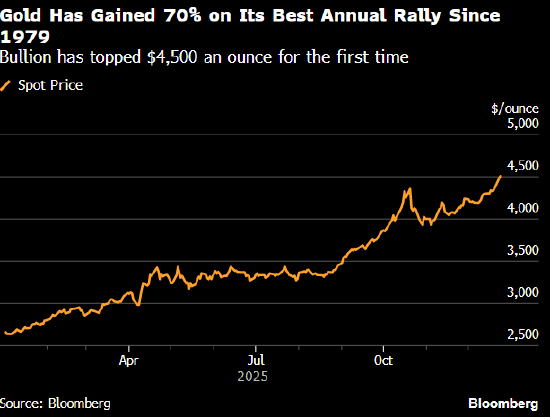
Core Insights - US stock index futures are hovering near historical highs as the seasonal strength of the stock market approaches, with gold prices rising above $4,500 per ounce [1][3] - The three major US stock index futures are relatively flat, following a surge in tech stocks that pushed the S&P 500 index to a record high [1][3] - Traders are optimistic about year-end performance, potentially extending the approximately 17% gain of the US benchmark index for the year [1][3] Economic Outlook - The US economy continues to outperform expectations, boosting investor optimism and supporting profit prospects for the coming year [1][3] - The money market anticipates at least two interest rate cuts by the Federal Reserve in 2026, which could uplift broader stock sectors despite concerns over tech stock valuations [1][3] Analyst Commentary - Swissquote analyst Ipek Ozkardeskaya noted that recent market trends suggest a positive holiday season, but cautioned that reality may soon take precedence, with some tech market segments appearing unstable [1][3] - The focus for the upcoming earnings season is expected to shift from impressive numbers to the actual sources of income [1][3]

26年投资者最怕什么?AI泡沫高居榜首,地缘政治竟被无视
Jin Shi Shu Ju· 2025-12-19 03:21
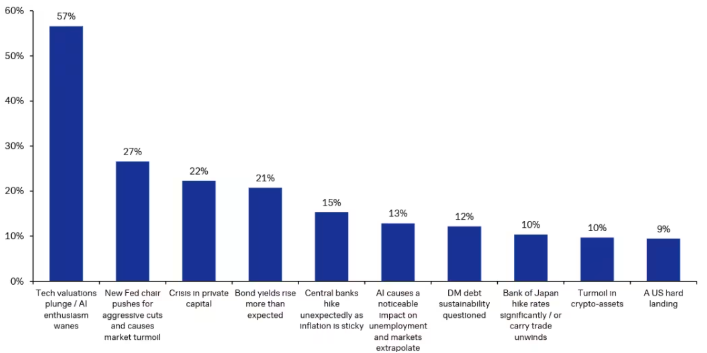
Group 1 - The core concern for investors regarding risks in 2026 is the "AI/technology bubble risk," which has significantly overshadowed other risks [1][3] - Over half of the surveyed asset managers identified the AI/technology bubble as their primary worry, followed closely by concerns about the new Federal Reserve Chair's potential aggressive rate cuts and the possibility of a crisis in private equity [3] - The survey indicated that while the perception of bubble risk remains high, it has decreased compared to September levels and is lower than during the liquidity surge post-pandemic in 2021 [3] Group 2 - 71% of respondents expressed a preference for sectors outside the "Magnificent Seven" in their pension investments, despite the latter outperforming the market by approximately 9 percentage points since July 2024 [3] - The adoption rate of AI in the workplace has risen from 50% in the summer of 2024 to 86%, with higher adoption rates observed in Europe compared to the U.S. [3] - The average expected return for the S&P 500 index in 2026 is projected at 6.9%, which is the highest forecast value in four years, contrasting with a 15% return achieved so far in 2025 [4]
德银调查:AI估值风险成为2026年市场稳定性面临的最大单一威胁
Ge Long Hui A P P· 2025-12-18 15:36
Core Viewpoint - The valuation risks associated with artificial intelligence (AI) have emerged as the largest single threat to market stability in 2026, according to a recent global market survey by Deutsche Bank [1] Group 1: Market Risks - 57% of respondents believe that a decline in enthusiasm for AI leading to a crash in tech stock valuations is the biggest risk facing the market next year [1] - The second major concern is the potential for the new Federal Reserve Chair to implement aggressive rate cuts, which could lead to market turmoil [1] - Concerns about a crisis in private capital markets and the possibility of government bond yields rising beyond expectations follow closely [1] - The risk of unexpected interest rate hikes due to persistent inflation ranks fifth [1] Group 2: Investor Preferences - Approximately 71% of respondents prefer to invest retirement funds in other segments of the U.S. stock market rather than the "Magnificent Seven," a preference that has remained stable since July 2024 [1] - Looking ahead to 2026, respondents have a cautious outlook on market returns, expecting an average return of about 7% for the "Magnificent Seven" and a similar average increase of nearly 7% for the S&P 500 index, marking the strongest outlook recorded in the past four years [1]
甲骨文业绩遇挫终结跨资产市场狂欢 交易者扎堆避险
Xin Lang Cai Jing· 2025-12-11 12:57
Core Viewpoint - The market excitement following the Federal Reserve's policy decision quickly dissipated, primarily due to Oracle's disappointing earnings, raising concerns about tech stock valuations and the potential for a Christmas rally [1][4]. Market Reactions - The Morgan Stanley Capital International Global All Countries Index approached historical peaks before reversing downward, while gold ended a potential three-day rally [1][4]. - Oracle's stock plummeted due to revenue falling short of market expectations and increased spending, leading to a significant decline in investor optimism [1][4]. - Nasdaq futures dropped by 1.6%, and the 10-year U.S. Treasury yield fell by 3 basis points following Oracle's earnings report [1][4]. Investor Sentiment - Despite a brief recovery in risk appetite due to expectations of further monetary easing from the Federal Reserve, the rapid reversal in market sentiment highlighted ongoing concerns about an AI bubble [5]. - New uncertainties in the AI sector, combined with Powell's remarks on stabilizing the labor market, have intensified market uncertainty in the final weeks of the year [5]. - Nick Freyres, CIO of Singapore's Jeng Cheng Asset Management, expressed a contradictory outlook on market prospects, indicating potential for dual-direction volatility and difficulty in forming clear directional judgments [5]. Bond Market Impact - Following the Federal Reserve's decision, the two-year U.S. Treasury yield fell nearly 8 basis points, marking the largest single-day decline in two months, with an additional drop of 1 basis point during Thursday's Asian trading session [2][5]. - SoftBank Group also experienced a sell-off, with its stock dropping 8.4%, the largest decline since November 25 [2][5]. Market Observations - Some market observers remain calm, with Kenny Polcari, Chief Market Strategist at Slatestone Wealth, stating that the market's reaction to Oracle's earnings is not surprising given the significant rise in tech stocks this year [3][6].

美股集体调整,降息节点前观望情绪较强
Mei Ri Jing Ji Xin Wen· 2025-12-09 01:49
Group 1 - The three major U.S. stock indices closed lower, with the Dow Jones down 0.45%, the Nasdaq down 0.14%, and the S&P 500 down 0.35% due to cautious sentiment ahead of the Federal Reserve's interest rate meeting [1] - Tesla's stock fell over 3% following a downgrade in ratings, while Marvell Technology dropped nearly 7% after losing an AI chip order from Amazon [1] - The semiconductor industry showed strong performance, with the Philadelphia Semiconductor Index rising 1.1%, Micron Technology up over 4%, and other companies like AEM, ON Semiconductor, Broadcom, and TSMC increasing by more than 2% [1] Group 2 - The Nasdaq Golden Dragon China Index saw a slight increase of 0.08%, with Baidu and Miniso rising over 3%, while XPeng Motors, New Oriental, and JinkoSolar gained over 2%, and NetEase fell over 2% [1] - International gold prices faced pressure, with spot gold dropping below $4200 per ounce [1] - Market focus is on the Federal Reserve's December interest rate decision, with the probability of a rate cut rising to 87.3%. A dovish signal could alleviate liquidity concerns and impact technology stock valuations and policy paths [1]
AI热潮里的科技股估值密码:现金流说了算
Zhi Tong Cai Jing· 2025-12-04 13:48
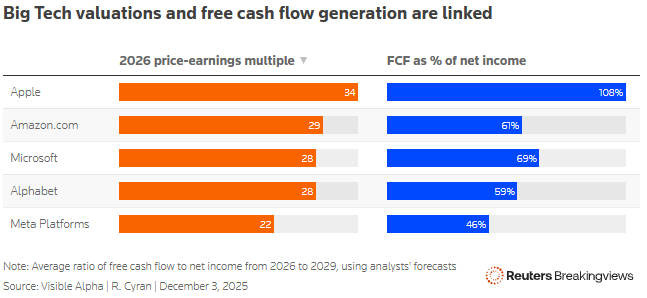
Core Viewpoint - The article discusses the valuation dynamics of major tech companies amidst the current AI hype, highlighting that despite Apple's cautious approach, it maintains a higher valuation compared to its peers due to its strong cash flow generation capabilities [1][2][5]. Group 1: Company Valuations - Apple's market capitalization is $4.2 trillion, and its price-to-earnings (P/E) ratio based on expected earnings for 2026 is 34 times, which is 15% higher than Amazon's P/E of 29 times [2]. - Meta's P/E ratio is relatively low at 22 times, attributed to significant capital expenditures on data centers, which analysts estimate will result in its future free cash flow averaging only half of its earnings [6][10]. - Alphabet and Amazon are positioned in the middle regarding valuations, with their P/E ratios reflecting their respective levels of capital investment in AI [6][7]. Group 2: Cash Flow and Investment - The article emphasizes the importance of free cash flow over earnings, noting that Apple's free cash flow from 2026 to 2029 is expected to be 108% of its earnings, allowing for substantial dividends and buybacks [5]. - In contrast, companies like Meta are investing heavily in data centers, leading to lower valuations as investors are skeptical about the return on these investments [7][10]. - Nvidia and Oracle are highlighted as exceptions, with Nvidia's P/E ratio at 24 times and Oracle's at 27 times, despite Oracle's significant investments in AI data centers leading to negative free cash flow in the coming years [10][11]. Group 3: Market Sentiment and Future Outlook - The article suggests that investors are more focused on fundamentals than on discussions of market bubbles, validating Apple's cautious stance in the AI race [11]. - As competitors invest heavily in AI, Apple is likely to continue prioritizing cash returns to shareholders, which aligns with long-term investor interests [11].

英伟达成市场风暴眼 AI泡沫争议愈演愈烈
Zhong Guo Zheng Quan Bao· 2025-11-23 20:06
Core Viewpoint - Nvidia has become the center of market turmoil following allegations of financial discrepancies in its recent earnings report, raising concerns about potential fraud and the sustainability of the tech stock bubble [1][2]. Group 1: Allegations Against Nvidia - A social media post by researcher Shanaka Anslem Perera claimed that Nvidia's financial data showed "serious contradictions," including accounts receivable of $33.4 billion, a 89% increase, and inventory rising 32% to $19.8 billion, contradicting claims of chip shortages [1][2]. - The report also highlighted a cash conversion rate of only 75%, significantly below the semiconductor industry standard, suggesting potential fraud detected by AI algorithms [1]. - An analysis report countered these claims, arguing that the increase in accounts receivable and inventory is typical for a rapidly expanding tech company and does not indicate fraudulent revenue [2]. Group 2: Market Reactions and Broader Implications - The AI industry's circular trading network, valued at $610 billion, has raised doubts about the actual demand for AI applications, as cash flow has not completed a full cycle due to insufficient profitable AI applications [2]. - Despite the allegations, experts believe that Nvidia's stock price fluctuations are common during earnings season and do not indicate fraud [2]. - Market sentiment has been affected by concerns over the Federal Reserve's interest rate policies, with recent comments from Fed officials causing fluctuations in market expectations regarding rate cuts [3]. Group 3: Investment Trends and Future Outlook - Many top investment firms have recently reduced their holdings in high-priced tech stocks like Nvidia, indicating a shift in investment strategy [3]. - Analysts suggest that the high valuations of AI-related stocks may be driven by overly optimistic expectations for long-term profitability, which could lead to a correction in the tech sector [4]. - Despite the current turmoil, the long-term development trend of AI remains positive, with expectations that capital investments will eventually balance with returns as AI applications continue to evolve [5].

全球市场恐慌:日本股债汇三杀,纳指期货跌1%,比特币跌破9万美元大关,金价跌破4000美元
Ge Long Hui A P P· 2025-11-18 08:19
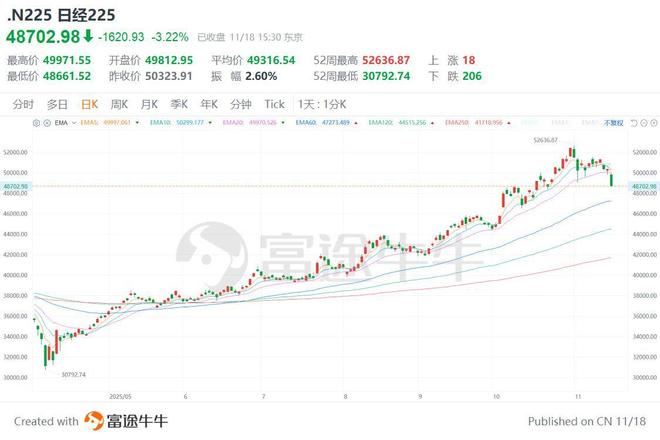
Core Viewpoint - Global markets experienced widespread sell-offs, with significant declines in U.S. stock futures and cryptocurrencies, driven by concerns over interest rate outlook and technology stock valuations [1]. Market Performance - The Nikkei 225 index in Japan fell by 3.2%, marking its largest single-day drop since April, amid worries over government spending and geopolitical factors [1]. - The KOSPI index in South Korea dropped by 3.32%, led by declines in semiconductor stocks [2]. - A-shares also saw declines, with the Shanghai Composite Index down 0.81%, the ChiNext Index down 1.1%, and the Shenzhen Component Index down 0.92%. The Taiwan Weighted Index fell by 2.5% [3]. - U.S. stock futures showed significant declines, with the Nasdaq 100 futures down over 1%, Dow futures down 0.5%, and S&P 500 futures down 0.7% [4]. Interest Rate and Commodity Impact - The probability of a 25 basis point rate cut by the Federal Reserve in December dropped to 42.9%, leading to a decrease in optimistic sentiment towards gold, which fell below the $4,000 mark [1][5]. - Bitcoin experienced intensified selling pressure, dropping to a low of $89,253 per coin, with traders betting on further declines to $85,000 and even $80,000 [5][13].
全球风险情绪恶化:日本股债汇三杀,纳指期货跌1%,比特币下破9万美元关口,金价继续下探
Hua Er Jie Jian Wen· 2025-11-18 05:55
Core Market Trends - The Nasdaq 100 futures fell by 1%, Dow futures decreased by 0.5%, and S&P 500 futures dropped by 0.7% [2] - The Nikkei 225 index experienced a decline of over 3%, while the TOPIX index fell by 2.4% [2] - The MSCI Asia-Pacific index decreased by 2% to 221.28 points, marking its first drop below the 50-day moving average since April [2] - Bitcoin fell below the $90,000 mark, and Ethereum dropped below $3,000 [2] Japanese Market Dynamics - The Nikkei 225 index closed at 48,908.25, down 1,415.66 points or 2.81%, while the TOPIX index was at 3,267.32, down 80.21 points or 2.40% [3] - The Japanese yen fell to 155.37 against the US dollar, the lowest since January, and the yield on the 10-year Japanese government bond rose to 1.754%, the highest since June 2008 [3][4] - Concerns over government spending and geopolitical factors have led to a sell-off in Japan's stock, bond, and currency markets [4] Investor Sentiment and Economic Outlook - Investors are closely monitoring the upcoming Nvidia earnings report and the September employment report for insights into the tech sector's valuation and Federal Reserve policy direction [5] - Analysts indicate that the current sell-off reflects ongoing concerns about interest rate prospects and tech stock valuations [5] - The probability of a Federal Reserve rate cut next month is currently priced at about 40% [6] Technical Analysis and Market Signals - Analysts warn that technical indicators suggest a potential 10% correction risk for US stocks, with the S&P 500 down 3.2% since its record high on October 28 [7] - The Nasdaq Composite index is showing weak internal signals, with more stocks hitting 52-week lows than those reaching new highs [8] - Bitcoin's decline has erased all gains for 2025, significantly impacting the sentiment in the digital asset market [8]
