
核心+卫星配置思路

Search documents
A股1月展望:跨年行情还能持续吗?
Sou Hu Cai Jing· 2025-12-30 11:27
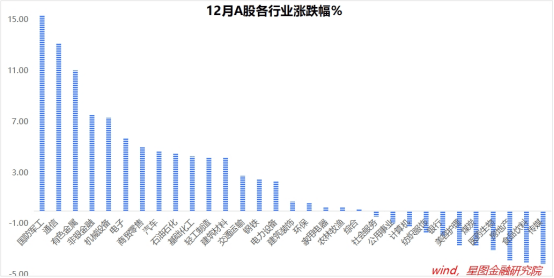
Market Overview - The A-share market in December 2025 ended with a structural differentiation, characterized by a growth style leading the market, with the Wind All A Index rising by 3.34% [1] - The ChiNext Index surged by 5.57%, indicating a strong preference for small and medium-sized growth stocks, while the Shanghai Composite Index only saw a modest increase of 1.97% [1] - The cyclical style index rose by 5.21%, and the growth style index increased by 4.97%, significantly outperforming the consumer style index, which fell by 1.44% [1] Sector Performance - The commercial aerospace sector was notably strong, driven by intensive industrial policies, with the aerospace and defense sector rising by 15.87% and the communication equipment sector increasing by 16.51% [2] - The insurance sector also performed well, rising by 16.98% due to year-end institutional allocation demand and expectations of long-term investment policies [2] - Conversely, sectors such as interactive media and services, as well as the media sector, experienced declines due to previous overheating or lack of catalysts [2] Driving Factors - The primary driver of the market's performance was the influx of incremental capital, with net subscriptions to broad-based ETFs exceeding 110 billion yuan, particularly in the A500 ETF [4] - Strong domestic industrial policies, such as the National Space Administration's action plan for commercial aerospace, played a crucial role in stimulating related sectors [4] - Global liquidity expectations shifted with the Federal Reserve's interest rate cut in December, alongside the appreciation of the yuan, creating a favorable external environment [4] Market Expectations - Looking ahead to January 2026, the cross-year market trend is expected to continue, but with a focus on structure and rhythm [6] - Major broad-based indices may experience a "volatile consolidation and structural differentiation" pattern, with support from institutional fund layouts for the spring rally [6] - Opportunities in sectors are anticipated to revolve around dual drivers of policy and industry, with ongoing stories in the non-ferrous metals sector and a focus on commercial aerospace themes due to policy developments [6] Investment Strategy - A flexible and structured approach is recommended for upcoming market conditions, with a "core + satellite" investment strategy suggested [7] - Core positions should focus on high-growth sectors with clear industry trends, such as energy storage and precious metals, while flexible positions can target policy-sensitive themes like commercial aerospace [7] - Overall positions should be controlled to avoid chasing high prices, especially in light of potential market volatility from upcoming economic data releases and policy announcements [7]

黄金白银基金2025年领涨商品型基金市场
Mei Ri Jing Ji Xin Wen· 2025-12-25 15:00
Core Insights - The global commodity fund market experienced significant divergence in 2025, with gold and silver funds emerging as standout performers, some achieving nearly double returns, while energy and chemical funds faced downward pressure [1][2]. Group 1: 2025 Review - Gold and silver funds saw remarkable performance, with over 50 funds achieving annual returns exceeding 50%, making them one of the most notable segments in the fund market [1]. - Silver funds demonstrated exceptional strength, with the Guotou Ruijin Silver Futures A and C shares achieving annual returns of 98.27% and 97.52%, respectively, marking them as "dark horse" products of the year [1]. Group 2: Internal Fund Differentiation - Despite the success of gold and silver funds, there was significant internal differentiation within commodity funds, with some energy and chemical-focused products experiencing declines of over 20% since the beginning of 2025 [2]. Group 3: 2026 Outlook - Market sentiment for 2026 is optimistic regarding gold, with several institutions highlighting investment opportunities in gold, silver, copper, and other industrial metals [3]. - The Ant Group's research team maintains a positive outlook on gold, suggesting that while the market may be sensitive to negative factors, underlying demand will support buying, leading to potential price fluctuations [3]. - Citic Prudential's fund manager emphasizes that gold's financial attributes make it a better long-term holding compared to silver and industrial metals, which may be more volatile [3]. Group 4: Industrial Metals and AI Demand - Recent increases in industrial metals like copper are driven by demand expectations from AI infrastructure development, but potential interest rate changes and investment slowdowns could lead to price corrections [4]. - Different commodity categories are expected to perform variably in 2026, with industrial metals benefiting from AI-related demand, while precious metals' performance will depend on interest rate cycles and geopolitical developments [4]. Group 5: Investment Strategy for 2026 - Investors are advised to adopt a prudent investment approach, diversifying their portfolio and avoiding concentrated positions in a single commodity sector, with recommendations to limit commodity fund exposure to no more than 10% of the overall portfolio [5]. - The Ant Group's research team suggests a macro asset allocation strategy, emphasizing the importance of cross-regional, cross-asset, and cross-strategy diversification to navigate the complex global environment [5]. Group 6: Core and Satellite Strategy - Industry insiders recommend focusing on industrial metals and gold as core holdings due to their clearer long-term prospects, while considering energy metals and oil as satellite positions for supplementary returns [6]. - For ordinary investors, a focus on gold-based stable commodity funds is recommended, while those with higher risk tolerance may explore opportunities in industrial metals, ensuring strict control over position sizes and exit strategies [6].