核能超级周期

Search documents
核电复兴+供应集中,铀已站上十年大牛市起点?
Hua Er Jie Jian Wen· 2025-11-25 07:33
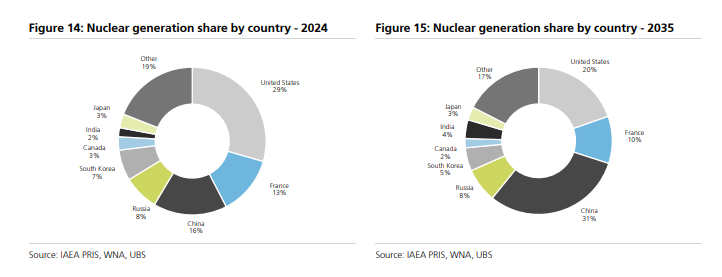
Core Insights - The article discusses a "nuclear renaissance" driven by global energy transition and decarbonization, highlighting a significant turning point in the uranium market, which is expected to enter a decade-long bull market due to structural demand and limited supply [1][2] Group 1: Demand Dynamics - The demand for uranium is projected to increase significantly, with global consumption expected to grow by over 50% by 2035, driven by a resurgence in nuclear energy as countries aim to double their nuclear power generation capacity by 2050 [1][4] - The annual compound growth rate (CAGR) for global uranium demand is forecasted to reach 3.6% from 2025 to 2030 and further accelerate to 4.9% from 2030 to 2035, with China and India contributing approximately three-quarters of this growth [4][5] - Emerging technologies, such as small modular reactors (SMRs), are anticipated to create new demand opportunities, particularly in high-energy industries like AI data centers, enhancing the narrative of a nuclear revival [4] Group 2: Supply Constraints - The uranium supply is highly concentrated, with Kazakhstan, Canada, and Namibia accounting for about 75% of global production, and the top five producers controlling approximately 75% of the market [15] - Major producers have shifted their strategy to prioritize value over volume, leading to a reluctance to increase production without sustainable long-term contracts and adequate pricing [15][8] - The supply growth is expected to average around 4% from 2025 to 2035, but significant risks exist due to regulatory challenges and financing difficulties for new projects [15][8] Group 3: Market Imbalance - A supply-demand imbalance is anticipated, with the uranium market expected to experience a mild shortage from 2025 to 2029, escalating into a "persistent and expanding deficit" in the 2030s as demand outpaces supply [10][16] - The current "contract stalemate" is characterized by utilities hesitating to sign long-term contracts due to uncertainties in the downstream nuclear fuel cycle, while producers are unwilling to commit to new supplies without long-term orders [16] - The article notes that approximately two-thirds of global utility demand for uranium over the next twenty years (around 3 billion pounds) remains uncontracted, indicating an impending large-scale inventory replenishment cycle [16]

巴克莱:供应集中+核能超级周期=一个多年的“铀牛市”
美股IPO· 2025-11-04 07:24
Core Viewpoint - The uranium market is entering a structural bull market driven by a significant supply-demand imbalance, geopolitical risks, and a nuclear energy supercycle, with global uranium demand expected to increase by 124% to 391 million pounds by 2040 [3][9]. Supply Concentration and Geopolitical Risks - The uranium supply chain is highly concentrated, with Kazakhstan accounting for nearly 40% of global production and Russia controlling about 40% of processing capacity, creating significant geopolitical risks [1][5]. - The top five companies, including Kazakhstan's Kazatomprom, Canada's Cameco, and France's Orano, control 70% of global uranium production, exacerbating supply risks [5]. Demand Surge Driven by Nuclear Energy - The demand for uranium is expected to surge due to the nuclear energy supercycle, with the World Nuclear Association predicting an increase from 175 million pounds in 2024 to 391 million pounds by 2040, a growth of 124% [9][12]. - Key drivers of this demand include the expansion of nuclear power in China, the restart of nuclear plants in the U.S., and the rise of small modular reactors (SMRs) [12]. Supply Response Challenges - Uranium supply is inelastic due to long exploration cycles, high capital investment, and regulatory hurdles, with new mines taking over ten years to develop [13]. - A supply deficit is projected to occur as early as 2032, even considering existing inventories, establishing a solid foundation for a prolonged uranium bull market [13]. Policy Support and Supply Chain Restructuring - Governments are actively working to localize the uranium value chain in response to supply security challenges, creating unprecedented opportunities for related companies [15]. - The U.S. government has taken significant steps, including an executive order to accelerate domestic mineral production and a commitment to quadruple nuclear power capacity by 2050 [16][17]. - The EU is also moving towards supporting policies that aim to reduce dependence on Russian uranium imports, with significant investments needed for nuclear power projects [20][21].
供应集中+核能超级周期=一个多年的“铀牛市”
Hua Er Jie Jian Wen· 2025-11-04 06:27
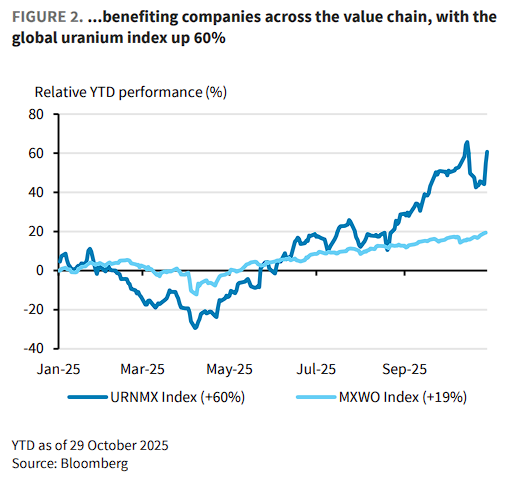
Core Viewpoint - The uranium market is entering a structural bull market driven by geopolitical risks and a nuclear energy supercycle, characterized by a highly concentrated supply and surging demand [1] Supply Concentration and Geopolitical Risks - Kazakhstan accounts for nearly 40% of global uranium production, while Russia controls about 40% of uranium processing and enrichment capacity, creating significant geopolitical risks [3] - The top five companies, including Kazakhstan's Kazatomprom and Canada's Cameco, control 70% of global uranium mining, exacerbating supply risks [3] Vulnerabilities in Processing - Approximately 40% of uranium conversion and enrichment capacity is located in Russia, making Western countries heavily reliant on geopolitical adversaries for critical nuclear fuel processing [6] - The U.S. is particularly vulnerable, consuming over 25% of global uranium while producing less than 1% domestically [6][7] Structural Supply-Demand Imbalance - The World Nuclear Association predicts global uranium demand will surge from 175 million pounds in 2024 to 391 million pounds by 2040, a 124% increase [8] - Demand is driven by the expansion of nuclear power in China, the restart of U.S. nuclear plants, and the rise of small modular reactors (SMRs) [8] - Uranium supply is inelastic due to long exploration cycles and high capital requirements, with new mines taking over ten years to develop [8] - A supply deficit in the global uranium market could occur as early as 2032, establishing a solid foundation for a prolonged bull market [8] Policy Support and Supply Chain Restructuring - Governments are actively promoting the localization of the uranium value chain to address supply security challenges, creating unprecedented opportunities for related companies [10] - The U.S. government has taken significant steps, including an executive order to accelerate domestic mineral production and a commitment to quadruple nuclear power capacity by 2050 [10] - Following policy announcements, U.S. uranium companies have seen substantial stock price increases, with Cameco rising 108% and Centrus Energy soaring 487% [10] EU Policy Environment - The European Commission's roadmap aims to eliminate reliance on Russian energy, including uranium imports, requiring an estimated €241 billion investment for nuclear power projects [13] - Sweden has proposed lifting the ban on uranium exploration and mining, indicating a shift in policy among some EU member states [13]