
欧洲绿色新政

Search documents
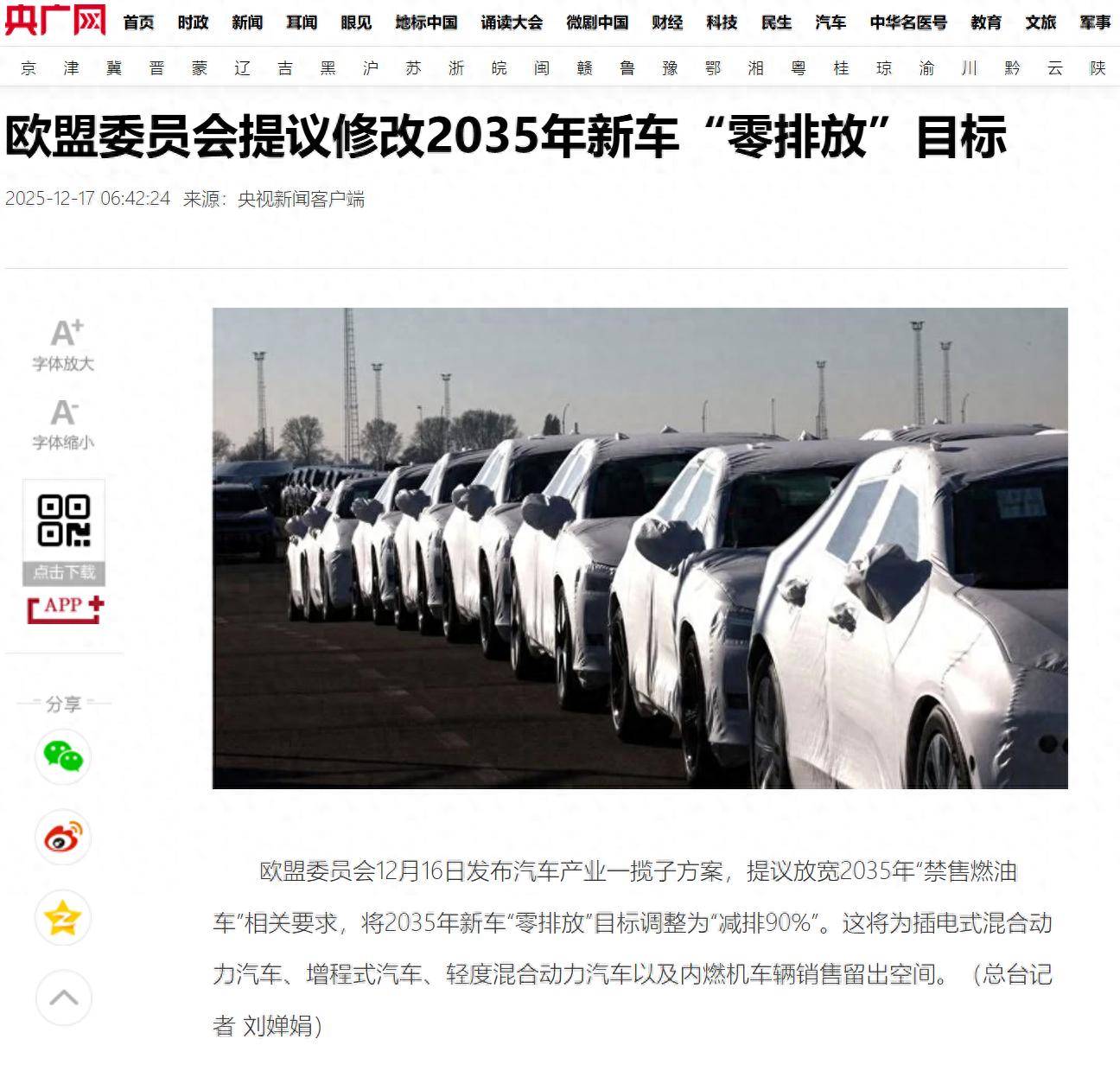
欧洲也撑不住了!昨天欧盟突然正式宣布:放弃2035年内燃机禁令!
Sou Hu Cai Jing· 2025-12-18 09:08
Group 1 - The European Commission has officially abandoned its previous commitment to a complete ban on internal combustion engines by 2035, now aiming for a 90% reduction in carbon emissions from new cars compared to 2021 levels [4][12] - The shift reflects the reality of economic pressures, as the automotive industry, a crucial pillar of the European economy, faces significant challenges, including over 50,000 job losses in Germany alone within a year [6][10] - The initial ambitious plan for a complete ban on gasoline and diesel vehicles faced strong opposition from major automotive nations like Germany and Italy, leading to a compromise that allowed for synthetic fuels [5][10] Group 2 - The transition to electric vehicles has revealed significant infrastructure and supply chain issues, with a severe shortage of public charging stations in Europe, where the ratio of charging stations to electric vehicles is 15:1 compared to 3:1 in China [8] - The European automotive industry is heavily reliant on imports for critical battery raw materials, with 87% of lithium sourced from Australia and 40% of natural graphite from China, complicating the transition to electric vehicles [8][10] - Political and social opposition to the internal combustion engine ban is growing, with key political figures and parties questioning the feasibility of such radical policies and their impact on the industrial base [10][12] Group 3 - The recent policy reversal illustrates the harsh reality that ambitious environmental goals must consider economic realities, industry foundations, and employment [12] - The European Union's decision to prioritize survival over radical environmental policies serves as a lesson on the dangers of detaching policy from practical considerations [12]

陶氏:欧洲化工业陷入多重危机
Zhong Guo Hua Gong Bao· 2025-09-17 02:59
Group 1 - The European chemical and petrochemical industry is facing a "multiple crisis" due to weak domestic demand and significant new capacities being built overseas [1] - The market is shrinking as a result of a large influx of imported products, with only a 4% reduction in ethylene capacity announced, which is insufficient to address the underlying issues [1] - Consumer demand recovery is crucial, as purchasing behavior has changed, necessitating the industry to adapt quickly and improve production agility and efficiency [1] Group 2 - EU policymakers need to take decisive action, as current legislation, particularly the Carbon Border Adjustment Mechanism (CBAM) and the European Green Deal, does not adequately support the chemical industry [1] - The existing CBAM mechanism is not suitable for complex value chains like polymers, contradicting its original intent [1] - The EU Emissions Trading System (EU ETS) is seen as promoting deindustrialization rather than decarbonization, and without foundational support for decarbonization, it becomes merely a cost burden [1] Group 3 - The U.S. government demonstrates greater synergy with the industry regarding regulatory goals compared to the EU, which needs to reach consensus on "goal setting" and "implementation pathways" [2] - China is noted to be ahead of Europe in certain sustainable development areas, particularly in electrification and having a surplus of green energy, indicating that Europe needs to scale up its decarbonization efforts [2]
