柴油车

Search documents
欧洲二手电动车,销量激增
财联社· 2026-03-26 10:42
Core Viewpoint - The ongoing conflict in the Middle East is driving up gasoline prices, which in turn is leading to a significant increase in the sales of used electric vehicles (EVs) across Europe [1][2]. Group 1: Market Trends - The rise in fuel costs is making consumers hesitant to purchase traditional fuel vehicles, resulting in a surge in demand for electric vehicles in the used car market [2]. - In Norway, the largest used car trading platform, Finn.no, reports that electric vehicles have surpassed diesel cars to become the best-selling vehicle type on their platform [2]. - Data from the European Commission indicates that average gasoline prices in the EU rose by 12% from February 23 to March 16, reaching €1.84 per liter (approximately $2.12) [3]. Group 2: Sales Data - French online used car retailer Aramisauto noted that the proportion of electric vehicles sold increased from 6.5% to 12.7% within three weeks, while gasoline vehicle sales dropped from 34% to 28% and diesel vehicle sales fell from 14% to 10% [3]. - The OLX platform reported significant increases in electric vehicle inquiries across various markets, including France (+50%), Romania (+40%), Portugal (+54%), and Poland (+39%), with all markets showing weekly acceleration in interest [3]. Group 3: Consumer Behavior - The CEO of OLX highlighted that interest in electric vehicles was already on the rise before the recent events, suggesting that the current instability is accelerating an ongoing transition [4]. - The availability of a wider range of used electric vehicle models and the increasing prevalence of battery health certifications are alleviating consumer concerns, further supporting sales growth [4]. - Used electric vehicles are typically priced up to 40% lower than new cars and can be delivered immediately, making them more responsive to market sentiment and fluctuations in gasoline prices [4]. Group 4: Regional Insights - Data from Marketcheck indicates a noticeable and sustained increase in used electric vehicle sales since the outbreak of the conflict [5]. - In the Nordic region, platforms like Blocket reported an 11% increase in electric vehicle sales in the first two weeks of March compared to the previous two weeks, with a 17% rise in browsing activity [5][6]. - Denmark's Bilbasen also observed a rise in electric vehicle search volumes, attributing this trend primarily to rising gasoline prices [6]. - Germany's largest online car market, mobile.de, reported that the proportion of electric vehicle searches surged from 12% to 36% since early March, with inquiries for used electric vehicles increasing by 66% compared to February [6][7].


【微特稿】电车业务大收缩 斯泰兰蒂斯集团报巨额亏损
Xin Hua She· 2026-02-26 14:49
Core Insights - Stellantis Group is projected to incur a net loss of €22.3 billion (approximately $26.3 billion) in 2025, primarily due to significant cutbacks in its electric vehicle (EV) business and the associated costs of reverting to traditional fuel vehicles [1] - The company anticipates a revenue of €153.5 billion in 2025, reflecting only a 2% decline, with vehicle sales expected to increase by approximately 70,000 units to 5.48 million compared to 2024 [1] - The CEO, Antonio Filosa, indicated that the 2025 performance highlights the costs of overestimating the speed of energy transition, emphasizing the need to reset the business model to offer a full range of vehicle options [1] Financial Impact - Stellantis Group's financial burden is exacerbated by U.S. tariff policies, estimating a cost of €1.2 billion in tariffs for 2025, which is expected to rise to €1.6 billion in 2026 [2] - The company has confirmed its retreat from the EV sector by selling its 49% stake in the Canadian battery joint venture NextStar Energy and plans to exit the joint venture with Samsung for a U.S. battery factory [2] Market Strategy - Stellantis is set to reintroduce fuel models, including diesel vehicles, in the European and American markets as part of its strategy to adapt to current market conditions [2] - The company is banking on new model launches, particularly in the U.S. market with fuel pickup trucks, to drive profitability growth [1]
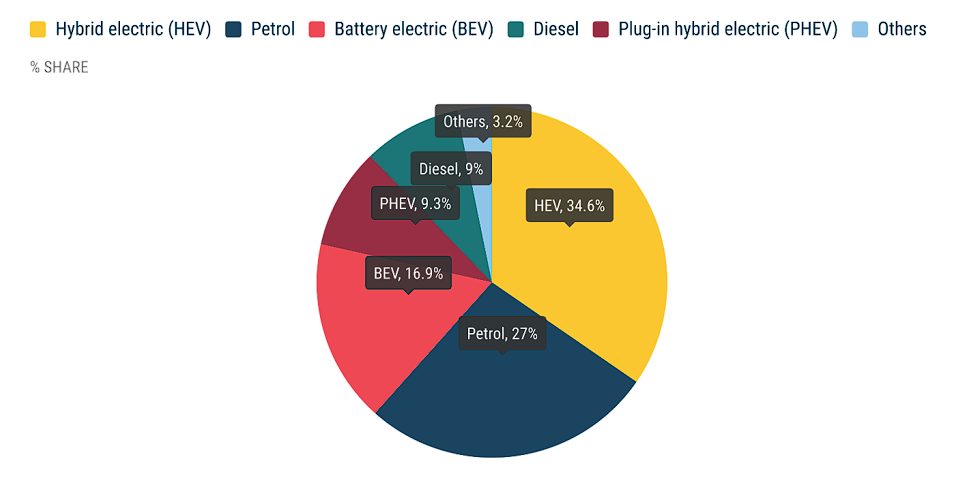
克罗地亚1月份新车销量下滑11.5%,混合动力车首超汽油车
Shang Wu Bu Wang Zhan· 2026-02-11 17:36
Core Insights - In January 2026, new car sales in Croatia decreased by 11.5% year-on-year, totaling 3,946 vehicles sold [1] - The market is experiencing a significant shift, with hybrid vehicles surpassing gasoline cars for the first time, accounting for 46% of sales compared to gasoline's 37.5% [1][2] Group 1: Sales Performance - Skoda led the market with 515 units sold, holding a market share of 13% [1] - Volkswagen followed closely with 514 units sold, while Toyota ranked third with 306 units [1] - Luxury car sales remained stable, with Aston Martin and Bentley each selling two units [1] Group 2: Market Composition - Hybrid vehicles sold 1,815 units, representing 46% of the total market share [1] - Gasoline vehicles accounted for 37.5% of sales, while diesel vehicles made up 11.4% [1] - Pure electric vehicles sold 145 units, constituting 3.7% of the market, and gas-powered vehicles represented 1.4% [1]

吉汽车保有量近200万辆
Shang Wu Bu Wang Zhan· 2026-02-06 16:18
Group 1 - The total number of vehicles in Kyrgyzstan has exceeded 1.9 million, with a year-on-year growth of 13%, becoming a significant environmental concern [1] - The breakdown of vehicles by type includes 972,000 gasoline cars, 339,000 diesel cars, 56,000 natural gas vehicles, and 37,000 hybrid vehicles [1] - In 2025, a total of 15,278 electric vehicles are expected to be imported, accounting for 0.8% of the total vehicle count [1] Group 2 - The proportion of cars aged five years or less is projected to increase from 1.5% in 2024 to 4.5% in 2025 [1] - Bishkek currently has 1,447 natural gas buses and 120 electric buses, with over 100 electric vehicle charging stations established nationwide [1]
欧盟汽车制造商协会:2025年比亚迪新车注册量增长268.6%
Xin Lang Cai Jing· 2026-01-27 23:42
Core Insights - BYD's new car registrations in the European market reached 187,657 units in 2025, representing a year-on-year growth of 268.6% [1] - In the EU, BYD's new car registrations grew by 227.8% year-on-year, with market share increasing from 0.4% in 2024 to 1.2% in 2025 [1] Electric Vehicle Market Trends - The market share of pure electric vehicles in the EU reached 17.4% in 2025, up from 13.6% the previous year [1] - Hybrid vehicles accounted for 34.5% of the market share, remaining the preferred choice among EU consumers [1] - The combined market share of gasoline and diesel vehicles decreased from 45.2% in 2024 to 35.5% in 2025 [1] December Market Performance - In December, the market share of new pure electric vehicle registrations in the EU reached 22.6%, surpassing gasoline vehicles at 22.5% for the first time [1]

2025年克罗地亚共售出69140辆新乘用车
Shang Wu Bu Wang Zhan· 2026-01-13 15:21
Core Insights - In 2025, Croatia sold a total of 69,140 new passenger cars, representing an 8.3% increase compared to 2024 [1] - December sales saw a year-on-year growth of 15.4%, reaching 4,206 vehicles [1] Brand Performance - The top-selling brands in Croatia were Skoda (9,458 units, 13.7% market share), Volkswagen (8,594 units, 12.4%), Opel (6,063 units, 8.7%), Renault (5,300 units, 7.7%), and Suzuki (4,299 units, 6.2%) [1] - Among emerging Asian brands, Geely sold 895 units and BYD sold 365 units [1] Fuel Type Distribution - Gasoline vehicles dominated the market with 32,574 units sold, accounting for 47.1% of the market share [1] - Hybrid vehicles followed with sales of 25,270 units, representing 36.5% of the market [1] - Diesel vehicles sold 8,684 units, making up 12.6% of the market [1] - Electric vehicles totaled 1,334 units sold, which is 1.9% of the market [1] - Gasoline-powered vehicles also had sales of 1,278 units, accounting for 1.8% [1]
郑州中原保时捷中心母公司东安集团回应“跑路”传闻:我们不会跑;2025年第三季度英国二手车市场增长2.8%丨汽车交通日报
创业邦· 2025-12-26 09:06
Group 1 - The core viewpoint of the article highlights the ongoing developments in the automotive industry, particularly focusing on electric vehicles and market performance [2][3]. Group 2 - Dongfeng Motor announced that it aims to achieve over 1 million sales in both new energy vehicles and self-owned passenger cars by 2025, with a year-on-year growth of 22% in new energy vehicle sales and a 12% increase in self-owned brand sales, which now account for 63% of total sales [2]. - The UK used car market experienced a growth of 2.8% in Q3 2025, with transaction volumes surpassing 2 million units, marking the strongest Q3 performance since 2021 and a record of 11 consecutive quarters of growth [2]. - A new mandatory standard for electric vehicle energy consumption will be implemented starting January 1, 2026, which is the first of its kind globally. This standard tightens the energy consumption limits by approximately 11% compared to the previous recommendation and aims to improve the driving experience by increasing the average driving range by about 7% for vehicles weighing around 2 tons [2][3].


为什么柴油车有加热装置?柴油车和汽油车还有哪些区别
Zhong Guo Zhi Liang Xin Wen Wang· 2025-12-24 06:15
Core Viewpoint - The article discusses the differences between diesel and gasoline engines, focusing on their combustion methods, structural differences, fuel characteristics, emissions, and after-treatment systems. Group 1: Combustion Method and Structure - The primary difference between diesel and gasoline engines lies in their combustion methods: gasoline engines use premixed flame propagation, while diesel engines rely on diffusion combustion [2] - Diesel engines operate on compression ignition (CI Engine), while gasoline engines use spark ignition (SI Engine) [2] - Diesel engines have higher fuel injection pressures, reaching up to 2500 bar, compared to gasoline engines, which typically max out at around 500 bar [3] Group 2: Efficiency and Compression Ratio - Diesel engines have a higher compression ratio (approximately 16-26) compared to gasoline engines (8-12), leading to greater thermal efficiency, which can reach 40%-45% or even over 50% in advanced models [4] - The structural simplicity of diesel engines contributes to their reliability, but they require heavier components to withstand higher explosion pressures [4] Group 3: Fuel Characteristics - Diesel has a higher energy density than gasoline, with 1 liter of diesel releasing energy equivalent to approximately 1.2 liters of gasoline [5] - Diesel engines face challenges in cold weather, as they can experience wax precipitation below 0°C, necessitating the use of low-temperature diesel [5] Group 4: Emissions and After-treatment Systems - Diesel engines emit lower carbon monoxide (CO) and hydrocarbons (HC) but higher nitrogen oxides (NOx) and particulate matter (PM) compared to gasoline engines [7] - Diesel vehicles are equipped with a diesel particulate filter (DPF) and a selective catalytic reduction (SCR) system to reduce NOx emissions, which involves injecting urea solution into the exhaust [8] - The urea solution used in SCR systems can freeze at temperatures below -11°C, requiring heating mechanisms to prevent freezing [8]
奔驰同意!支付超10亿元→
Xin Lang Cai Jing· 2025-12-23 13:54
Group 1 - Mercedes-Benz has reached a settlement agreement regarding a diesel vehicle emissions dispute, requiring the company to pay nearly $150 million to a coalition of attorneys general from nearly 50 U.S. states to address air pollution [1][3] - The settlement covers 48 U.S. states, the District of Columbia, and the federal territory of Puerto Rico, affecting 39,565 vehicles that have not been repaired or scrapped as of August 2023 [1][3] - Each affected vehicle owner will receive $2,000 for necessary repairs under the agreement [1] Group 2 - The lawsuit originated in 2020, initiated by multiple state attorneys general investigating diesel vehicle emissions, revealing that some Mercedes vehicles emitted pollutants at levels 30 to 40 times above legal limits [5] - Mercedes-Benz previously agreed to pay $2.2 billion to resolve the investigation and compensate 250,000 vehicle owners [5] - This incident is part of a broader trend in the automotive industry, following the 2015 emissions scandal involving Volkswagen, which admitted to installing defeat devices in nearly 11 million vehicles globally and ultimately paid over $20 billion in fines [5]

欧洲11月汽车销售五连增,特斯拉销售下滑11%,比亚迪大增超220%
Hua Er Jie Jian Wen· 2025-12-23 13:16
Group 1: Market Overview - The European new car market continues its recovery, with November sales increasing for the fifth consecutive month, up 2.4% year-on-year to 1.1 million units [1] - Electric vehicles (EVs) are the main growth driver, with pure electric vehicle (BEV) registrations reaching a market share of 21% in the EU and 26% in the UK, while Norway's share is as high as 98% [1] - Despite the positive momentum, overall sales remain significantly below pre-pandemic levels, indicating a slow recovery pace [9] Group 2: Electric Vehicle Performance - In November, BEV registrations surged by 44.1%, while hybrid electric vehicles (HEVs) grew by 38.4%, and plug-in hybrid electric vehicles (PHEVs) increased by 4.2% [2] - The combined market share of three types of electrified vehicles reached 65.6%, a significant increase from 56% in August 2024, driven by strong performances in Germany, France, Spain, and Italy [3] Group 3: Company Performance - BYD and Tesla show contrasting trajectories in the European market, with BYD's registrations soaring by 221.8% in November, achieving a market share of 2%, while Tesla's registrations fell by 11.8%, resulting in a market share of 2.1% [6] - The performance comparison highlights the changing competitive landscape in the European EV market, with Chinese brands challenging traditional leaders through price advantages and product innovation [6] Group 4: Traditional Vehicle Decline - The market for traditional internal combustion engine vehicles continues to shrink, with gasoline vehicle registrations declining by 18.6% and market share dropping from 33.7% to 27% [8] - Diesel vehicles are performing even worse, with registrations down 24.4% and a market share of only 9%, indicating a significant shift towards electrified models [8] Group 5: Future Outlook - The European automotive industry faces multiple challenges, including competition from China, potential U.S. import tariffs, and difficulties in meeting EU electrification regulations while maintaining profitability [9] - Analysts believe that despite current challenges, the long-term direction of the automotive industry remains focused on electric vehicles, with ongoing growth trends suggesting a deepening transition towards electrification in Europe [9]