
氢能产业转型

Search documents
全球氢能市场开始“脚踏实地”
中国能源报· 2026-01-26 12:18
Core Viewpoint - The global hydrogen industry is entering a critical phase where economic viability and sustainability will be the main criteria for project evaluation by 2026, marking a shift from policy-driven to market-driven dynamics [3][5]. Group 1: Industry Transition - The hydrogen industry is moving from a phase driven by ambitious policy goals to one where the success of projects will depend on the alignment of policy support, end-user demand, and viable business models [5][6]. - Projects that can synchronize policy and market demand are expected to advance, while those reliant solely on policy visions may stagnate or require adjustments [5][6]. - By 2026, at least three large hydrogen projects targeting the European market are anticipated to make final investment decisions, with a total capacity exceeding 50,000 tons per year [5]. Group 2: Economic Viability - The report emphasizes that many projects are now undergoing stricter economic viability assessments, revealing vulnerabilities in projects that have overly relied on policy goals without solid purchase agreements and cost control [6]. - The driving logic of the hydrogen industry is shifting from "setting goals first, then finding markets" to "demand-driven project feasibility" [6]. Group 3: China's Role - China is emerging as a key driver in the global clean hydrogen sector, showcasing a different development trajectory compared to other regions [8][9]. - Chinese companies are overcoming barriers to large-scale clean hydrogen development through continuous technological advancements and industrialization efforts, leading to a decrease in overall green hydrogen costs [8][9]. - China's complete industrial chain and sustained investment capabilities allow it to maintain a relatively stable development pace amid global uncertainties [9]. Group 4: Regional Pathways - The EU and Middle East are facing distinct pressures for adjustment in their hydrogen development paths by 2026 [11]. - In Europe, there may be substantive adjustments to the target of having 42% of industrial hydrogen sourced from renewable energy by 2030, as progress has been slow and regulatory burdens have increased project costs significantly [11]. - The Middle East is also under pressure, with at least three large-scale projects originally planned for export expected to be canceled or significantly scaled back due to delays in related policies [11]. Group 5: Emerging Opportunities - Certain segments within the hydrogen industry are still poised for new growth, with industrial ammonia cracking technology expected to achieve key breakthroughs by 2026 [12]. - Projects in India are showing a split, with some cost-advantaged projects likely to be operational on schedule, while others face higher risks due to lack of scale [12]. - Overall, 2026 is projected to be a pivotal year for the hydrogen industry, transitioning from vision to reality, with resources concentrating in economically viable and demand-secured regions [12].

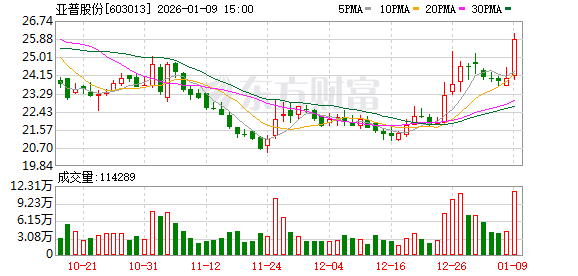
亚普股份:公司持续拓展燃料电池储氢系统领域新客户、新市场
Zheng Quan Ri Bao· 2026-01-09 13:14
Core Viewpoint - The company is actively expanding its customer base and market in the fuel cell hydrogen storage system sector while focusing on the research and development of large-volume IV-type hydrogen storage bottles and elongated IV-type hydrogen storage bottles [2] Group 1: Product Development - The company has mastered various manufacturing processes for gas cylinder liners, including blow molding and injection molding welding, achieving industry-leading product performance [2] - The company has developed and certified 35MPa and 70MPa valve products, including bottle mouth valves, pressure reducing valves, and hydrogen filling valves, with some products already in small-scale market release [2] - The 70MPa bottle mouth valve is the first product in China certified according to the new national standard, addressing critical technical challenges and breaking industry monopolies [2] Group 2: Regulatory Milestones - The company has obtained the Special Equipment Manufacturing License (pressure vessel manufacturing, B3 level) issued by the State Administration for Market Regulation, marking its entry into the strictly regulated special equipment manufacturing sector [2] - This achievement represents a significant step towards the company's transformation into strategic emerging industries such as hydrogen energy [2]

山西最大煤老板姚氏家族财富缩水253亿后,美锦能源赴港冲击二次上市
3 6 Ke· 2025-09-22 06:32
Core Viewpoint - Shanxi Meijin Energy Co., Ltd. is planning to issue H-shares and list on the Hong Kong Stock Exchange, aiming to enhance its global strategy and overseas financing capabilities despite facing challenges such as continuous losses and high debt levels [1][7]. Company Overview - Meijin Energy is one of the largest independent producers of coking coal and coke in China, with a leading position in the hydrogen energy industry [1]. - The company was founded in 1999 by Yao Juhuo, who transitioned from public service to the coal industry in the 1980s, establishing a small coal processing plant that grew into a significant enterprise [2][3]. Historical Development - The company experienced rapid growth during the coal industry's "golden decade" and successfully went public in 2007 through a reverse merger [2]. - Following the death of Yao Juhuo in 2014, his son Yao Junliang took over leadership, and the family maintained a strong financial position, with wealth peaking at 329 billion yuan in 2022 [2][4]. Financial Performance - Meijin Energy's financial performance has been volatile, with revenues fluctuating significantly over the past five years. In 2020, revenue was 12.846 billion yuan, peaking above 20 billion yuan in subsequent years, but dropping to 19.031 billion yuan in 2024 [6]. - The company reported a net loss of 1.143 billion yuan in 2024, following a peak profit of 2.541 billion yuan in 2021 [6][7]. Industry Challenges - The coal industry is subject to cyclical fluctuations, with Shanxi coking coal prices dropping from 2,560 yuan/ton at the beginning of 2024 to 1,420 yuan/ton by year-end, a decline of 44.53% [6]. - Despite early investments in hydrogen energy, the contribution from this sector remains limited, accounting for only 4.16% of total revenue in 2024, with a 62% decline in hydrogen energy revenue reported in the latest half-year results [7]. IPO Aspirations - The upcoming IPO is seen as a significant milestone for Meijin Energy, representing a bold attempt to transition from traditional energy to renewable energy [7]. - The company faces the challenge of demonstrating profitability and meeting the Hong Kong Stock Exchange's requirements while effectively communicating its hydrogen energy narrative to potential investors [7].
