汇率保卫战

Search documents
韩元连跌十日、逼近金融危机边缘 韩国汇率“保卫战”压力骤增
Zhi Tong Cai Jing· 2026-01-14 06:37
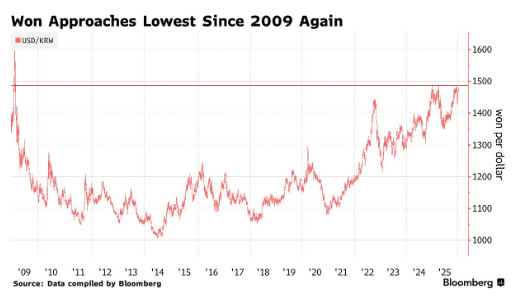
Core Viewpoint - The South Korean won is experiencing significant depreciation, nearing its lowest level since the global financial crisis, primarily due to accelerated capital outflows by domestic investors and strong demand for US dollars [1][3]. Group 1: Currency Performance - The won has depreciated against the US dollar, reaching 1,479.3 won per dollar, marking a 0.25% drop and continuing a ten-day decline [1]. - The year-to-date decline of the won against the dollar exceeds 2.6%, making it the worst-performing currency in Asia and placing it among the weakest globally [3]. Group 2: Market Dynamics - Domestic investors have significantly increased their investments in US stocks, with approximately $2.2 billion purchased by retail investors as of January 13 [1]. - Foreign investors are accelerating their sell-off of South Korean stocks, further intensifying the downward pressure on the won [1]. Group 3: Government Response - The South Korean authorities have implemented measures such as verbal interventions and the exemption of foreign exchange stability taxes to support the won, but these efforts have not effectively halted its decline [3]. - There is growing concern that the continued depreciation of the won may exacerbate imported inflation and suppress consumer demand, prompting the need for stronger policy responses [3].

余额飙涨到1035.5亿美元:韩国外汇存款出现3个月首次增长!17.1亿美金入场,汇率保卫战迎来转折?
Sou Hu Cai Jing· 2025-12-30 07:12
Group 1 - The core point of the article is that South Korea's foreign currency deposits increased for the first time in three months, reaching $103.55 billion by the end of November 2025, which is a $1.71 billion increase from October [1][3]. - The increase in foreign currency deposits is attributed mainly to corporate contributions, with corporate foreign currency deposits rising by $1.67 billion to $88.43 billion, while personal deposits only increased by $40 million to $15.11 billion [5][6]. - The rise in deposits coincides with a recovery in exports, particularly in semiconductors, which saw a year-on-year increase of 38.5%, and automotive exports, which grew by 13.7% due to a trade agreement with the U.S. [5][6]. Group 2 - The increase in foreign currency deposits is expected to alleviate liquidity pressure in the foreign exchange market, contributing to South Korea's foreign exchange reserves, which have risen for six consecutive months to $430.66 billion [8]. - Despite the positive short-term effects, the long-term pressure on the Korean won remains, as import prices rose by 2.6% in November due to currency depreciation, marking the largest increase in 19 months [8][10]. - Future trends in foreign currency deposits will depend on two key factors: the sustainability of export growth and the stability of the Korean won's exchange rate [8][10].