汽车产业格局调整

Search documents
上游涨价抬成本,关税松绑拓空间
HTSC· 2026-01-21 02:50
Investment Rating - The report maintains an "Overweight" rating for the automotive industry, indicating an expectation that the industry stock index will outperform the benchmark [6]. Core Insights - The automotive industry is undergoing significant changes, with rising costs from upstream components like storage chips and metals, alongside favorable tariff adjustments in Canada for Chinese electric vehicles [2][4]. - Bosch's declining profit margins reflect the broader challenges faced by traditional suppliers in Europe, highlighting the need for transformation amidst cost pressures [3]. - The reduction of tariffs on Chinese electric vehicles in Canada presents a new opportunity for Chinese automakers to penetrate the North American market [4]. Summary by Sections Upstream Cost Increases - The price increase of storage chips significantly impacts the cost of mid to high-end vehicles, with costs rising by 800 to 2304 RMB for mid-range cars and over 2700 RMB for high-end models due to increased RAM/ROM prices [2]. - Copper and aluminum prices are projected to rise, further increasing costs for electric vehicles, with cost increases of 1222 RMB for pure electric vehicles based on current price trends [2]. European Supply Chain Challenges - Bosch anticipates a profit margin drop to below 2% by 2025, down from 3.5% in 2024, due to restructuring costs and challenges in transitioning to electric and hydrogen technologies [3]. - The overall German automotive supply chain is experiencing similar pressures, with many companies facing reduced capacity utilization and increased operational costs [3]. Canadian Tariff Policy Changes - Canada has announced a significant reduction in tariffs on Chinese electric vehicles from 100% to 6.1%, which could reshape the competitive landscape in the North American market [4]. - This policy change allows Chinese brands to potentially increase their market share in Canada, particularly in the SUV and pickup segments, which account for 84% of sales [4]. Investment Recommendations - The report suggests focusing on two main investment directions: companies with strong supply chain advantages and cost reduction capabilities, and Chinese electric vehicle manufacturers poised to benefit from the new Canadian tariff policy [5].
汽车产量强省格局生变,谁在进位
Mei Ri Jing Ji Xin Wen· 2025-07-24 23:06
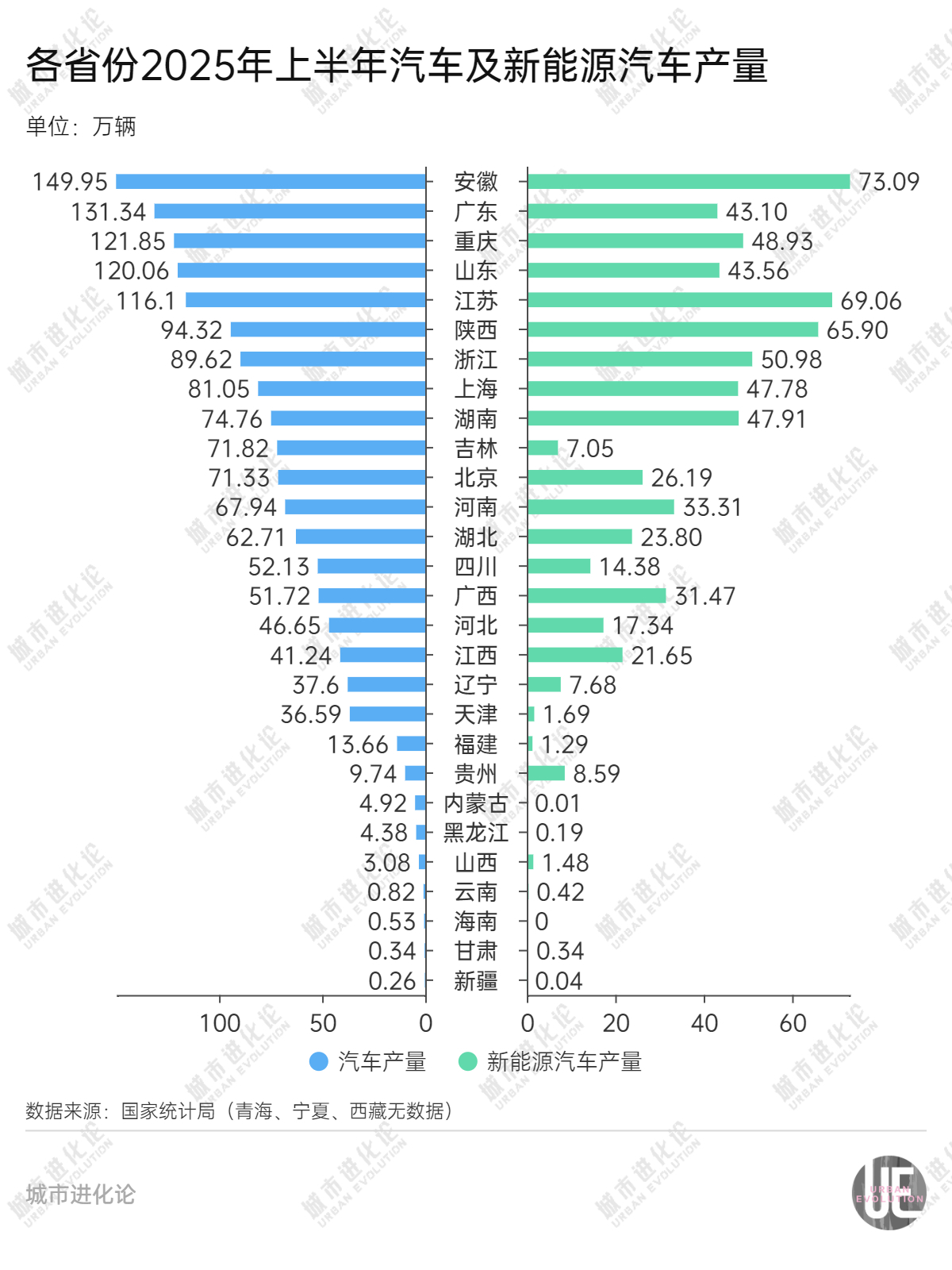
Core Insights - The automotive industry in China is experiencing a significant shift, with Anhui province achieving historic breakthroughs in both total vehicle and new energy vehicle (NEV) production, surpassing Guangdong for the first time in nearly a decade [1][3] Group 1: Automotive Production Data - In the first half of 2023, China's total automotive production reached 15.62 million units, marking a year-on-year increase of 12.5%, while sales reached 15.65 million units, up 11.4% [1] - Anhui's automotive production reached 1.4995 million units, and NEV production hit 730,900 units, both ranking first in the nation [1] - Guangdong's automotive production was 1.3134 million units, placing it second, and its NEV production was 431,000 units, dropping to ninth place [3] Group 2: Provincial Rankings and Changes - The top ten provinces for automotive production in the first half of 2023 included Anhui, Guangdong, Chongqing, Shandong, Jiangsu, Shaanxi, Zhejiang, Shanghai, Hunan, and Jilin [1] - The top ten provinces for NEV production were Anhui, Jiangsu, Shaanxi, Zhejiang, Chongqing, Hunan, Shanghai, Shandong, Guangdong, and Henan [1] - Hunan's automotive production reached 747,600 units, moving from 18th to 9th place, while its NEV production surged to 479,100 units, climbing from 15th to 6th place [3][4] Group 3: Industry Development Factors - Anhui's rise in automotive production is attributed to its robust industrial layout, including major manufacturers like Chery, NIO, and BYD, which have created a comprehensive NEV supply chain [3] - Hunan's automotive manufacturing grew by 25.1%, with NEV manufacturing increasing by 167.7%, becoming a significant economic driver [4] - In Henan, automotive production reached 679,400 units, moving from 17th to 12th place, with NEV production at 333,100 units, entering the national top ten [4]