汽车产业结构优化

Search documents
中国汽车强省格局生变:安徽广东双子星,吉林反而掉队
2 1 Shi Ji Jing Ji Bao Dao· 2026-02-02 12:01
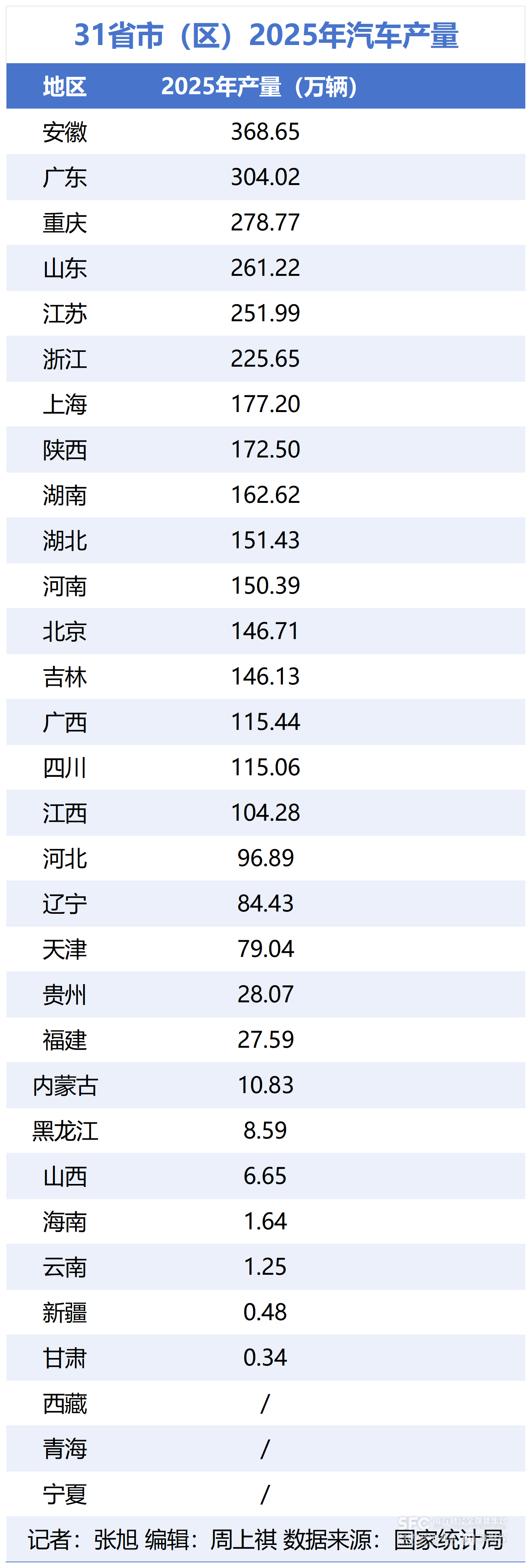
Core Viewpoint - In 2025, China's automotive industry is undergoing significant transformation driven by technology and policy, with a production volume of 34.78 million vehicles, representing a year-on-year growth of 10.2% [1] Industry Overview - The automotive industry is a pillar of the national economy, and changes in its regional structure reflect the transformation and upgrading of China's manufacturing sector [1] - From 2025, the National Bureau of Statistics will change its method of calculating automotive production from "enterprise legal person location" to "production location," impacting regional production data [1][5] Regional Production Changes - In 2025, 16 provinces exceeded a production volume of 1 million vehicles, an increase of 4 provinces from 2024, with notable rises in Hunan and Henan [1] - Hunan's ranking jumped from 18th to 9th, while Henan rose from 17th to 11th [1] - Jilin, the birthplace of China's automotive industry, fell out of the top ten, dropping to 13th place with a production decrease of 3% to 1.46 million vehicles [1][8] New Energy Vehicle Impact - The arrival of the new energy era is a crucial factor in the changing industry landscape, with provinces like Anhui, Hunan, and Jiangsu seeing new energy vehicle production ratios exceeding 50% [9] - In 2025, China's new energy vehicle production and sales surpassed 16 million units, with a year-on-year growth of 29% and 28.2%, respectively [8] Competitive Landscape - The automotive industry structure is optimizing, with companies like BYD and Chery making significant advancements in technology and overseas markets, while traditional automakers lag behind [2] - The competition has shifted from price and configuration to a comprehensive capability contest, emphasizing cost control, technology integration, and global operational capacity [9] Statistical Insights - The top ten provinces by automotive production in 2025 are Anhui, Guangdong, Chongqing, Shandong, Jiangsu, Zhejiang, Shanghai, Shaanxi, Hunan, and Hubei, with production figures ranging from 1.51 million to 3.68 million vehicles [4][5] - Guangdong's automotive production has declined due to a shift in focus from traditional fuel vehicles to high-end manufacturing and export orientation [6] Future Directions - The Ministry of Industry and Information Technology has outlined plans to accelerate breakthroughs in automotive chips, operating systems, artificial intelligence, and solid-state batteries, enhancing product performance and consumer demand [10] - Infrastructure upgrades and industry collaboration are essential for the healthy development of the automotive sector, with a focus on avoiding low-level competition and promoting regional strengths [11]

罗兰贝格:中国汽车产业结构优化与淘汰整合必将加速
Nan Fang Du Shi Bao· 2026-01-09 09:45
Core Insights - The Chinese automotive industry faced both challenges and opportunities in 2025, with total sales expected to reach 24.4 million vehicles, marking a historical high [1] - Roland Berger's report highlights the transition from price competition to high-quality competition, driven by policy adjustments and market dynamics [3] Group 1: Industry Trends - The report identifies six key transformations in the automotive sector, emphasizing the acceleration of competition and the elimination of weaker players [3][4] - The competition is shifting from price wars to a focus on comprehensive value chain capabilities, including R&D, manufacturing, supply chain, and user operations [4] - The internationalization of the Chinese automotive industry is deepening, with a shift from "product export" to "full value chain output," despite facing structural changes and increased competition [5] Group 2: Technological and Capital Dynamics - Technological leadership is becoming increasingly critical for both vehicle manufacturers and suppliers, influencing product competitiveness and brand positioning [5][6] - The capital race is intensifying, with companies needing to manage cash flow and mergers effectively to survive in a challenging market environment [6] - AI is emerging as a transformative force in the industry, with significant efficiency improvements of 30%-50% reported in certain applications, making 2026 a pivotal year for AI deployment [6][7]