
汽车保价

Search documents
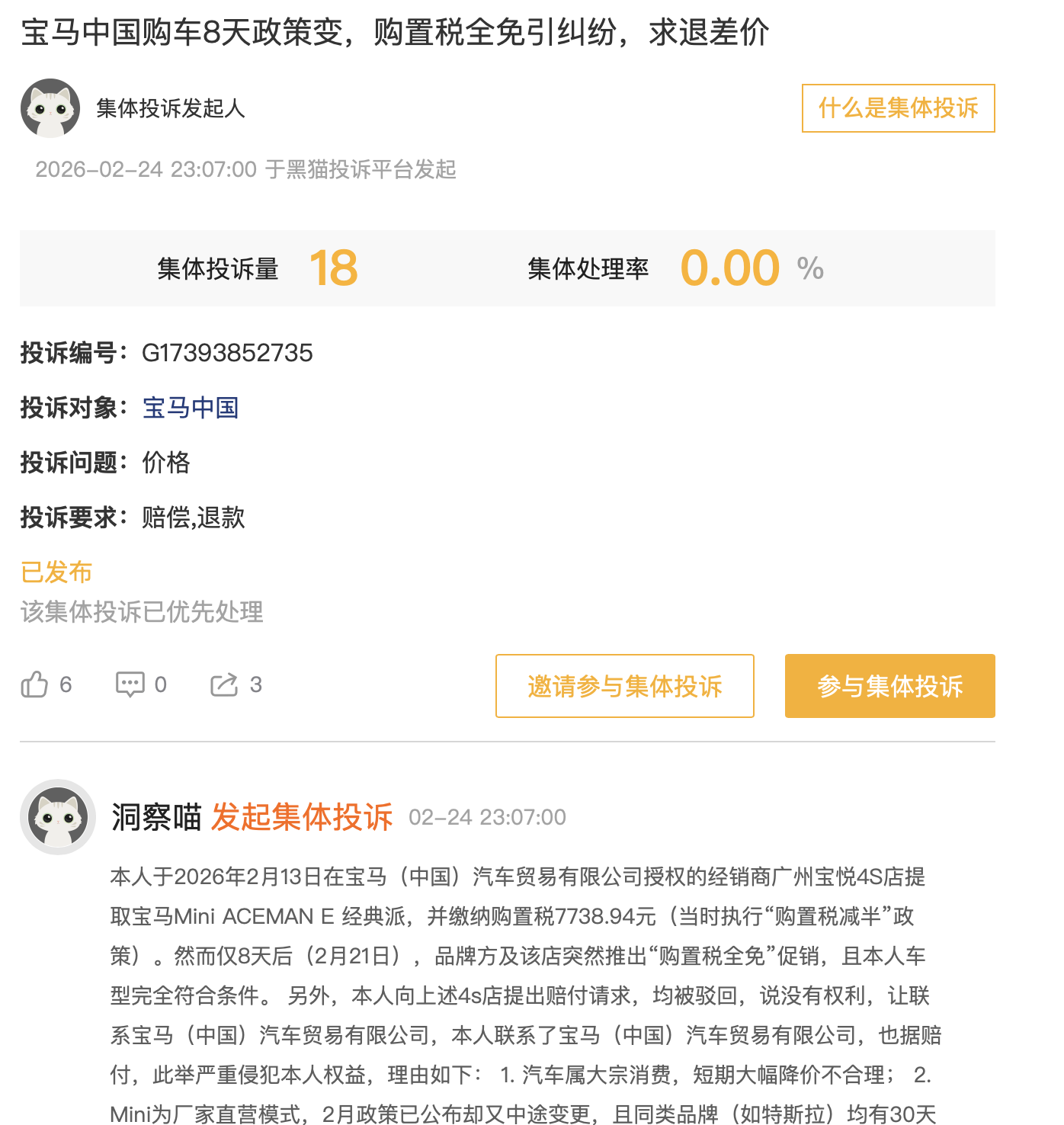
早买8天多花近万购置税 宝马中国拒不补偿老车主引众怒
Xin Lang Cai Jing· 2026-02-27 10:30
Core Viewpoint - BMW's recent decision to waive vehicle purchase tax for new MINI models just eight days after a customer made a purchase has sparked significant consumer backlash, leading to collective complaints regarding the lack of price protection for early buyers [1][11]. Group 1: Consumer Complaints - A customer who purchased a BMW MINI ACEMAN E on February 13 paid a vehicle purchase tax of 7,739 yuan, only to find out that the tax was waived on February 21, resulting in a loss of nearly 1,000 yuan per day for the customer [1][3]. - The collective complaints on the Black Cat Complaints platform have reached 18 cases, with affected consumers from nine provinces, including Guangdong, Jiangsu, and Chongqing [3][14]. - Many complainants had purchased their vehicles within a month of the promotional announcement, with some not even having received their cars before the price drop occurred [4][15]. Group 2: Price Protection Expectations - Consumers are demanding refunds for the tax difference, which ranges from 6,805.31 yuan to 23,168 yuan, highlighting a growing expectation for price protection similar to e-commerce practices [5][16]. - The concept of "price protection" has gained traction in the automotive industry, particularly in the context of price wars among electric vehicle manufacturers, where companies have implemented policies to protect consumers from sudden price drops [6][19]. - BMW previously offered a price protection policy for its MINI models, which raises questions about the company's current refusal to provide similar assurances [19][21]. Group 3: Market Dynamics and Company Response - BMW's recent promotional strategy, which involves tax waivers rather than direct price reductions, is viewed as a temporary marketing tactic rather than a fundamental change in pricing strategy [10][21]. - The traditional dealership model employed by BMW allows for flexible pricing, which contrasts with the direct sales approach of newer electric vehicle companies [21]. - Legally, BMW is not obligated to refund the price difference unless explicitly promised during the sale, reflecting a gap between consumer expectations and corporate practices in a rapidly changing market [10][21].


保价为何孤掌难鸣?
Zhong Guo Qi Che Bao Wang· 2025-06-16 01:05
Core Viewpoint - The automotive market is experiencing renewed price competition, with Deep Blue Automotive's S09 model introducing a "one-year price guarantee" policy, aiming to build consumer trust amidst the price war [2] Group 1: Price Guarantee Policy - Deep Blue S09 is priced between 239,900 to 309,900 yuan and offers a price guarantee for orders placed before June 30, 2025, for 365 days [2] - Few brands have followed suit with short-term price guarantees, with the longest being 90 days, contrasting sharply with the price guarantee trend seen at the end of 2022 [2] - The automotive industry's price guarantee strategy faces inherent contradictions, as it consumes future price adjustment space, especially in a rapidly evolving market [2][5] Group 2: Legal and Consumer Behavior Challenges - Legal risks are significant, as price guarantees have unilateral legal effects, and companies face compensation and reputation risks if they breach these promises [3] - Despite 83% of consumers welcoming price guarantees, only 27% consider them a crucial factor in purchasing decisions, indicating a preference for absolute low prices over relative value [3] Group 3: Industry Profitability and Competition - The automotive industry's profit margin has dropped to 3.5% in Q1 2023, down from a peak of 8.99% in 2014, leading to a cycle of increased sales but stagnant profits [5] - Price guarantees lock in profit margins, which can be detrimental for companies with low margins, as they may lead to significant profit reductions [5] Group 4: Supply Chain and Systemic Risks - Supply chain pressures complicate price guarantees, as manufacturers often transfer price competition costs to suppliers, creating a risk of unilateral price guarantees [6] - The collapse of the second-hand car residual value system highlights systemic risks associated with price guarantees, as consumer confidence in long-term value diminishes [8] Group 5: Technological Evolution and Market Dynamics - Rapid technological advancements weaken the foundation of price guarantees, as consumers face obsolescence of hardware, leading to a shift in focus towards software subscription services [9] - The automotive industry is undergoing a transformation from one-time transactions to lifecycle services, suggesting that traditional price guarantees may not be sustainable [9]

