汽车软件在线升级

Search documents
【行业政策】一周要闻回顾(2025年12月22日-12月28日)
乘联分会· 2025-12-29 08:38
Core Viewpoint - The article discusses the upgrade and launch of the "Automobile Software Online Upgrade Filing System" by the Ministry of Industry and Information Technology, aimed at enhancing the management of intelligent connected vehicles and their software upgrades [1]. Group 1: System Upgrade and Access - The new system will be operational from December 22, 2025, and will be integrated into the Ministry's unified government service platform [1]. - Enterprises can access the new system via a direct link or through the "Road Motor Vehicle Service Zone" on the government platform [1]. - Existing enterprise and operator accounts from the old system will be deactivated, requiring users to log in with new corporate and operator accounts authorized by the legal representative [3]. Group 2: Data and Permissions Management - The legal representative's account will have access to all enterprise data, including historical and new application data, while individual operators can only view data they have created [4]. Group 3: National Standards and Recommendations - The National Automotive Standardization Technical Committee is seeking opinions on two recommended national standards related to vehicle stability testing, with a deadline for feedback set for February 21, 2026 [7]. - The proposed standards include detailed methodologies for various stability tests, which are essential for the development and testing of automotive products [8]. Group 4: Product Admission Requirements - New type approval applications for passenger vehicles must comply with updated standards starting January 1, 2026, with existing approvals transitioning by January 1, 2028 [13][14]. - The notification outlines specific requirements for various vehicle components, including external protrusions, defrosting systems, and braking systems, with detailed timelines for compliance [14][15][16]. Group 5: Adjustments in Product Admission Names and Requirements - The product admission model names will be adjusted according to new standards effective January 1, 2026, requiring new applications to adhere to these changes [20]. - Additional requirements for product admission applications include providing comprehensive structural photographs and corresponding user manuals [21][22]. Group 6: Implementation and Compliance - Testing institutions are urged to enhance their testing capabilities in preparation for the new standards, while vehicle manufacturers must organize their compliance efforts and submit necessary reports [24].


OTA暂停?智能汽车强监管时代来了
3 6 Ke· 2025-08-27 07:11
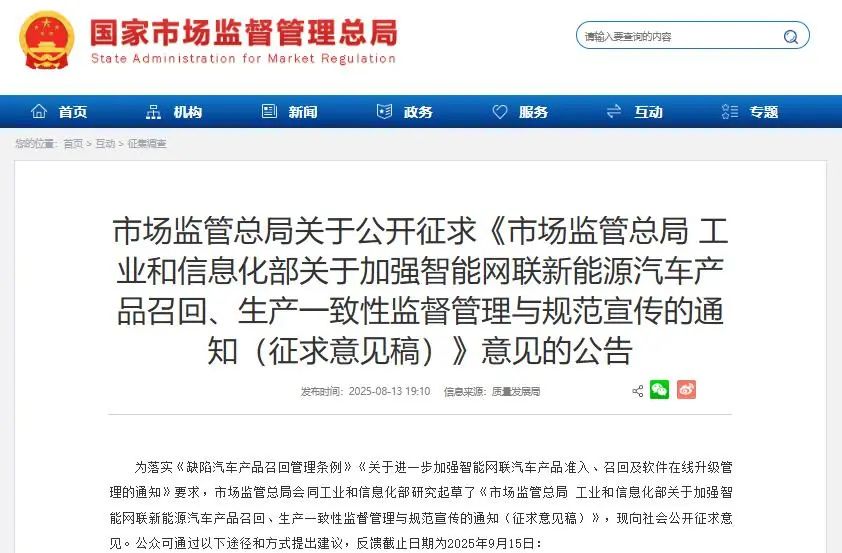
Core Insights - The article discusses the increasing regulation of Over-The-Air (OTA) updates in the smart electric vehicle industry, highlighting the shift from a "free trial" approach to mandatory compliance and oversight [1][2][3] - The new regulatory framework aims to ensure that all OTA updates are properly tested and approved before being pushed to consumers, marking a significant change in how automotive companies can operate [2][3][11] Regulatory Changes - The recent notification from the Market Regulation Administration and the Ministry of Industry and Information Technology emphasizes that all OTA upgrades must be filed for approval, especially those related to core functions like autonomous driving [2][3] - This regulatory shift has led to a slowdown in OTA updates across the industry, affecting companies like Tesla, XPeng, and Aito, which have faced delays in their planned updates due to compliance issues [2][3] User Experience and Expectations - The decline in OTA update frequency has resulted in user dissatisfaction, with many consumers expressing frustration over the lack of new features and updates, leading to concerns about the reliability of their vehicles [4][6] - Legal experts warn that failure to deliver on promises of "lifetime OTA" updates could lead to consumer rights violations and potential lawsuits, impacting brand reputation [6][11] Future of OTA and Revenue Models - OTA is evolving from a free service to a potential revenue stream, with companies like Tesla already generating significant income from paid software upgrades [8][10] - The automotive software market is projected to grow substantially, with estimates suggesting a tripling in size from €76 billion to €252 billion between 2020 and 2030, indicating a shift in focus towards enhancing functionality and value rather than just update frequency [10] Conclusion - The current pause in OTA updates presents both challenges and opportunities for the industry, as companies must adapt to stricter regulations while also improving the safety and reliability of their software [11] - The regulatory changes signify a transition in China's smart automotive sector from encouraging innovation to prioritizing safety and compliance, which may ultimately strengthen consumer trust in the long run [11]