汽车金融创新

Search documents
车市卷向7年超长贷,是否暗藏风险?
第一财经· 2026-02-02 10:52
Core Viewpoint - The article discusses the introduction of 7-year low-interest financing plans by various automotive companies, including Tesla, NIO, and others, as a strategy to stimulate sales in a competitive market [2][4][5]. Group 1: Financing Plans - Tesla initiated a 7-year low-interest loan plan with a minimum down payment of 79,900 yuan and a monthly payment of approximately 1,918 yuan for the Model 3 [4]. - NIO offers a similar plan with a down payment as low as 20% and an annual interest rate of 0.49%, allowing for a monthly payment of 1,872 yuan [4]. - Other companies like Li Auto provide varied financing options, with down payments starting at 15% but higher annual interest rates, ranging from 1.69% to 2.50% [5][6]. Group 2: Market Dynamics - The introduction of these long-term financing options is seen as a response to intense competition in the automotive market, aiming to lower the monthly payment burden for consumers [7]. - The shift from a 5-year to a 7-year repayment period significantly reduces monthly payments, making it easier for consumers to afford new vehicles [7]. - The financing products are primarily offered through automotive financing companies or third-party financial institutions rather than traditional banks, which typically limit car loans to a maximum of 5 years [9][10]. Group 3: Consumer Considerations - Consumers are advised to carefully evaluate the terms of financing or leasing agreements, including ownership rights and potential fees for early repayment [11]. - The article highlights the importance of understanding the differences between direct leasing and return leasing models, as they affect ownership and insurance responsibilities [10][11]. - The financing leasing model is increasingly popular among automotive brands targeting lower-tier customers, but it also presents risks related to payment defaults and vehicle depreciation [12].


车市卷向7年超长贷 是否暗藏风险?
Di Yi Cai Jing· 2026-02-02 09:27
Core Viewpoint - Tesla has initiated a 7-year low-interest loan promotion, leading other automakers like Xpeng, Li Auto, Xiaomi, and Geely to follow suit with similar financing options aimed at boosting consumer purchases in a competitive market [1][5]. Group 1: Financing Options - Tesla's Model 3 offers a 7-year loan with a minimum down payment of 79,900 yuan and a monthly payment of approximately 1,918 yuan, with an annual interest rate of 0.5% [2]. - NIO provides a similar 7-year financing plan with a down payment as low as 20% and an annual interest rate starting at 0.49%, significantly lowering the purchase threshold [2][3]. - Li Auto's financing options vary by model, with 6-7 year plans starting at a 15% down payment and annual interest rates ranging from 1.69% to 2.50% [3]. Group 2: Market Dynamics - The introduction of 7-year low-interest loans is seen as a strategy to increase vehicle sales amid fierce competition in the automotive market [5]. - The average monthly payment for a 7-year loan can be reduced to around 2,000 yuan, compared to approximately 5,000 yuan for a 5-year loan, easing the financial burden on consumers [5]. Group 3: Regulatory Context - Current regulations limit personal auto loans to a maximum of 5 years, but a recent policy change allows for a phased extension to 7 years, enabling companies like Tesla and NIO to offer these financing options [4]. - The shift to 7-year loans is facilitated by the conversion of auto loans into consumer loans by some financial institutions, reflecting a change in risk management practices [4]. Group 4: Financing Providers - Many of the 7-year low-interest products are provided by automotive financing leasing companies or third-party financial institutions rather than traditional banks [7]. - Li Auto's financing products are offered through various leasing companies, indicating a trend towards alternative financing models in the automotive sector [7]. Group 5: Consumer Considerations - Consumers are advised to carefully evaluate third-party leasing products, distinguishing between direct leasing and buy-back options, and to consider the total cost of ownership, including any additional fees and penalties for early repayment [9]. - The financing leasing model presents challenges, such as potential losses for leasing companies due to customer defaults and the difficulty in recovering costs from returned vehicles [10].
车市卷向7年超长贷,是否暗藏风险?
Di Yi Cai Jing· 2026-02-02 09:23
Core Viewpoint - The automotive finance market is currently dominated by conventional car loans with terms of 1 to 5 years, while 7-year low-interest products are not mainstream and serve primarily as promotional tools to attract consumers [1][9]. Group 1: 7-Year Low-Interest Loan Products - Tesla has extended its low-interest loan period to 7 years, initiating a trend that other manufacturers like Xiaopeng, Li Auto, and Geely have followed with similar offerings [1][2]. - The 7-year low-interest loans typically feature lower down payments and monthly payments, with Tesla's Model 3 offering a minimum down payment of 79,900 yuan and a monthly payment of approximately 1,918 yuan [2]. - NIO offers a 7-year loan with a down payment as low as 20% and an annual interest rate of 0.49%, significantly lowering the entry barrier for consumers [2][3]. Group 2: Financial Institutions and Risk Management - Many of the 7-year low-interest products are provided by automotive financing leasing companies or third-party financial institutions rather than traditional banks, which typically do not offer loans longer than 5 years due to risk management policies [4][7]. - The current regulatory framework allows for personal auto loans to be extended to 7 years, a change that has enabled companies like Tesla and NIO to introduce these products [4]. - The financing leasing model often involves lower upfront costs but may include conditions such as penalties for early repayment, which vary by institution [8][9]. Group 3: Market Dynamics and Consumer Impact - The introduction of 7-year low-interest loans is primarily aimed at boosting vehicle sales amid intense market competition, with varying levels of interest subsidies across different manufacturers [5][10]. - Extending the repayment period from 5 to 7 years can significantly reduce monthly payments, making it easier for consumers to afford vehicles [5]. - Consumers are advised to carefully evaluate the total cost of ownership, including potential additional fees and the implications of different ownership structures (direct lease vs. return lease) when considering these financing options [9][10].


开年金融战打响!多家车企出手,七年超长车贷来了
Nan Fang Du Shi Bao· 2026-01-26 15:27
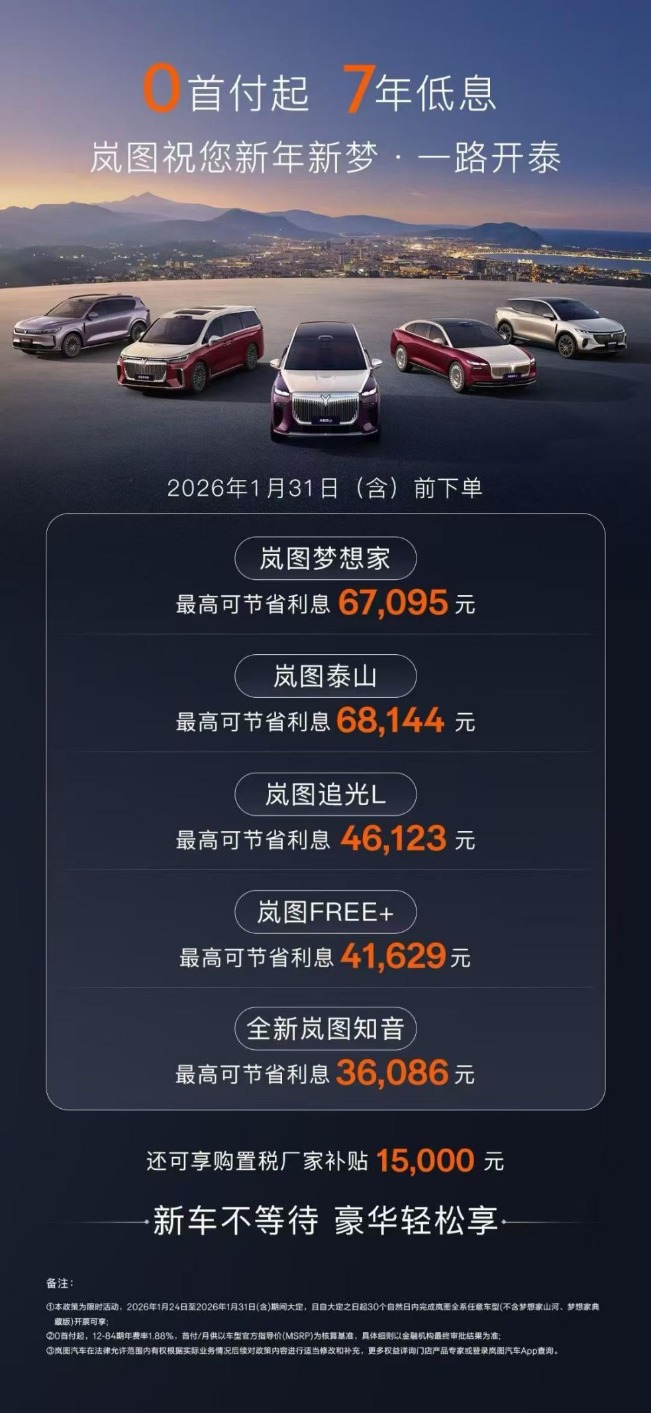
Group 1 - Lantu Motors has launched a "seven-year low-interest" car purchase plan, allowing customers to enjoy benefits such as zero down payment and interest rates as low as 1.88% for 12-84 months, potentially saving between 36,000 to 68,000 yuan in interest depending on the model [1] - This policy is not unique to Lantu; Tesla initiated a similar "five-year zero-interest" policy in April 2024, which has since been adopted by various brands including Xiaopeng and NIO, indicating a shift in the automotive market towards financial innovations rather than direct price cuts [4][5] - The automotive industry is responding to a sluggish market by collectively increasing long-term low-interest policies, as evidenced by a significant drop in retail sales of passenger vehicles, which fell by 14% year-on-year in December 2025 [5] Group 2 - The long-term low-interest model may pose risks for smaller car manufacturers, as the cost of interest subsidies could consume 10% to 15% of their profit margins, and the reliance on long-term loans may strain cash flow [6] - There are concerns that excessive long-term financing could lead to a depletion of future consumer demand, potentially resulting in a market downturn and a return to price wars if financial competition escalates [6][7] - Industry experts emphasize the need for a shift towards higher quality competition, suggesting that financial policies should be viewed as short-term tools while long-term competitiveness relies on technological innovation and product value enhancement [7]