
汽车金融风控

Search documents
7年期车贷来了 车企“超低息”大促有点儿猛
2 1 Shi Ji Jing Ji Bao Dao· 2026-01-27 14:43
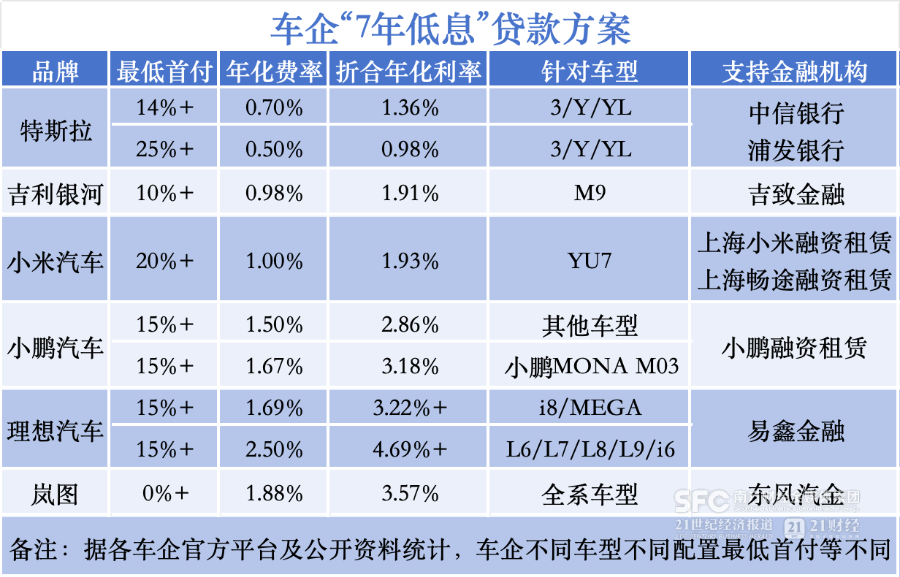
Core Insights - The automotive industry is experiencing a promotional wave of "7-year low-interest" financing plans, initiated by companies like Tesla, Xiaomi, and Xpeng, aimed at stimulating consumer demand and increasing sales before the Chinese New Year [1][4]. Group 1: Promotional Strategies - Various automakers have launched "7-year low-interest" loan schemes to lower the barriers for car purchases and stimulate end-consumer demand [4][5]. - The promotional period for these financing options is limited, primarily from January to February 2026, indicating a strategic push to boost sales during a peak buying season [5][6]. Group 2: Financing Details - The financing plans differ significantly among brands in terms of lending institutions, down payment requirements, funding costs, and model coverage [5][6]. - Tesla offers a low-interest rate of 0.50% for a 25% down payment, while other brands like Li Auto and Xpeng have higher rates, with some reaching up to 2.50% [6][7]. - The monthly payment burden is significantly reduced with the extended loan term, but the total interest paid over the loan period increases [8][10]. Group 3: Consumer Considerations - Consumers are advised to assess their financial capabilities and long-term repayment abilities before opting for the "7-year low-interest" loans, as the longer repayment period may lead to increased financial strain [15][17]. - The risk of depreciation in vehicle value over the extended loan term raises concerns, particularly for electric vehicles, which may face rapid technological obsolescence [10][11]. Group 4: Market Trends - The trend of offering longer loan terms aligns with national policies aimed at boosting consumer spending, reflecting a broader economic strategy [2][4]. - The resale value of electric vehicles is notably lower compared to traditional fuel vehicles, with electric models experiencing a decline in value due to market competition and rapid advancements in technology [11][13].


汽车金融高增长:银行如何筑好风控防线
Zhong Guo Jing Ying Bao· 2025-05-09 19:11
Group 1 - The automotive finance market is expanding due to policy stimulation and consumption upgrades, with significant growth in auto loans and credit card installment businesses reported by some banks [1][2] - In 2024, major banks like Bank of Communications and Ping An Bank reported substantial increases in their automotive finance portfolios, with Ping An Bank's new energy vehicle loans growing by 73.3% year-on-year [2][3] - The People's Bank of China and the National Financial Regulatory Administration have introduced policies to support automotive consumption, including adjustments to loan issuance ratios for various vehicle types [3] Group 2 - Banks are exploring new development paths in automotive finance, focusing on enhancing their product offerings and customer service, particularly in new energy and used car loans [4] - The automotive finance sector includes various institutions such as commercial banks and automotive finance companies, with banks being the largest competitors due to their lower funding costs and extensive networks [4] Group 3 - Despite growth, risks are emerging in the automotive finance sector, particularly related to the collaboration with intermediaries, which can lead to issues such as information asymmetry and high channel costs [5][6] - Banks face challenges when partnering with intermediaries, including potential violations and the risk of transferring financial responsibilities to lower-tier agents [6][7] Group 4 - Regulatory bodies are encouraging banks to optimize their collaboration with automotive dealers and to focus on direct customer engagement to enhance the quality of automotive finance services [8] - Recommendations for banks include restructuring channel cooperation models and building a comprehensive ecosystem to directly reach end customers, integrating services across the automotive finance process [8]
