理想i8/MEGA

Search documents
车企掀7年低息促销潮,特斯拉、小米、小鹏等都在列,月供低至千元
2 1 Shi Ji Jing Ji Bao Dao· 2026-01-28 00:59
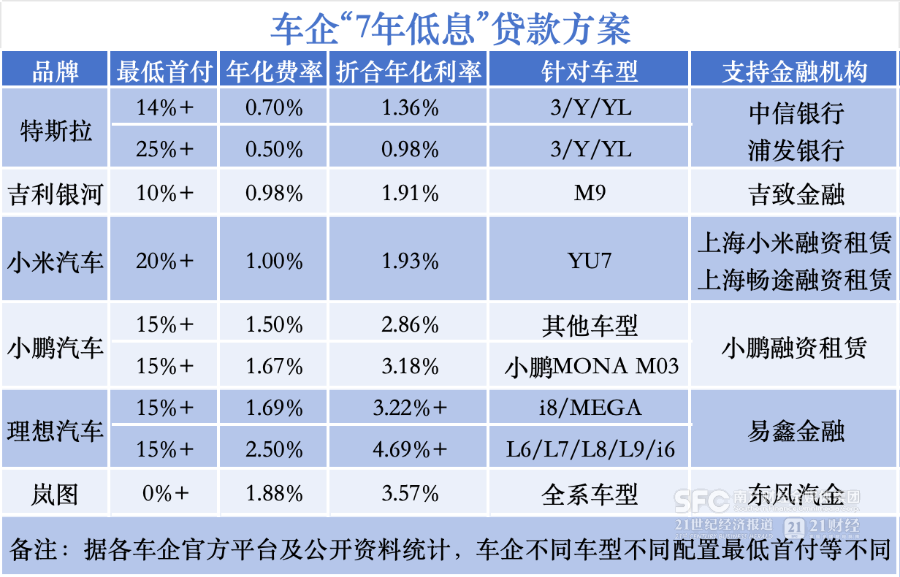
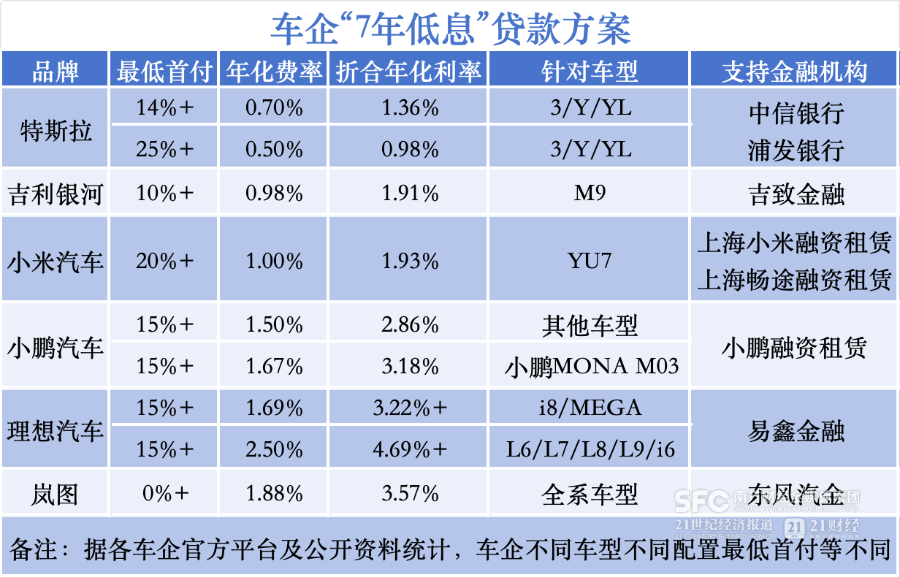
Core Insights - The automotive industry is experiencing a promotional wave of "7-year low-interest" financing plans, initiated by companies like Tesla, Xiaomi, and Xpeng, aimed at stimulating consumer demand and increasing sales before the Chinese New Year [1][2][4] Group 1: Financing Plans Overview - Various automakers have launched "7-year low-interest" loan policies to lower the purchase threshold and stimulate end-consumer demand [4] - The financing plans differ significantly among brands in terms of lending institutions, down payment requirements, funding costs, and model coverage [4][5] - Tesla offers a lower financing cost with a 0.50% annualized fee for a 25%+ down payment option, while other brands like Li Auto have higher costs, reaching up to 2.50% [5][6] Group 2: Consumer Impact - The extended repayment period significantly reduces monthly payment pressure for consumers, but total interest payments will increase [8][10] - For example, under Xiaomi's "7-year low-interest" plan, a consumer would pay a total interest of 14,252.28 yuan over the loan period [8] - Consumers are advised to assess their financial situation carefully, as the longer loan terms may lead to increased financial strain if not managed properly [17] Group 3: Market Dynamics - The push for longer loan terms aligns with national policies aimed at boosting consumption, allowing banks to extend personal consumption loan terms from 5 to 7 years [2] - The automotive market is seeing a shift in consumer preferences, with some opting for higher upfront payments to avoid long-term debt, while others appreciate the lower monthly payments offered by extended loans [10][15] - Concerns about vehicle depreciation and residual values are heightened with longer loan terms, especially for electric vehicles, which may face rapid technological obsolescence [10][11] Group 4: Risk and Regulatory Considerations - Financial institutions face increased risk management challenges due to the longer loan terms and lower down payments, necessitating more stringent consumer assessments [15][16] - The distinction between traditional auto loans and financing leases is crucial, as ownership rights differ significantly, impacting consumer decisions [20][21] - Legal experts emphasize the importance of understanding contract terms related to ownership and repayment obligations in financing leases [22][23]




车企掀7年低息促销潮,特斯拉、小米、小鹏等都在列,月供低至千元
21世纪经济报道· 2026-01-28 00:53
Core Viewpoint - The article discusses the recent trend of car manufacturers offering "7-year low-interest" financing plans to stimulate consumer demand, driven by government policies aimed at boosting consumption [2][5]. Group 1: Financing Trends - Various car manufacturers, including Tesla, Xiaomi, and Xpeng, have launched "7-year low-interest" financing options, breaking away from the traditional 1-5 year loan terms [1][5]. - The financing plans are designed to lower monthly payments and initial down payments, making it easier for consumers to purchase vehicles [1][5]. - The trend is a response to government initiatives encouraging consumer spending, particularly before the Lunar New Year [2][5]. Group 2: Loan Details and Variations - The financing options vary significantly among manufacturers, particularly in terms of lending institutions, down payment requirements, and interest rates [5][6]. - Tesla offers competitive rates, with a 0.50% annual fee translating to an effective annual rate of 0.98% for those making a 25% down payment [6]. - Other brands like Li Auto and Xpeng have higher effective annual rates, ranging from 1.9% to 4.69%, indicating a broader range of financing costs [6]. Group 3: Consumer Perception and Financial Implications - Consumers generally perceive the "7-year low-interest" loans as a way to reduce monthly financial burdens, although total interest payments may increase over the loan term [8][10]. - For example, a Xiaomi YU7 financed over 7 years with a 1% annual fee results in a total interest payment of approximately 14,252.28 yuan [8]. - Some consumers express caution, preferring to pay in full rather than take on long-term debt, indicating a desire to avoid overextending financially [10]. Group 4: Risk and Valuation Concerns - The longer loan terms raise concerns about vehicle depreciation and residual values, especially for electric vehicles, which may not hold their value as well as traditional combustion vehicles [11][14]. - The article notes that the average resale value for electric vehicles is lower than that of traditional vehicles, which could pose risks for consumers taking on long-term loans [11][14]. - The article highlights that the main models offered under these financing plans have relatively high resale values, which may mitigate some concerns [11][13]. Group 5: Consumer Eligibility and Approval Process - The approval process for "7-year low-interest" loans is more stringent, requiring higher credit qualifications compared to shorter-term loans [14][15]. - Financial institutions are increasing their risk assessment criteria, necessitating thorough evaluations of consumers' long-term repayment capabilities [14][15]. - Consumers are advised to assess their financial situations carefully before opting for these extended loan terms to avoid potential rejections or financial strain [15].

7年期车贷来了 车企“超低息”大促有点儿猛
2 1 Shi Ji Jing Ji Bao Dao· 2026-01-27 14:43
Core Insights - The automotive industry is experiencing a promotional wave of "7-year low-interest" financing plans, initiated by companies like Tesla, Xiaomi, and Xpeng, aimed at stimulating consumer demand and increasing sales before the Chinese New Year [1][4]. Group 1: Promotional Strategies - Various automakers have launched "7-year low-interest" loan schemes to lower the barriers for car purchases and stimulate end-consumer demand [4][5]. - The promotional period for these financing options is limited, primarily from January to February 2026, indicating a strategic push to boost sales during a peak buying season [5][6]. Group 2: Financing Details - The financing plans differ significantly among brands in terms of lending institutions, down payment requirements, funding costs, and model coverage [5][6]. - Tesla offers a low-interest rate of 0.50% for a 25% down payment, while other brands like Li Auto and Xpeng have higher rates, with some reaching up to 2.50% [6][7]. - The monthly payment burden is significantly reduced with the extended loan term, but the total interest paid over the loan period increases [8][10]. Group 3: Consumer Considerations - Consumers are advised to assess their financial capabilities and long-term repayment abilities before opting for the "7-year low-interest" loans, as the longer repayment period may lead to increased financial strain [15][17]. - The risk of depreciation in vehicle value over the extended loan term raises concerns, particularly for electric vehicles, which may face rapid technological obsolescence [10][11]. Group 4: Market Trends - The trend of offering longer loan terms aligns with national policies aimed at boosting consumer spending, reflecting a broader economic strategy [2][4]. - The resale value of electric vehicles is notably lower compared to traditional fuel vehicles, with electric models experiencing a decline in value due to market competition and rapid advancements in technology [11][13].
21调查|7年期车贷来了 车企“超低息”大促有点儿猛
2 1 Shi Ji Jing Ji Bao Dao· 2026-01-27 14:33
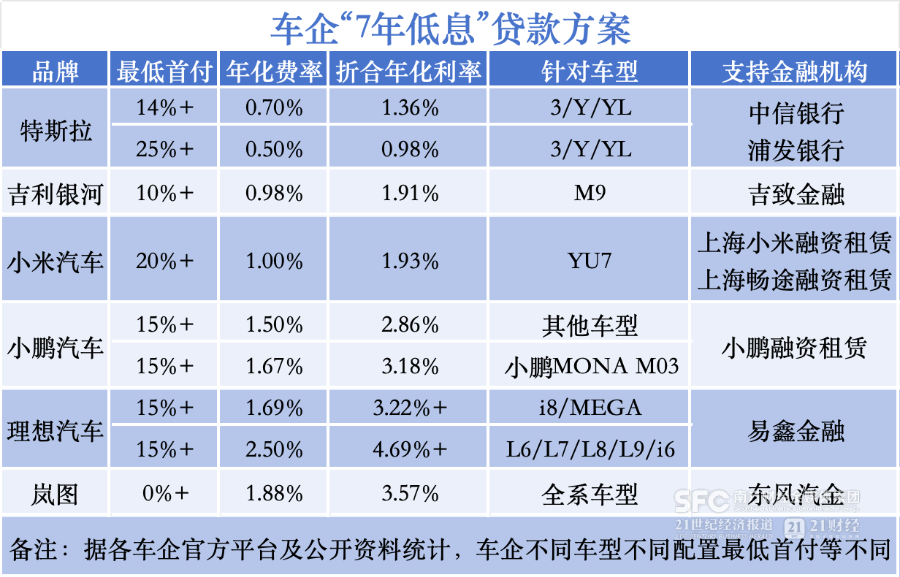
Core Viewpoint - The automotive industry is experiencing a promotional wave of "7-year low-interest" financing plans, driven by government policies aimed at boosting consumer spending and sales before the Lunar New Year [2][5]. Group 1: Promotional Trends - Multiple automakers, including Tesla, Xiaomi, Xpeng, Li Auto, Geely Galaxy, and Lantu, have launched "7-year low-interest" financing options, breaking away from the traditional 1-5 year loan terms [1][5]. - The promotional period for these financing plans is limited, primarily from January to February 2026, aimed at increasing sales volume [6]. Group 2: Financing Details - The financing plans vary significantly among automakers in terms of lending institutions, down payment requirements, and annualized interest rates [6][7]. - Tesla offers a minimum down payment of 14% with an annualized interest rate as low as 0.98% for certain plans, while other brands like Li Auto have higher rates, reaching up to 4.69% [3][7]. - The down payment requirements range from 0% for Lantu to over 25% for Tesla, indicating a wide disparity in accessibility for consumers [6][7]. Group 3: Consumer Impact - The extended loan terms reduce monthly payment burdens, making it easier for consumers to afford new vehicles, but they also lead to higher total interest payments over the loan's duration [10]. - For example, a Xiaomi YU7 financed over 7 years results in a total interest payment of approximately 14,252.28 yuan, compared to a higher monthly payment with a shorter loan term [10]. Group 4: Market Dynamics - The introduction of these financing options is a response to consumer demand for lower upfront costs and monthly payments, particularly before the Lunar New Year [2][5]. - However, concerns about vehicle depreciation and the long-term viability of such financing options exist, especially given the rapid technological advancements in electric vehicles [13][14]. Group 5: Risk and Regulation - Financial institutions face increased risk management challenges due to the longer loan terms and lower down payments, necessitating more stringent consumer assessments [19][20]. - The approval process for "7-year low-interest" loans is more rigorous, with banks requiring higher credit qualifications compared to shorter-term loans [20][21].