汽车预售模式

Search documents
预售的双刃剑
Zhong Guo Qi Che Bao Wang· 2025-11-24 06:40
Core Insights - The pre-sale model is becoming a standard practice in the automotive industry, serving as a crucial strategy for companies to achieve annual sales targets as new car launches surge towards the end of the year [2] - While the pre-sale model offers significant advantages, it also poses risks that can disrupt market order and damage brand reputation, highlighting its "double-edged sword" effect in an increasingly competitive environment [2][6] Group 1: Advantages of Pre-sale Model - The pre-sale model empowers both companies and consumers, acting as a bridge between market demand and production supply, allowing for more precise production planning based on locked-in order data [3] - Marketing strategies such as limited-time discounts and priority delivery during the pre-sale phase can rapidly increase market attention and brand awareness, as demonstrated by NIO's Firefly brand, which saw a 20% price reduction leading to a surge in orders [3][4] - Pre-sale data provides critical insights for product strategy adjustments, enabling companies to optimize pricing and configurations based on market feedback before official delivery [4] Group 2: Risks Associated with Pre-sale Model - The industry has seen issues such as data inflation, where companies misrepresent refundable deposits as actual orders, leading to a significant discrepancy between order totals and actual sales [6] - Delivery delays and discrepancies between advertised and actual vehicle specifications have become major consumer complaints, exacerbated by supply chain issues and production capacity constraints [6][7] - Over-marketing and price wars have intensified irrational competition, with companies focusing on short-term gains rather than product quality, which can harm brand image and long-term sustainability [7] Group 3: Regulatory and Strategic Recommendations - The industry needs to establish a robust regulatory framework to enhance transparency and accountability in pre-sale activities, including penalties for misleading practices [9] - Companies should adopt differentiated pre-sale strategies that emphasize unique features and customer satisfaction rather than solely competing on price, as seen with NIO's focus on safety and personalized services [9] - Improving fulfillment capabilities and service quality is essential for the long-term success of the pre-sale model, requiring companies to assess production and supply chain risks adequately [9][10]


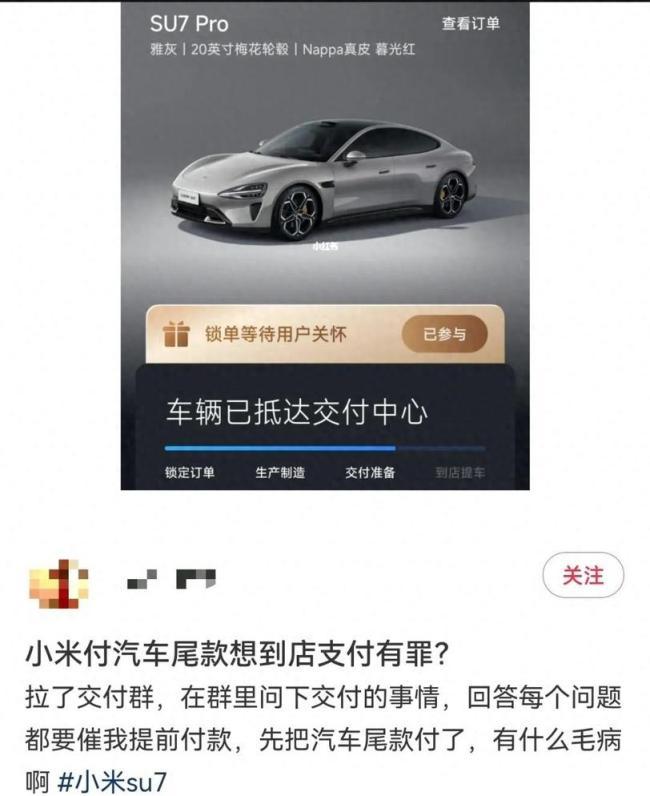
“不给钱不生产”?小米SU7 Ultra被曝强制车主提前付全款
Qi Lu Wan Bao Wang· 2025-08-06 13:18
Core Viewpoint - The controversy surrounding Xiaomi's SU7 Ultra pre-order process highlights significant consumer dissatisfaction due to the company's demand for upfront payment of the remaining balance before vehicle production, which deviates from industry norms and raises concerns about consumer rights and trust [1][17][24]. Group 1: Consumer Experience and Feedback - Many prospective buyers of the SU7 Ultra have reported being required to pay the remaining balance within seven days, even when the vehicle has not yet entered production, leading to feelings of being misled [1][3][10]. - Customers have expressed frustration over the lack of transparency in the payment process, with some stating that they received payment notifications while still waiting for their vehicles to be produced [8][10]. - The increase in the deposit amount from 20,000 yuan to 40,000 yuan, along with the high total price of the vehicle, has raised concerns about the financial burden on consumers [13][18]. Group 2: Comparison with Industry Practices - Xiaomi's approach of requiring payment before vehicle production contrasts sharply with the practices of established automakers like Tesla and NIO, which typically allow customers to inspect the vehicle before final payment [9][17]. - Traditional automotive companies often follow a "down payment + final payment upon delivery" model, which helps mitigate consumer risk and enhances trust [9][17]. - The automotive industry generally emphasizes shared risk in high-value transactions, which Xiaomi's current model appears to undermine [9][18]. Group 3: Financial Implications for Xiaomi - Analysts suggest that Xiaomi's strategy of demanding early payment may be driven by cash flow pressures and the need to combat scalpers, as the company faces significant financial demands during its production ramp-up phase [18][23]. - By securing early payments from consumers, Xiaomi could potentially lock in approximately 1.8 billion yuan in cash flow monthly, which would alleviate some of the financial strain associated with production and supply chain costs [23]. - However, this strategy risks alienating consumers and could lead to increased order cancellations, further complicating the company's market position [18][24]. Group 4: Legal and Ethical Considerations - The legality of Xiaomi's contract terms has been questioned, particularly regarding the stipulation that failure to pay on time constitutes a fundamental breach of contract, which may violate consumer protection laws [23]. - The company's practices have raised ethical concerns, as they appear to shift the financial risks associated with production delays onto consumers, undermining the trust that is essential in the automotive market [24]. - The ongoing issues with the SU7 Ultra, including previous controversies over product quality and misleading advertising, have compounded consumer distrust and dissatisfaction [24][26].