
油降化升

Search documents
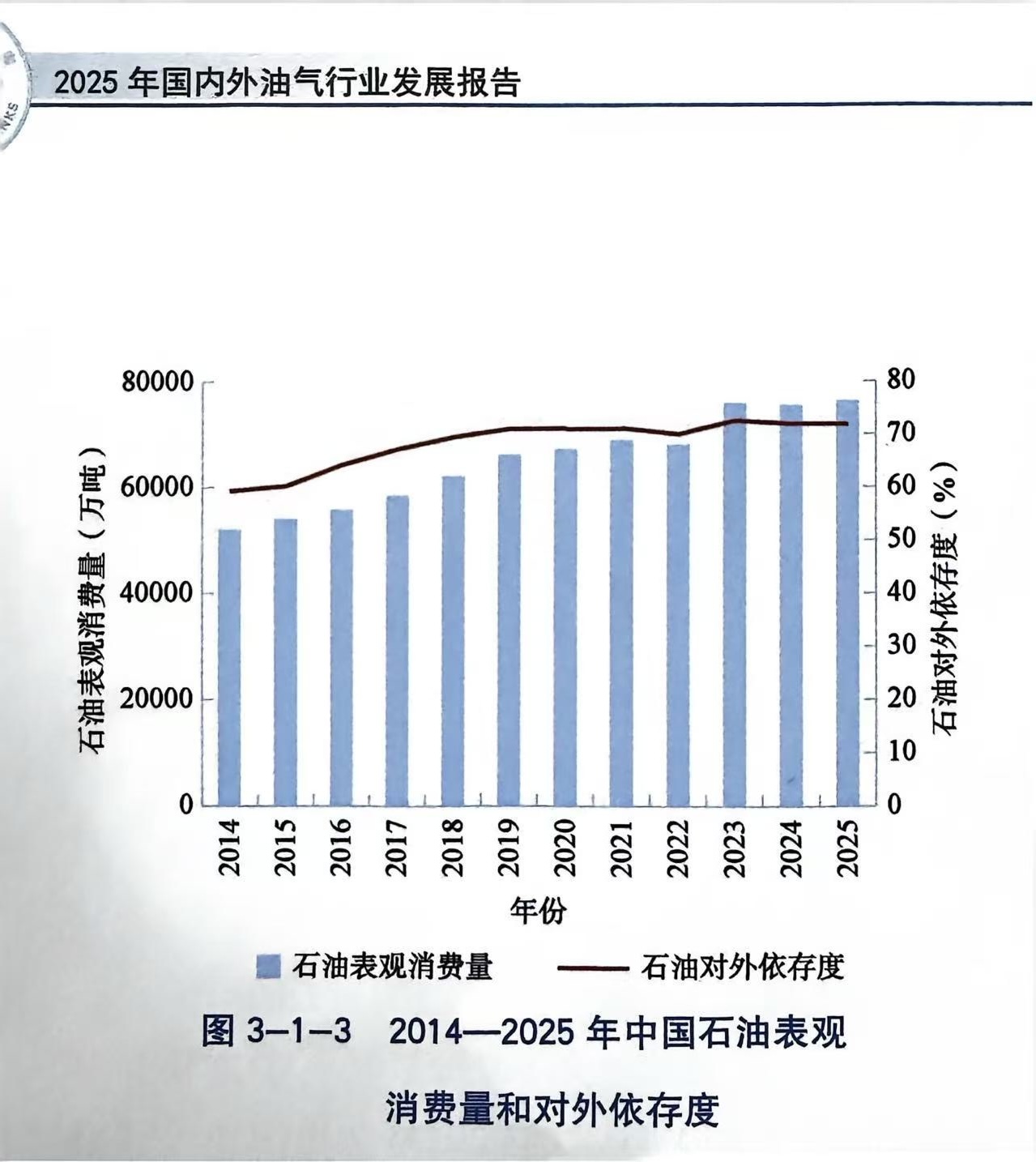
最新报告:“十五五”国内石油对外依存度约为70%
Xin Lang Cai Jing· 2026-02-05 00:40
Group 1: Oil Dependency and Consumption Trends - During the "14th Five-Year Plan" period, China's oil import dependency is projected to remain around 70% [1] - Domestic crude oil production continued to increase, with imports reaching 578 million tons in 2023, a year-on-year increase of 4.4% [3] - By 2025, domestic oil consumption is expected to reach 762 million tons, growing by 1.1% year-on-year, primarily driven by the aviation and chemical sectors [5] Group 2: Shifts in Energy Consumption - The trend of "oil reduction and chemical increase" is becoming more pronounced, with a shift in energy structure as new energy sources increasingly replace traditional fossil fuels [5] - From 2024, refined oil demand is expected to decline, with a projected decrease of 3% in 2025 [5] - Chemical raw material oil demand is anticipated to become a new growth engine, with an expected increase of 8.8% in 2025 [9] Group 3: Chemical Industry Growth - By 2025, China's chemical light oil production is projected to reach 184 million tons, an increase of 8.8% from the previous year, with a yield rate of 25% [9] - The self-sufficiency rate for ethylene is expected to rise to 78.1% by 2025, with significant improvements in the supply capacity of petrochemical products [13] - The demand for high-performance chemical materials is projected to grow at an annual rate of 9% to 14% across various sectors during the "14th Five-Year Plan" [14] Group 4: Global Oil Market Dynamics - Global oil demand growth is expected to slow, with an increase of only 700,000 barrels per day in 2025, down from 900,000 barrels per day the previous year [15] - Brent crude oil prices are projected to average $68.19 per barrel in 2025, a decrease of 14.6% year-on-year, marking the lowest level in five years [19] - The oil market is expected to shift from a tight balance to a significant surplus, with an estimated oversupply of 1.4 million barrels per day in 2025 [21]

报告预计2026年中企海外油气权益产量有望突破2亿吨
Xin Lang Cai Jing· 2026-02-04 04:07
Core Insights - The report indicates that by 2025, China's energy self-sufficiency rate will rise to 84.4%, with non-fossil energy consumption accounting for 21.8% of total energy consumption, and this is expected to increase to over 23% by 2026 [1][2] - The "Seven-Year Action Plan" will conclude successfully in 2025, achieving an oil and gas production of 420 million tons of oil equivalent, setting historical records [1][2] - China's overseas equity production is projected to reach 196 million tons by 2025, with expectations to exceed 200 million tons in 2026 through enhanced collaboration across the entire industry chain and integration of renewable energy [1][2] Oil Consumption - In 2025, China's oil consumption is expected to be 76.2 million tons, reflecting a year-on-year growth of 1.1%, with a shift in energy structure characterized by a decrease in gasoline and diesel, an increase in aviation fuel, and a significant rise in chemical light oil [2][3] - By 2026, oil consumption is anticipated to stabilize, with a more pronounced trend of "oil decline and chemical rise," where demand for chemical raw materials becomes a new growth driver [2][3] Natural Gas Consumption - China's natural gas consumption is projected to reach 432 billion cubic meters in 2025, with transportation gas usage growing over 10%, and steady growth in industrial and power generation gas usage [2][3] - For 2026, natural gas consumption is expected to be between 450 billion and 455 billion cubic meters, with a forecast of approximately 550 billion cubic meters by 2030 [2][3] Refining Industry - The refining industry in China is entering a plateau phase in terms of capacity, with a self-sufficiency rate for basic petrochemical products rising to 80% by 2025 [2][3] - The industry is expected to continue optimizing its structure, with an anticipated addition of 15 million tons per year in refining capacity and 19 million tons per year in basic petrochemical capacity by 2026, accelerating the transition towards high-end and refined production [2][3]