
治理能力现代化

Search documents
跨越山海阔步行
Xin Lang Cai Jing· 2026-01-23 20:58
Group 1 - The core viewpoint of the article highlights the significance of the 2026 Spring Festival travel season, with an expected 539 million railway passengers, representing a 5.0% year-on-year increase, indicating a surge in travel demand during the longest Spring Festival holiday in history [1] - The Spring Festival travel period is not only a test for transportation services but also a critical measure of public welfare, reflecting the growing consumer activity and diverse travel needs [1][2] - The railway department is leveraging big data from the 12306 platform to implement various convenience measures, such as free limited-time ticket refunds for mistaken purchases and new services for elderly passengers, enhancing the overall travel experience [2] Group 2 - The article emphasizes the transformation of the railway system from a focus on capacity constraints to addressing structural and temporal mismatches in travel demand, as popular routes and time slots remain in high demand while less popular resources may go unused [2] - The introduction of personalized services, such as specific markings on tickets for different needs, reflects a shift towards a more human-centered approach in railway services, aligning with the principle of "People's Railway for the People" [3] - The article also notes the impressive growth of China's economy, with the GDP reaching 140 trillion yuan, which supports the development of a comprehensive high-speed rail network, further enhancing the connection between national progress and individual happiness [3]
2026年山西水利投资将超220亿,聚焦现代水网与民生保障
Zhong Guo Xin Wen Wang· 2026-01-23 00:58
Core Insights - In 2026, Shanxi Province aims to invest over 22 billion yuan in water conservancy construction, focusing on modern water network development, major project advancement, and rural water supply security [1] Group 1: Investment Focus - The investment will concentrate on six key "hard investment" areas, including the acceleration of national "two heavy" projects and provincial key projects [1] - Key projects such as the Guoxian Shanxi Water Resource Allocation Project, Lvliang Yuko River Reservoir, and others will see expedited preliminary work and construction [1] Group 2: Modern Water Network Development - The provincial "three verticals and nine horizontals, eight rivers interconnected" modern water network backbone project will accelerate, with plans to add six counties to achieve effective supporting water networks [1] - Innovative implementations combining "water network + ecological restoration," "water network + cultural tourism," and "water network + industrial agglomeration" will promote deep integration with various sectors [1] Group 3: Rural Water Supply Initiatives - Plans include the maintenance and repair of 1,900 rural water supply projects, benefiting over 2 million people, and increasing the coverage of rural large-scale water supply projects to 62% [1] - The goal is to achieve a rural tap water penetration rate of 98.8% [1] Group 4: Agricultural Support - The modernization of large and medium-sized irrigation districts, such as Cedian and Zun Village, will be promoted to support stable grain production [1] - The effective utilization coefficient of irrigation water in farmland aims to reach 0.586 [1] Group 5: River and Lake System Protection - Shanxi will advance the governance of 21 small and medium rivers, initiate flood control and disaster reduction projects, and continue comprehensive soil erosion control, targeting an area of 5.5 million acres [2] Group 6: Soft Construction Initiatives - The province will seek breakthroughs in "soft construction" by strictly implementing the "four waters and four determinations" principle, deepening groundwater over-extraction governance, and accelerating the cultivation of water rights markets [2] - Enhancements to the water and drought disaster prevention system will be made to ensure investment effectiveness and long-term operation of projects [2]
智库·理论周刊丨赵忠秀:以系统性变革对接国际高标准经贸规则
Sou Hu Cai Jing· 2025-12-18 02:38
Core Viewpoint - China is undergoing a profound transformation from a flow-based opening to an institutional opening, which is a strategic upgrade to align with international high-standard economic and trade rules, fostering new advantages in international competition and cooperation [3][4]. Group 1: Strategic Importance of High-Standard Economic Rules - Aligning with high-standard international economic and trade rules is a strategic choice made by the Chinese leadership in response to significant global changes, marking a key step towards a new phase of high-level institutional opening [4]. - The 20th National Congress of the Communist Party of China emphasized the need to steadily expand institutional opening in terms of rules, regulations, management, and standards, which is crucial for enhancing China's role in global governance [4][5]. - The shift in global economic competition from traditional tariffs to institutional rules highlights the importance of high-standard economic rules in determining the allocation of high-end resources globally [4][5]. Group 2: Domestic and International Circulation - The domestic circulation provides strategic support for high-standard opening, while high-standard opening injects external momentum into domestic circulation, creating a dialectical unity [5][6]. - China's large-scale market demand allows it to participate more effectively in aligning with high-standard international economic rules, facilitating a transition from being a "rule taker" to a "rule maker" [5][6]. - Continuous improvement in technological innovation and the cultivation of new productive forces lay the foundation for aligning with international high-standard rules in emerging fields such as digital trade and service industry opening [5][6]. Group 3: Pathways for Institutional Opening - The transformation towards institutional opening involves three interconnected focus areas: rule alignment as the foundation, institutional opening as the core form, and modernization of governance capabilities as the fundamental guarantee [6][7]. - Rule alignment aims to achieve institutional compatibility, requiring proactive benchmarking against international high-standard rule systems, particularly in areas like intellectual property protection and digital economy [7]. - Institutional opening signifies a fundamental shift in the mode of opening, integrating international rules with domestic reforms to create a stable and credible open institutional environment [7][8]. Group 4: Governance and Security - Modernization of governance capabilities is essential for the effective implementation of rules and institutions, necessitating a shift in government functions towards post-event regulation and service optimization [8][9]. - The depth of opening correlates with the requirements for a modern security system, emphasizing the need for a multi-dimensional security framework covering supply chain safety, data governance, and financial stability [9]. - Achieving a dynamic balance between opening and security is crucial for ensuring the long-term success of institutional opening and maintaining strategic advantages in the evolving global economic landscape [9].


中交集团董事长、总经理双双换人,发生了什么?
Sou Hu Cai Jing· 2025-07-03 13:59
Core Viewpoint - The recent leadership changes at China Communications Construction Group (CCCC) reflect a strategic response to the company's current challenges and aim to drive high-quality development amidst a complex operating environment [5]. Group 1: Leadership Changes - CCCC appointed Song Hailiang as the new Party Secretary and Chairman, replacing Wang Tongzhou, and Zhang Bingnan as the new General Manager, replacing Wang Haihuai [2][3]. - Song Hailiang has extensive experience in the transportation sector, having held various positions within the Ministry of Transport and CCCC [2]. - Zhang Bingnan has a background in the gold industry and has held senior roles in several state-owned enterprises before joining CCCC [3]. Group 2: Current Challenges - CCCC faces pressure on revenue growth and profitability due to global economic fluctuations, geopolitical risks in overseas projects, and rising raw material costs [3][4]. - The company’s net profit attributable to the parent company has shown a decline, with significant pressure on the gross margins of core engineering segments [3][4]. - There is an accumulation of risks in overseas operations, necessitating enhanced compliance management and risk control measures [4]. Group 3: Strategic Needs - The company needs to innovate and focus on its development strategy to overcome bottlenecks in traditional models and competition in emerging sectors [5]. - The new leadership is expected to bring fresh perspectives and resource allocation strategies to accelerate industrial structure optimization and transformation [5]. - There is a pressing need for a strong leadership core to manage overseas risks, compliance pressures, and internal management challenges effectively [5]. Group 4: Market Reaction - The capital market reacted positively to the leadership changes, with several listed subsidiaries of CCCC experiencing a rise in market value [5].

科策云:以科技之力,驱动科创数智新发展
Sou Hu Cai Jing· 2025-05-21 09:52
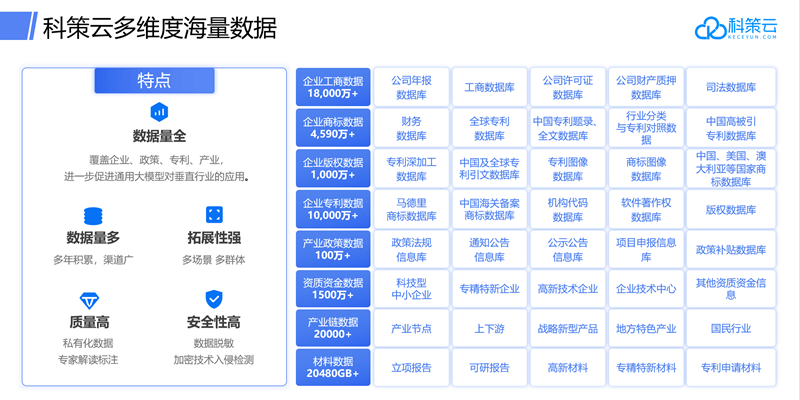
Core Insights - The strategic significance of vertical large models in government affairs is highlighted as a digital transformation accelerator, facilitating the transition from "information-based" to "intelligent" government services [1] - AI empowerment is emphasized for modernizing governance capabilities, enhancing decision-making science, service precision, and emergency response capabilities [2] - The release of data element value is crucial, aiming to break down data silos in government and achieve intelligent integration and application of data across departments and levels [2] Data and Technology - The document outlines a comprehensive data structure, including over 18 million enterprise business data, 4.59 million enterprise trademark data, and 10 million patent data, indicating a vast database supporting vertical industry applications [3] - The core technology architecture consists of a three-layer model system: a foundational layer based on domestic computing power, a domain layer for specific scenarios like policy interpretation and public service, and an application layer for lightweight fine-tuning models [3] Application Scenarios - Typical application scenarios include multi-modal government knowledge processing technology, a privacy-computing-based federated learning framework, and a structured parsing engine for policy texts [4] - Intelligent policy services are highlighted, including precise policy matching and push notifications, intelligent pre-examination of application conditions, and simulation of policy effects [4] Implementation Pathways - Suggested implementation pathways include a step-by-step strategy from single department pilots to cross-department collaboration, establishing data standards, security standards, and ethical guidelines for government large models [10] - The cultivation of "government + AI" composite talents is recommended to build a sustainable evolution capability [10] Future Outlook - The vertical large model in government affairs is expected to drive a new governance model characterized by "data-driven decision-making and intelligent service empowerment," ultimately achieving a new paradigm of government services that benefits the public [6] - The company, 科策云, is positioned as a leader in the science and technology innovation sector, with a focus on AI products and government-enterprise product lines, continuously enhancing its offerings to provide high-quality information services [6][8]
以重点提案督办示范推动提案成果转化见成效——省政协确定38件重点提案
Shan Xi Ri Bao· 2025-05-10 23:48
Group 1 - The provincial political consultative conference has identified 38 key proposals aimed at enhancing the quality of proposal handling and promoting effective transformation of proposal outcomes [1][2] - The proposals cover a wide range of topics, focusing on promoting high-quality economic development and ensuring the improvement of people's livelihoods [1][2] - Specific suggestions include expanding effective investment, boosting consumption, strengthening key industrial chains, and advancing high-quality development in education, elderly care, and healthcare [1][2] Group 2 - The proposals also emphasize modernizing governance capabilities, enhancing administrative review transparency, and strengthening measures against new AI telecom fraud [1][2] - In terms of cultural development, suggestions include improving the online micro-drama industry chain and protecting the Qin Zhi Dao [1][2] - Environmental protection proposals focus on air pollution control in the Guanzhong region and promoting ecological treatment and comprehensive utilization of coal gangue waste [1][2]